
巨大革裥菌醇提物在白血病细胞系中表现出促凋亡和抗增殖作用。
Meripilus giganteus ethanolic extract exhibits pro-apoptotic and anti-proliferative effects in leukemic cell lines.
机构信息
Department of Pharmacy and Biotechnology, University of Bologna, Via San Donato 15, 40127, Bologna, Italy.
Institute of Food Technology, University of Novi Sad, Bul. Cara Lazara 1, Novi Sad, 21000, Serbia.
出版信息
BMC Complement Altern Med. 2018 Nov 12;18(1):300. doi: 10.1186/s12906-018-2366-7.
BACKGROUND
The interest towards botanicals and plant extracts has strongly risen due to their numerous biological effects and ability to counteract chronic diseases development. Among these effects, chemoprevention which represents the possibility to counteract the cancerogenetic process is one of the most studied. The extracts of mushroom Meripilus giganteus (MG) (Phylum of Basidiomycota) showed to exert antimicrobic, antioxidant and antiproliferative effects. Therefore, since its effect in leukemic cell lines has not been previously evaluated, we studied its potential chemopreventive effect in Jurkat and HL-60 cell lines.
METHODS
MG ethanolic extract was characterized for its antioxidant activity and scavenging effect against different radical species. Moreover, its phenolic profile was evaluated by HPLC-MS-MS analyses. Flow cytometry (FCM) analyses of Jurkat and HL-60 cells treated with MG extract (0-750 μg/mL) for 24-72 h- allowed to evaluate its cytotoxicity, pro-apoptotic and anti-proliferative effect. To better characterize MG pro-apoptotic mechanism ROS intracellular level and the gene expression level of FAS, BAX and BCL2 were also evaluated. Moreover, to assess MG extract selectivity towards cancer cells, its cytotoxicity was also evaluated in human peripheral blood lymphocytes (PBL).
RESULTS
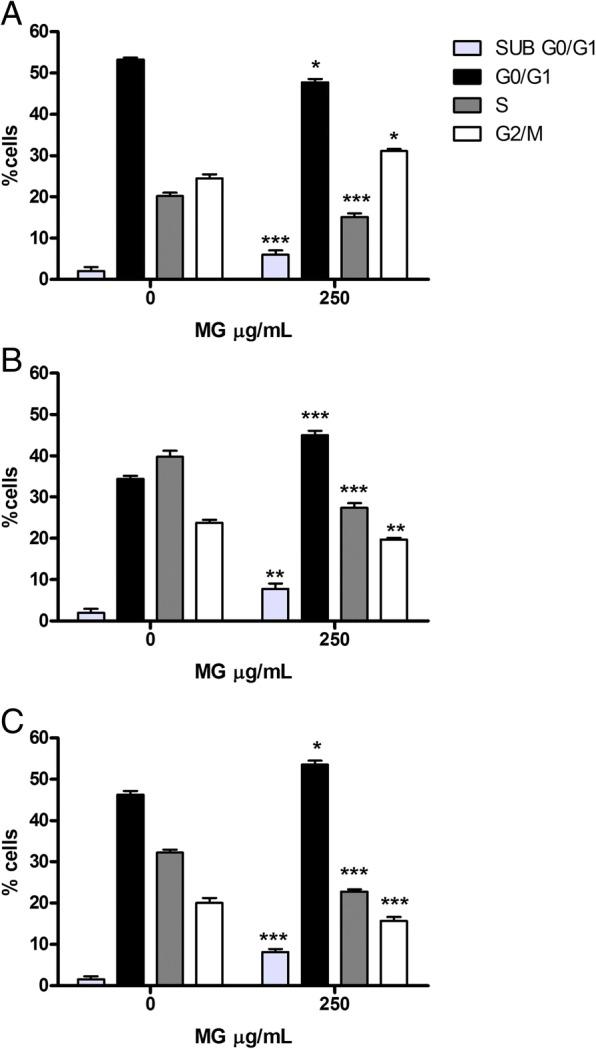
MG extract induced apoptosis in Jurkat and HL-60 cells in a dose- and time- dependent manner by increasing BAX/BCL2 ratio, reducing ROS intracellular level and inducing FAS gene expression level. In fact, reduced ROS level is known to be related to the activation of apoptosis in leukemic cells by the involvement of death receptors. MG extract also induced cell-cycle arrest in HL-60 cells. Moreover, IC at 24 h treatment resulted 2 times higher in PBL than in leukemic cell lines.
CONCLUSIONS
Our data suggest that MG extract might be considered a promising and partially selective chemopreventive agent since it is able to modulate different mechanisms in transformed cells at concentrations lower than in non-transformed ones.
背景
由于其众多的生物效应和对抗慢性病发展的能力,对植物提取物和植物的兴趣大大增加。在这些作用中,化学预防是研究最多的一种,它代表了对抗致癌过程的可能性。蘑菇 Meripilus giganteus(MG)(担子菌门)的提取物显示出抗菌、抗氧化和抗增殖作用。因此,由于其在白血病细胞系中的作用尚未得到评估,我们研究了其在 Jurkat 和 HL-60 细胞系中的潜在化学预防作用。
方法
对 MG 乙醇提取物的抗氧化活性及其对不同自由基的清除作用进行了表征。此外,还通过 HPLC-MS-MS 分析评估了其酚类谱。用 MG 提取物(0-750μg/mL)处理 Jurkat 和 HL-60 细胞 24-72 小时的流式细胞术(FCM)分析,评估其细胞毒性、促凋亡和抗增殖作用。为了更好地描述 MG 促凋亡机制,还评估了 ROS 细胞内水平和 FAS、BAX 和 BCL2 的基因表达水平。此外,为了评估 MG 提取物对癌细胞的选择性,还在人外周血淋巴细胞(PBL)中评估了其细胞毒性。
结果
MG 提取物以剂量和时间依赖的方式诱导 Jurkat 和 HL-60 细胞凋亡,通过增加 BAX/BCL2 比值、降低 ROS 细胞内水平和诱导 FAS 基因表达水平。事实上,ROS 水平的降低与通过死亡受体参与白血病细胞的凋亡激活有关。MG 提取物还诱导 HL-60 细胞细胞周期停滞。此外,在 24 小时处理时,IC 在 PBL 中的值比在白血病细胞系中高 2 倍。
结论
我们的数据表明,MG 提取物可能被认为是一种有前途的、部分选择性的化学预防剂,因为它能够在低于非转化细胞的浓度下调节转化细胞中的不同机制。




 Zotero 插件