
追踪 21 世纪的病毒爆发。
Tracking virus outbreaks in the twenty-first century.
机构信息
Department of Immunology and Microbiology, The Scripps Research Institute, La Jolla, CA, USA.
Department of Epidemiology of Microbial Diseases, Yale School of Public Health, New Haven, CT, USA.
出版信息
Nat Microbiol. 2019 Jan;4(1):10-19. doi: 10.1038/s41564-018-0296-2. Epub 2018 Dec 13.
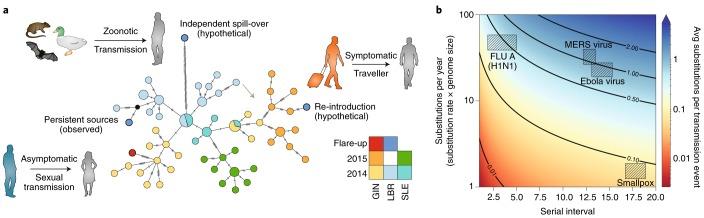
Emerging viruses have the potential to impose substantial mortality, morbidity and economic burdens on human populations. Tracking the spread of infectious diseases to assist in their control has traditionally relied on the analysis of case data gathered as the outbreak proceeds. Here, we describe how many of the key questions in infectious disease epidemiology, from the initial detection and characterization of outbreak viruses, to transmission chain tracking and outbreak mapping, can now be much more accurately addressed using recent advances in virus sequencing and phylogenetics. We highlight the utility of this approach with the hypothetical outbreak of an unknown pathogen, 'Disease X', suggested by the World Health Organization to be a potential cause of a future major epidemic. We also outline the requirements and challenges, including the need for flexible platforms that generate sequence data in real-time, and for these data to be shared as widely and openly as possible.
新兴病毒有可能给人类带来巨大的死亡、发病和经济负担。为了协助控制传染病,传统上一直依赖于对传染病暴发过程中收集的病例数据进行分析。在这里,我们描述了传染病流行病学中的许多关键问题,从最初发现和描述暴发病毒,到追踪传播链和暴发源,现在都可以通过病毒测序和系统发育学的最新进展来更准确地解决。我们用世界卫生组织提出的一个假想的未知病原体“疾病 X”的暴发来突出这种方法的实用性,认为它可能是未来重大传染病的潜在原因。我们还概述了这一方法的要求和挑战,包括需要灵活的平台,以便实时生成序列数据,并尽可能广泛和公开地共享这些数据。


 Zotero 插件