
小分子诱导人神经脑类器官产生 Aβ-42 肽以模拟与阿尔茨海默病相关的表型。
Small-molecule induction of Aβ-42 peptide production in human cerebral organoids to model Alzheimer's disease associated phenotypes.
机构信息
Service d'Etude des Prions et Infections Atypiques (SEPIA), Institut François Jacob, CEA, Université Paris-Saclay, Fontenay-aux-Roses, France.
Sup'Biotech, Villejuif, France.
出版信息
PLoS One. 2018 Dec 17;13(12):e0209150. doi: 10.1371/journal.pone.0209150. eCollection 2018.
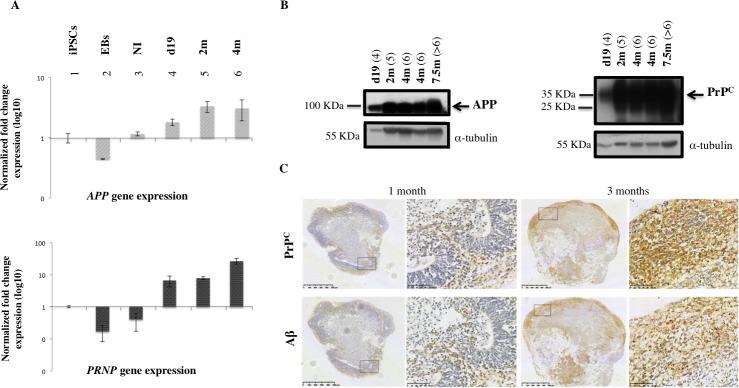
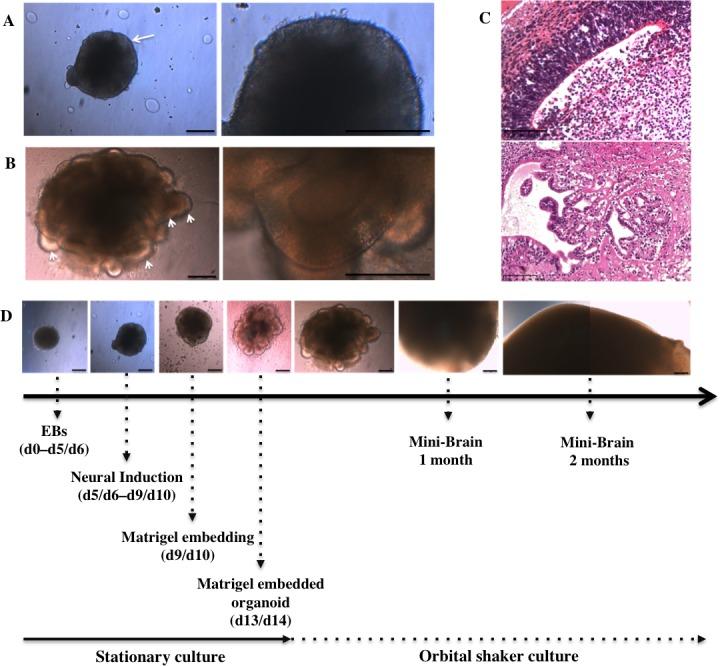
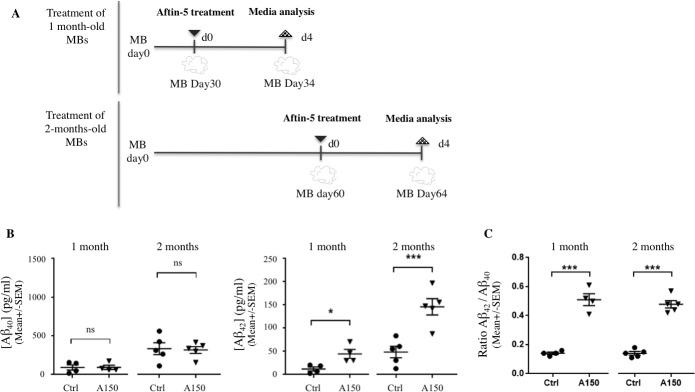
Human mini-brains (MB) are cerebral organoids that recapitulate in part the complexity of the human brain in a unique three-dimensional in vitro model, yielding discrete brain regions reminiscent of the cerebral cortex. Specific proteins linked to neurodegenerative disorders are physiologically expressed in MBs, such as APP-derived amyloids (Aβ), whose physiological and pathological roles and interactions with other proteins are not well established in humans. Here, we demonstrate that neuroectodermal organoids can be used to study the Aβ accumulation implicated in Alzheimer's disease (AD). To enhance the process of protein secretion and accumulation, we adopted a chemical strategy of induction to modulate post-translational pathways of APP using an Amyloid-β Forty-Two Inducer named Aftin-5. Secreted, soluble Aβ fragment concentrations were analyzed in MB-conditioned media. An increase in the Aβ42 fragment secretion was observed as was an increased Aβ42/Aβ40 ratio after drug treatment, which is consistent with the pathological-like phenotypes described in vivo in transgenic animal models and in vitro in induced pluripotent stem cell-derived neural cultures obtained from AD patients. Notably in this context we observe time-dependent Aβ accumulation, which differs from protein accumulation occurring after treatment. We show that mini-brains obtained from a non-AD control cell line are responsive to chemical compound induction, producing a shift of physiological Aβ concentrations, suggesting that this model can be used to identify environmental agents that may initiate the cascade of events ultimately leading to sporadic AD. Increases in both Aβ oligomers and their target, the cellular prion protein (PrPC), support the possibility of using MBs to further understand the pathophysiological role that underlies their interaction in a human model. Finally, the potential application of MBs for modeling age-associated phenotypes and the study of neurological disorders is confirmed.
人类微型脑(MB)是一种脑类器官,它在独特的三维体外模型中部分重现了人类大脑的复杂性,产生了类似于大脑皮层的离散脑区。与神经退行性疾病相关的特定蛋白质在 MB 中生理表达,例如 APP 衍生的淀粉样蛋白(Aβ),其生理作用和与其他蛋白质的相互作用在人类中尚未得到很好的建立。在这里,我们证明神经外胚层类器官可用于研究与阿尔茨海默病(AD)相关的 Aβ 积累。为了增强蛋白质分泌和积累的过程,我们采用了一种化学诱导策略,使用一种名为 Aftin-5 的β淀粉样蛋白四十诱导物来调节 APP 的翻译后途径。在 MB 条件培养基中分析分泌的可溶性 Aβ 片段浓度。药物处理后观察到 Aβ42 片段分泌增加,Aβ42/Aβ40 比值增加,这与体内转基因动物模型和 AD 患者来源的诱导多能干细胞衍生的神经培养物中描述的病理样表型一致。值得注意的是,在这种情况下,我们观察到 Aβ 的时间依赖性积累,这与治疗后发生的蛋白质积累不同。我们表明,来自非 AD 对照细胞系的微型脑对化学化合物诱导有反应,产生生理 Aβ 浓度的变化,表明该模型可用于鉴定可能引发最终导致散发性 AD 的事件级联的环境因素。Aβ 寡聚体及其靶标细胞朊蛋白(PrPC)的增加支持使用 MB 进一步理解其在人类模型中相互作用的病理生理作用的可能性。最后,证实了 MB 用于建模与年龄相关的表型和研究神经退行性疾病的潜在应用。
 Zotero 插件