
医保患者接受卡铂联合紫杉醇或培美曲塞治疗转移性非鳞状非小细胞肺癌的住院和生存情况。
Hospitalization and Survival of Medicare Patients Treated With Carboplatin Plus Paclitaxel or Pemetrexed for Metastatic, Nonsquamous, Non-Small Cell Lung Cancer.
机构信息
The Dartmouth Institute for Health Policy and Clinical Practice, Geisel School of Medicine, Lebanon, New Hampshire.
Department of Medicine, Geisel School of Medicine, Lebanon, New Hampshire.
出版信息
JAMA Netw Open. 2018 Oct 5;1(6):e183023. doi: 10.1001/jamanetworkopen.2018.3023.
IMPORTANCE
Chemotherapy is a mainstay treatment of metastatic non-small cell lung cancer. However, little is known about the comparative risk of hospitalization associated with commonly used chemotherapy regimens.
OBJECTIVE
To evaluate the real-world association of specific lung cancer chemotherapy regimens with measures of acute hospital care (primary objective) and survival (secondary objective).
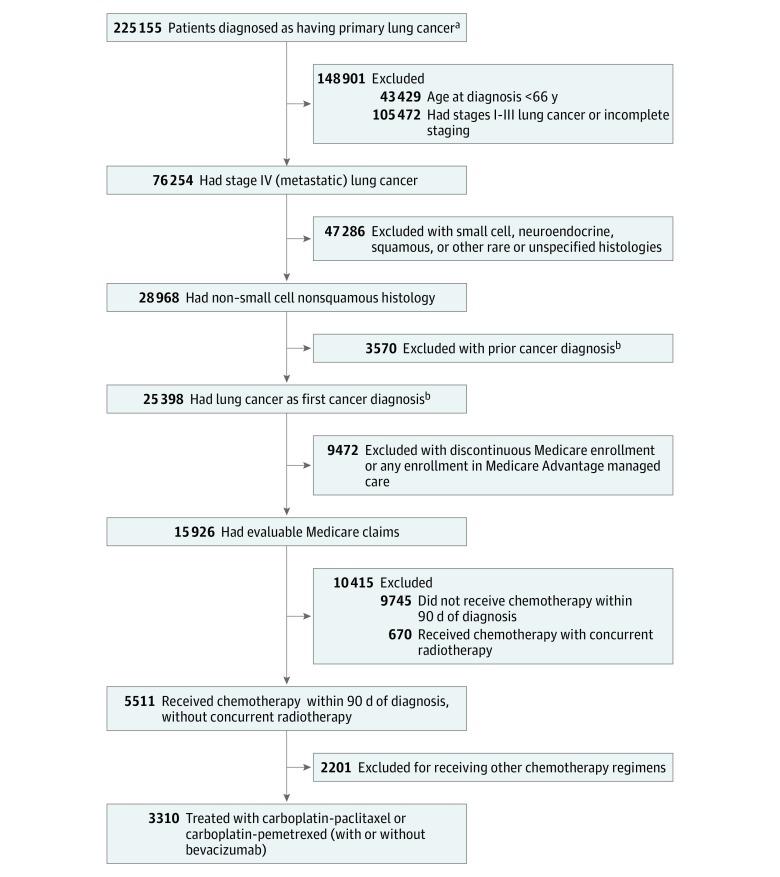
DESIGN, SETTING, AND PARTICIPANTS: Retrospective, propensity-matched, cohort study using the Surveillance, Epidemiology, and End Results-Medicare linked data for cancer diagnoses between 2008 and 2013, with follow-up through 2014. Patients were Medicare beneficiaries 66 years of age or older receiving initial chemotherapy for treatment of stage IV, nonsquamous, non-small cell lung cancer. Analyses were performed between September 2017 and April 2018.
EXPOSURES
Receipt of chemotherapy with carboplatin-pemetrexed or carboplatin-paclitaxel, with or without concurrent bevacizumab.
MAIN OUTCOMES AND MEASURES
The primary outcome was risk of hospitalization within 30 days of chemotherapy initiation. Secondary measures included cumulative 90-day hospitalizations, 90-day mean hospital-free survival time, and overall survival.
RESULTS
Of the 3310 eligible patients, 1823 received carboplatin-pemetrexed, and 1487 received carboplatin-paclitaxel. The median age at diagnosis was 73 years (interquartile range, 69-77 years), 1784 patients (53.9%) were men, and 2909 patients (87.9%) were non-Hispanic white. In total, 2182 patients were included in the propensity-matched analysis. The 30-day hospitalization risk was 20.7% (95% CI, 18.3%-23.1%) among patients receiving carboplatin-pemetrexed vs 26.0% (95% CI, 23.4%-28.6%) among patients receiving carboplatin-paclitaxel (5.3% difference; P = .003). The 90-day cumulative hospitalizations did not differ significantly between the 2 treatment groups; however, the 90-day mean hospital-free survival time was improved for patients receiving carboplatin-pemetrexed (68.4 days [95% CI, 66.5-70.4 days] vs 63.6 days [95% CI, 61.6-65.7 days]; P = .001). The median survival time was 9.0 months (95% CI, 8.4-9.5 months) with carboplatin-pemetrexed therapy vs 7.6 months (95% CI, 7.0-8.4 months) with carboplatin-paclitaxel therapy (P = .005). Stratified analyses showed no association of bevacizumab use with hospitalization risk or survival when combined with either chemotherapy regimen.
CONCLUSIONS AND RELEVANCE
The findings from this study suggest that patients receiving carboplatin-pemetrexed compared with those receiving carboplatin-paclitaxel have a lower 30-day hospitalization risk, a greater 90-day hospital-free survival, and improved overall survival. Information about hospitalization risk may provide valuable context for evaluating real-world cancer treatment outcomes.
重要性:化疗是转移性非小细胞肺癌的主要治疗方法。然而,对于常用化疗方案与住院风险的比较,我们知之甚少。
目的:评估特定肺癌化疗方案与急性住院护理(主要目标)和生存(次要目标)措施的真实世界关联。
设计、环境和参与者:这是一项回顾性、倾向匹配队列研究,使用了 2008 年至 2013 年间癌症诊断的监测、流行病学和最终结果-医疗保险链接数据,并在 2014 年进行了随访。患者是 66 岁或以上的医疗保险受益人,接受初始化疗治疗 IV 期、非鳞状、非小细胞肺癌。分析于 2017 年 9 月至 2018 年 4 月进行。
暴露:接受顺铂-培美曲塞或顺铂-紫杉醇治疗,伴或不伴贝伐珠单抗。
主要结果和措施:主要结局是化疗开始后 30 天内住院的风险。次要措施包括 90 天内累计住院、90 天平均无住院生存时间和总生存。
结果:在 3310 名符合条件的患者中,1823 名患者接受了顺铂-培美曲塞治疗,1487 名患者接受了顺铂-紫杉醇治疗。诊断时的中位年龄为 73 岁(四分位间距,69-77 岁),1784 名患者(53.9%)为男性,2909 名患者(87.9%)为非西班牙裔白人。共有 2182 名患者纳入了倾向匹配分析。接受顺铂-培美曲塞治疗的患者 30 天住院风险为 20.7%(95%置信区间,18.3%-23.1%),而接受顺铂-紫杉醇治疗的患者为 26.0%(95%置信区间,23.4%-28.6%)(5.3%的差异;P = .003)。两组治疗的 90 天累计住院情况无显著差异;然而,接受顺铂-培美曲塞治疗的患者 90 天平均无住院生存时间有所改善(68.4 天[95%置信区间,66.5-70.4 天] vs 63.6 天[95%置信区间,61.6-65.7 天];P = .001)。顺铂-培美曲塞治疗的中位生存时间为 9.0 个月(95%置信区间,8.4-9.5 个月),顺铂-紫杉醇治疗的中位生存时间为 7.6 个月(95%置信区间,7.0-8.4 个月)(P = .005)。分层分析表明,贝伐珠单抗联合任何一种化疗方案使用与住院风险或生存无关。
结论和相关性:这项研究的结果表明,与接受顺铂-紫杉醇治疗的患者相比,接受顺铂-培美曲塞治疗的患者 30 天住院风险较低、90 天无住院生存率较高、整体生存率提高。住院风险信息可能为评估真实世界癌症治疗结果提供有价值的背景。

 Zotero 插件