
BAP1 杂合性缺失预测恶性腹膜间皮瘤具有独特的免疫原性。
BAP1 haploinsufficiency predicts a distinct immunogenic class of malignant peritoneal mesothelioma.
机构信息
Vancouver Prostate Centre, 2660 Oak St, Vancouver, BC, V6H 3Z6, Canada.
Bioinformatics Training Program, University of British Columbia, Vancouver, BC, V6T 1Z4, Canada.
出版信息
Genome Med. 2019 Feb 18;11(1):8. doi: 10.1186/s13073-019-0620-3.
BACKGROUND
Malignant peritoneal mesothelioma (PeM) is a rare and fatal cancer that originates from the peritoneal lining of the abdomen. Standard treatment of PeM is limited to cytoreductive surgery and/or chemotherapy, and no effective targeted therapies for PeM exist. Some immune checkpoint inhibitor studies of mesothelioma have found positivity to be associated with a worse prognosis.
METHODS
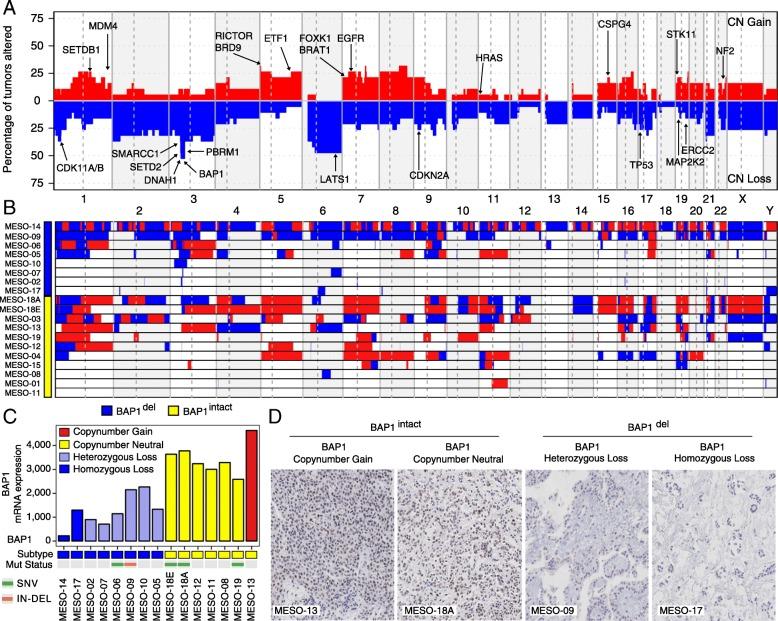
To search for novel therapeutic targets for PeM, we performed a comprehensive integrative multi-omics analysis of the genome, transcriptome, and proteome of 19 treatment-naïve PeM, and in particular, we examined BAP1 mutation and copy number status and its relationship to immune checkpoint inhibitor activation.
RESULTS
We found that PeM could be divided into tumors with an inflammatory tumor microenvironment and those without and that this distinction correlated with haploinsufficiency of BAP1. To further investigate the role of BAP1, we used our recently developed cancer driver gene prioritization algorithm, HIT'nDRIVE, and observed that PeM with BAP1 haploinsufficiency form a distinct molecular subtype characterized by distinct gene expression patterns of chromatin remodeling, DNA repair pathways, and immune checkpoint receptor activation. We demonstrate that this subtype is correlated with an inflammatory tumor microenvironment and thus is a candidate for immune checkpoint blockade therapies.
CONCLUSIONS
Our findings reveal BAP1 to be a potential, easily trackable prognostic and predictive biomarker for PeM immunotherapy that refines PeM disease classification. BAP1 stratification may improve drug response rates in ongoing phases I and II clinical trials exploring the use of immune checkpoint blockade therapies in PeM in which BAP1 status is not considered. This integrated molecular characterization provides a comprehensive foundation for improved management of a subset of PeM patients.
背景
恶性腹膜间皮瘤(PeM)是一种罕见且致命的癌症,起源于腹部的腹膜衬里。PeM 的标准治疗方法仅限于细胞减灭术和/或化疗,并且不存在针对 PeM 的有效靶向治疗方法。一些间皮瘤的免疫检查点抑制剂研究发现,阳性与更差的预后相关。
方法
为了寻找 PeM 的新治疗靶点,我们对 19 例未经治疗的 PeM 的基因组、转录组和蛋白质组进行了全面的综合多组学分析,特别是检查了 BAP1 突变和拷贝数状态及其与免疫检查点抑制剂激活的关系。
结果
我们发现 PeM 可以分为具有炎症性肿瘤微环境的肿瘤和没有炎症性肿瘤微环境的肿瘤,这种区别与 BAP1 的杂合性缺失相关。为了进一步研究 BAP1 的作用,我们使用了我们最近开发的癌症驱动基因优先级算法 HIT'nDRIVE,并观察到 BAP1 杂合性缺失的 PeM 形成了一个独特的分子亚型,其特征是染色质重塑、DNA 修复途径和免疫检查点受体激活的独特基因表达模式。我们证明,这种亚型与炎症性肿瘤微环境相关,因此是免疫检查点阻断治疗的候选者。
结论
我们的研究结果表明 BAP1 是 PeM 免疫治疗的一个潜在的、易于追踪的预后和预测生物标志物,可以细化 PeM 的疾病分类。BAP1 分层可能会提高正在进行的 I 期和 II 期临床试验中药物反应率,这些临床试验正在探索免疫检查点阻断疗法在 PeM 中的应用,而 BAP1 状态在这些临床试验中未被考虑。这种综合分子特征为改善一部分 PeM 患者的管理提供了全面的基础。



 Zotero 插件