
实施和评估一项驾驶戒除干预措施,以改善痴呆症患者的社区流动性和幸福感:“CarFreeMe”痴呆症患者计划研究方案。
Implementation and evaluation of a driving cessation intervention to improve community mobility and wellbeing outcomes for people living with dementia: study protocol of the 'CarFreeMe' for people with dementia program.
机构信息
School of Psychology, The University of Queensland, St Lucia, Queensland, 4072, Australia.
School of Information Technology and Electrical Engineering, The University of Queensland, St Lucia, Queensland, 4072, Australia.
出版信息
BMC Geriatr. 2019 Mar 4;19(1):66. doi: 10.1186/s12877-019-1074-6.
BACKGROUND
Giving up driving is a pivotal life event and universal challenge for people living with dementia and their families, and a complex area of clinical practice for health professionals who monitor driving cessation. The best outcomes are for individuals to plan for and eventually cease driving, however with insufficient support programs in place, many avoid the issue until it is reaches a crisis point. This program of research investigates a comprehensive support- and education-based intervention targeted at people living with dementia and their care partners who are managing driving cessation. The primary aim of this research is to determine the effectiveness of the program through a cluster randomized controlled trial.
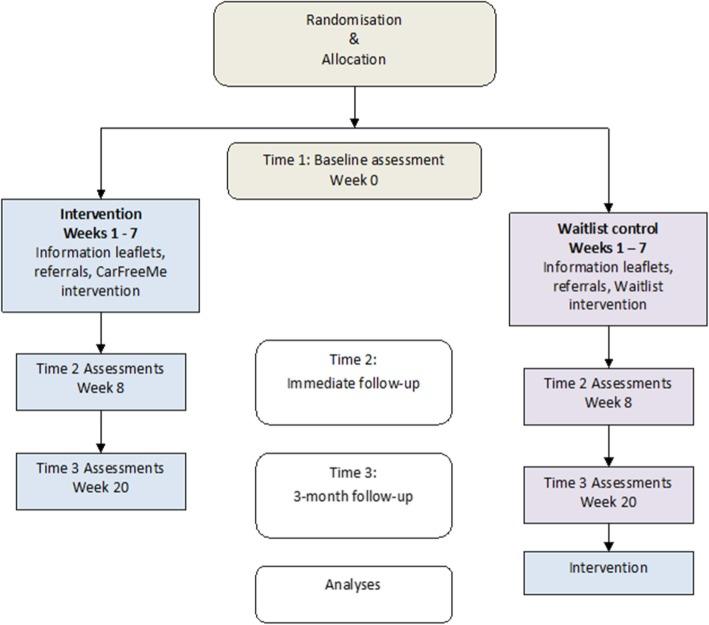
METHODS/DESIGN: The intervention (CarFreeMe) is an intensive program delivered by a trained health professional that addresses practical and emotional needs relevant to driving cessation. The seven module program is person-centred, covering awareness raising, adjustment, and practical support that is individualized according to geographic location and the particular goals and preferences of participants. A cluster randomized controlled trial will evaluate the effectiveness of the program. Evaluation will take place pre-intervention, immediately following, and three months post-intervention. Clusters are randomized to either intervention or usual treatment. Participants within clusters will be recruited via primary and secondary care clinics, community agencies, service providers, local media, social media, support groups, and word of mouth. The primary outcome measure for persons with dementia and their care partners is lifespace, collected via (i) smartphone GPS technology and (ii) self-reported number of episodes away from home (during the past week). Secondary outcomes include safe alternative transport status, wellbeing, depression, anxiety, and self-efficacy, which will be collected from dyads. Caregiving strain will be collected from care partner/family member only. A process evaluation of the intervention will also be undertaken.
DISCUSSION
There is an urgent need for therapeutic approaches to supporting people living with dementia and their families to negotiate the complex decision making involved in deciding to change their approach to driving. The driving cessation intervention may fill an important gap in service delivery to people living with dementia who are adjusting to life without driving.
TRIAL REGISTRATION
Australian and New Zealand Clinical Trials Registry ACTRN12618000388213 , 15 March 2018.
背景
放弃驾驶对于患有痴呆症的患者及其家属来说是一个重大的生活事件和普遍的挑战,也是监测驾驶停止的卫生专业人员临床实践的一个复杂领域。最佳结果是个人进行计划并最终停止驾驶,然而,由于支持计划不足,许多人避免在问题达到危机点之前处理该问题。这项研究计划调查了一项针对患有痴呆症的患者及其正在管理驾驶停止的护理伙伴的综合支持和教育干预措施。该研究的主要目的是通过集群随机对照试验确定该方案的有效性。
方法/设计:干预措施(CarFreeMe)是由经过培训的卫生专业人员提供的强化计划,该计划解决了与驾驶停止相关的实际和情感需求。七个模块的计划以个人为中心,涵盖了提高认识、调整和根据地理位置以及参与者的特定目标和偏好进行个性化的实际支持。集群随机对照试验将评估该计划的有效性。评估将在干预前、干预后立即和干预后三个月进行。集群被随机分配到干预组或常规治疗组。集群内的参与者将通过初级和二级保健诊所、社区机构、服务提供商、当地媒体、社交媒体、支持小组和口碑招募。痴呆症患者及其护理伙伴的主要结果衡量指标是生活空间,通过(i)智能手机 GPS 技术和(ii)自我报告的离家事件数(过去一周)收集。次要结果包括安全替代交通工具状况、幸福感、抑郁、焦虑和自我效能,这些将从二人组中收集。仅从护理伙伴/家庭成员收集护理负担。还将对干预措施进行过程评估。
讨论
迫切需要治疗方法来支持患有痴呆症的患者及其家人在决定改变他们的驾驶方式时进行复杂的决策。驾驶停止干预措施可能填补了向正在适应无驾驶生活的痴呆症患者提供服务的重要空白。
试验注册
澳大利亚和新西兰临床试验注册中心 ACTRN12618000388213,2018 年 3 月 15 日。
 Zotero 插件