
呼吸复合物 I 的 NADH/FMN 位点中质子偶联电子转移的能量学和动力学。
Energetics and Dynamics of Proton-Coupled Electron Transfer in the NADH/FMN Site of Respiratory Complex I.
机构信息
Department of Chemistry , Technical University of Munich (TUM) , Lichtenbergstrasse 4 , Garching D-85747 , Germany.
出版信息
J Am Chem Soc. 2019 Apr 10;141(14):5710-5719. doi: 10.1021/jacs.8b11059. Epub 2019 Mar 27.
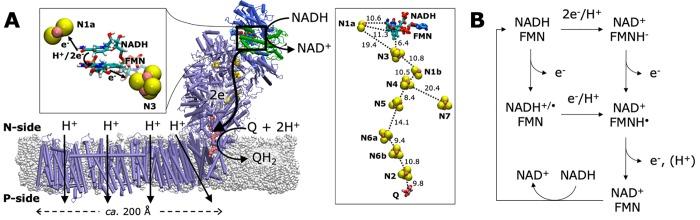
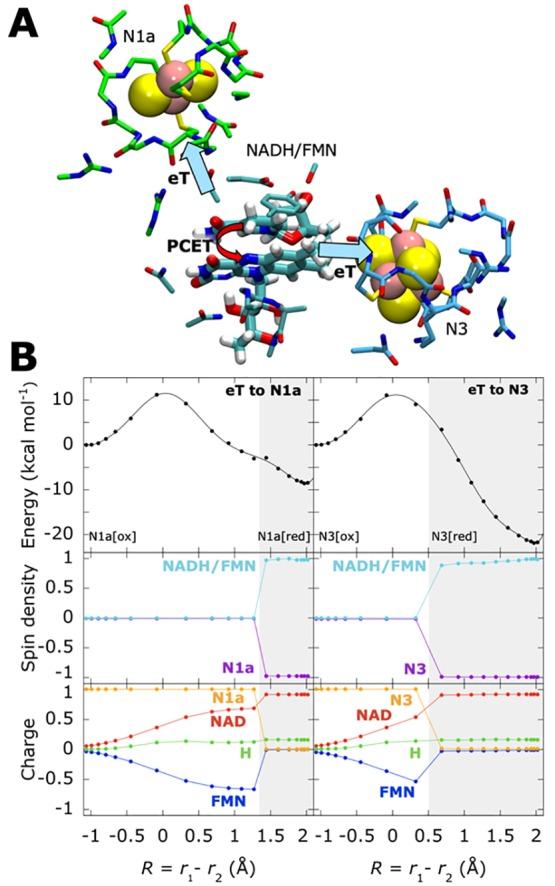
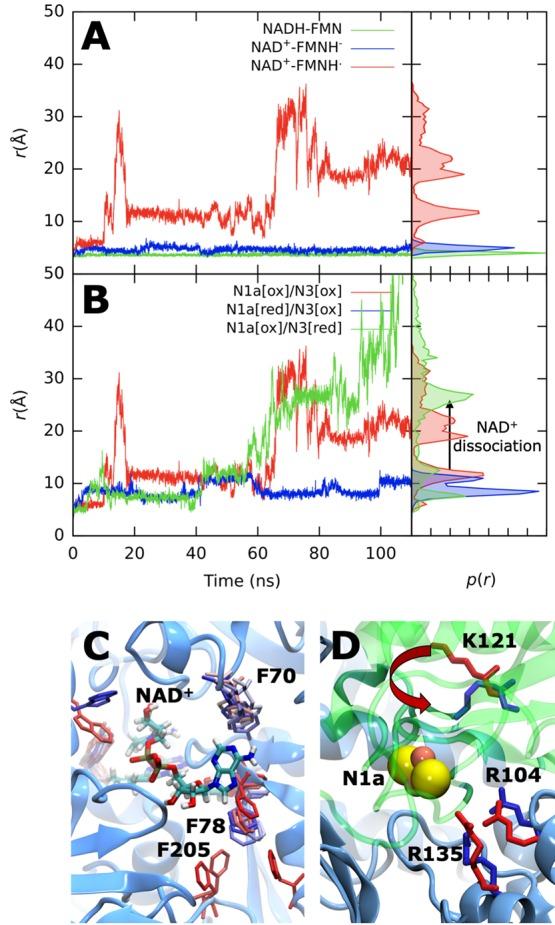
Complex I functions as an initial electron acceptor in aerobic respiratory chains that reduces quinone and pumps protons across a biological membrane. This remarkable charge transfer process extends ca. 300 Å and it is initiated by a poorly understood proton-coupled electron transfer (PCET) reaction between nicotinamide adenine dinucleotide (NADH) and a protein-bound flavin (FMN) cofactor. We combine here large-scale density functional theory calculations and quantum/classical models with atomistic molecular dynamics simulations to probe the energetics and dynamics of the NADH-driven PCET reaction in complex I. We find that the reaction takes place by concerted hydrogen atom (H) transfer that couples to an electron transfer (eT) between the aromatic ring systems of the cofactors and further triggers reduction of the nearby FeS centers. In bacterial, Escherichia coli-like complex I isoforms, reduction of the N1a FeS center increases the binding affinity of the oxidized NAD that prevents the nucleotide from leaving prematurely. This electrostatic trapping could provide a protective gating mechanism against reactive oxygen species formation. We also find that proton transfer from the transient FMNH to a nearby conserved glutamate (Glu97) residue favors eT from N1a onward along the FeS chain and modulates the binding of a new NADH molecule. The PCET in complex I isoforms with low-potential N1a centers is also discussed. On the basis of our combined results, we propose a putative mechanistic model for the NADH-driven proton/electron-transfer reaction in complex I.
复合体 I 作为有氧呼吸链中的初始电子受体,还原醌并将质子泵过生物膜。这个非凡的电荷转移过程延伸约 300Å,由 NADH 和蛋白结合黄素(FMN)辅因子之间的质子耦合电子转移(PCET)反应引发,这个反应的机制目前还不太清楚。我们结合了大规模密度泛函理论计算和量子/经典模型以及原子分子动力学模拟,以研究复合体 I 中 NADH 驱动的 PCET 反应的能量学和动力学。我们发现,该反应通过协同氢原子(H)转移发生,该转移与辅因子的芳环系统之间的电子转移(eT)耦合,并进一步触发附近 FeS 中心的还原。在细菌、大肠杆菌样复合体 I 同工酶中,N1a FeS 中心的还原增加了氧化 NAD 的结合亲和力,从而防止核苷酸过早离开。这种静电捕获可能提供了一种针对活性氧物质形成的保护性门控机制。我们还发现,瞬态 FMNH 向附近保守谷氨酸(Glu97)残基的质子转移有利于 eT 从 N1a 沿 FeS 链进行,并调节新的 NADH 分子的结合。还讨论了具有低电位 N1a 中心的复合体 I 同工酶中的 PCET。基于我们的综合结果,我们提出了一个用于复合体 I 中 NADH 驱动的质子/电子转移反应的假设机制模型。



 Zotero 插件