
解析生物能量转化中的化学动力学:呼吸复合物 I 中的长程质子耦合电子转移。
Resolving Chemical Dynamics in Biological Energy Conversion: Long-Range Proton-Coupled Electron Transfer in Respiratory Complex I.
机构信息
Department of Biochemistry and Biophysics, Stockholm University, 10691 Stockholm, Sweden.
出版信息
Acc Chem Res. 2021 Dec 21;54(24):4462-4473. doi: 10.1021/acs.accounts.1c00524. Epub 2021 Dec 13.
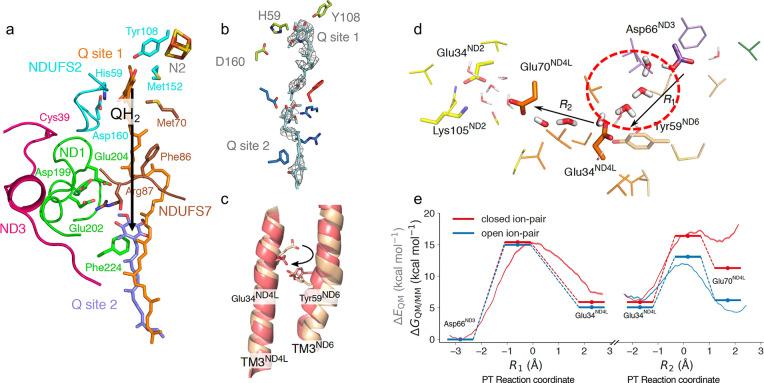
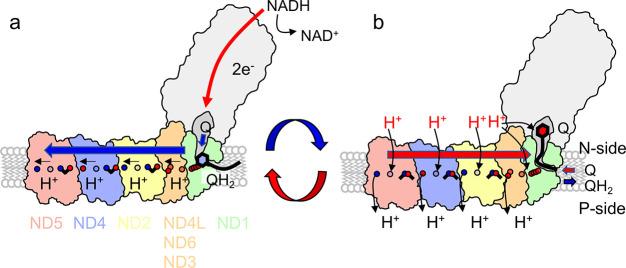
Biological energy conversion is catalyzed by membrane-bound proteins that transduce chemical or light energy into energy forms that power endergonic processes in the cell. At a molecular level, these catalytic processes involve elementary electron-, proton-, charge-, and energy-transfer reactions that take place in the intricate molecular machineries of cell respiration and photosynthesis. Recent developments in structural biology, particularly cryo-electron microscopy (cryoEM), have resolved the molecular architecture of several energy transducing proteins, but detailed mechanistic principles of their charge transfer reactions still remain poorly understood and a major challenge for modern biochemical research. To this end, multiscale molecular simulations provide a powerful approach to probe mechanistic principles on a broad range of time scales (femtoseconds to milliseconds) and spatial resolutions (10-10 atoms), although technical challenges also require balancing between the computational accuracy, cost, and approximations introduced within the model. Here we discuss how the combination of atomistic (aMD) and hybrid quantum/classical molecular dynamics (QM/MM MD) simulations with free energy (FE) sampling methods can be used to probe mechanistic principles of enzymes responsible for biological energy conversion. We present mechanistic explorations of long-range proton-coupled electron transfer (PCET) dynamics in the highly intricate respiratory chain enzyme Complex I, which functions as a redox-driven proton pump in bacterial and mitochondrial respiratory chains by catalyzing a 300 Å fully reversible PCET process. This process is initiated by a hydride (H) transfer between NADH and FMN, followed by long-range (>100 Å) electron transfer along a wire of 8 FeS centers leading to a quinone biding site. The reduction of the quinone to quinol initiates dissociation of the latter to a second membrane-bound binding site, and triggers proton pumping across the membrane domain of complex I, in subunits up to 200 Å away from the active site. Our simulations across different size and time scales suggest that transient charge transfer reactions lead to changes in the internal hydration state of key regions, local electric fields, and the conformation of conserved ion pairs, which in turn modulate the dynamics of functional steps along the reaction cycle. Similar functional principles, which operate on much shorter length scales, are also found in some unrelated proteins, suggesting that enzymes may employ conserved principles in the catalysis of biological energy transduction processes.
生物能量转换是由膜结合蛋白催化的,这些蛋白将化学或光能转化为细胞内吸能过程的能量形式。在分子水平上,这些催化过程涉及基本的电子、质子、电荷和能量转移反应,这些反应发生在细胞呼吸和光合作用的复杂分子机器中。结构生物学的最新进展,特别是冷冻电子显微镜(cryoEM),已经解析了几种能量转导蛋白的分子结构,但它们的电荷转移反应的详细机制原理仍然知之甚少,这是现代生化研究的主要挑战。为此,多尺度分子模拟提供了一种强大的方法,可以在广泛的时间尺度(飞秒到毫秒)和空间分辨率(10-10 个原子)上探测机制原理,尽管技术挑战也需要在计算准确性、成本和模型中引入的近似之间取得平衡。在这里,我们讨论了如何将原子(aMD)和混合量子/经典分子动力学(QM/MM MD)模拟与自由能(FE)采样方法相结合,用于探测负责生物能量转换的酶的机制原理。我们展示了对高度复杂的呼吸链酶复合物 I 中长程质子偶联电子转移(PCET)动力学的机制探索,该酶作为细菌和线粒体呼吸链中的氧化还原驱动质子泵,通过催化 300 Å 完全可逆的 PCET 过程发挥作用。该过程由 NADH 和 FMN 之间的氢(H)转移引发,然后沿着 8 个 FeS 中心的长程(>100 Å)电子转移,导致醌结合位点。醌的还原引发后者与第二个膜结合结合位点的解离,并触发质子穿过复合物 I 的膜结构域泵送,距离活性位点最远可达 200 Å。我们在不同大小和时间尺度上的模拟表明,瞬态电荷转移反应导致关键区域的内部水合状态、局部电场和保守离子对构象的变化,进而调节反应循环中功能步骤的动力学。在一些不相关的蛋白质中也发现了类似的功能原理,这些原理在更短的长度尺度上运作,这表明酶可能在生物能量转导过程的催化中采用保守原理。



 Zotero 插件