
体质指数与 HUNT 和 UK Biobank 研究中的全因死亡率:线性和非线性孟德尔随机化分析。
Body mass index and all cause mortality in HUNT and UK Biobank studies: linear and non-linear mendelian randomisation analyses.
机构信息
Department of Clinical and Molecular Medicine (IKOM), NTNU, Norwegian University of Science and Technology, Trondheim, Norway.
MRC Biostatistics Unit, Cambridge Institute of Public Health, Cambridge CB2 0SR, UK
出版信息
BMJ. 2019 Mar 26;364:l1042. doi: 10.1136/bmj.l1042.
EDITOR'S NOTE: Please see the Editor's Note (doi: https://doi.org/10.1136/bmj.l1042) on Methodological Criticism and an Updated Analysis
OBJECTIVE
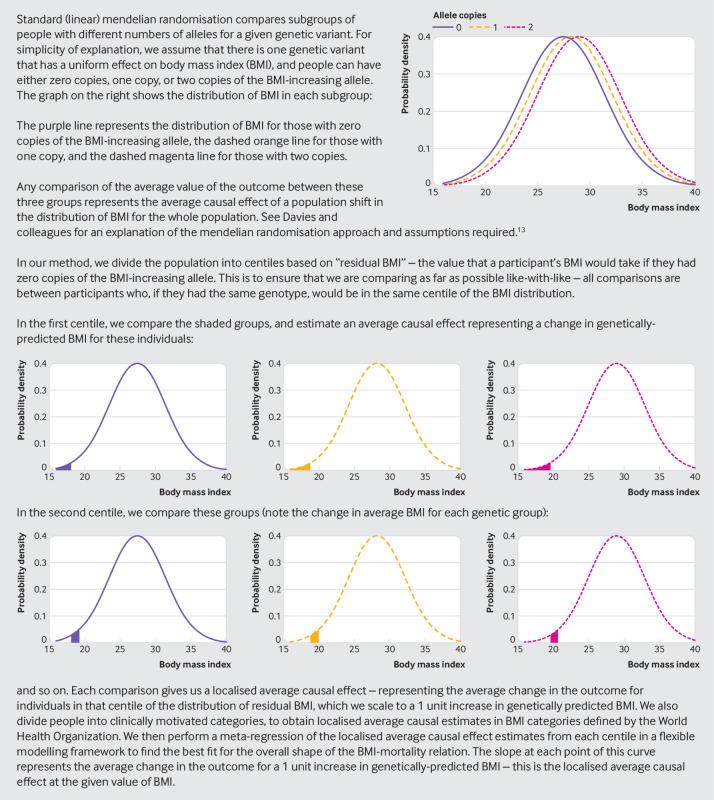
To investigate the shape of the causal relation between body mass index (BMI) and mortality.
DESIGN
Linear and non-linear mendelian randomisation analyses.
SETTING
Nord-Trøndelag Health (HUNT) Study (Norway) and UK Biobank (United Kingdom).
PARTICIPANTS
Middle to early late aged participants of European descent: 56 150 from the HUNT Study and 366 385 from UK Biobank.
MAIN OUTCOME MEASURES
All cause and cause specific (cardiovascular, cancer, and non-cardiovascular non-cancer) mortality.
RESULTS
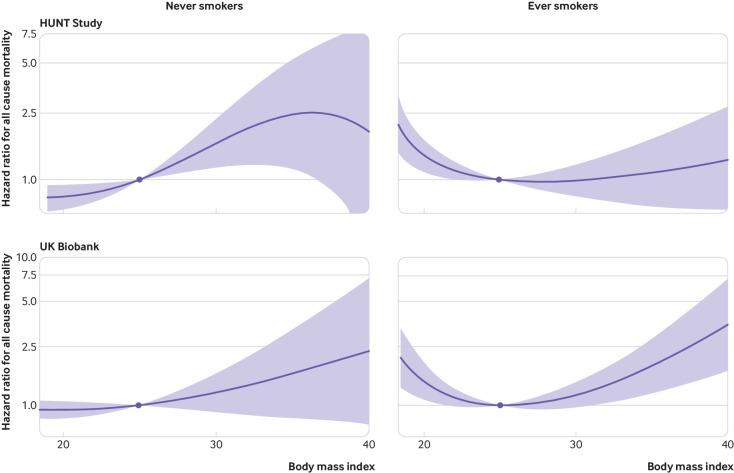
12 015 and 10 344 participants died during a median of 18.5 and 7.0 years of follow-up in the HUNT Study and UK Biobank, respectively. Linear mendelian randomisation analyses indicated an overall positive association between genetically predicted BMI and the risk of all cause mortality. An increase of 1 unit in genetically predicted BMI led to a 5% (95% confidence interval 1% to 8%) higher risk of mortality in overweight participants (BMI 25.0-29.9) and a 9% (4% to 14%) higher risk of mortality in obese participants (BMI ≥30.0) but a 34% (16% to 48%) lower risk in underweight (BMI <18.5) and a 14% (-1% to 27%) lower risk in low normal weight participants (BMI 18.5-19.9). Non-linear mendelian randomisation indicated a J shaped relation between genetically predicted BMI and the risk of all cause mortality, with the lowest risk at a BMI of around 22-25 for the overall sample. Subgroup analyses by smoking status, however, suggested an always-increasing relation of BMI with mortality in never smokers and a J shaped relation in ever smokers.
CONCLUSIONS
The previously observed J shaped relation between BMI and risk of all cause mortality appears to have a causal basis, but subgroup analyses by smoking status revealed that the BMI-mortality relation is likely comprised of at least two distinct curves, rather than one J shaped relation. An increased risk of mortality for being underweight was only evident in ever smokers.
编辑按
请参见方法学批评和更新分析的编辑按(doi:https://doi.org/10.1136/bmj.l1042)
目的
探讨体质指数(BMI)与死亡率之间因果关系的形态。
设计
线性和非线性孟德尔随机化分析。
设置
挪威北特伦德拉格健康(HUNT)研究和英国生物银行(United Kingdom)。
参与者
欧洲血统的中老年人:HUNT 研究中的 56150 人和英国生物银行中的 366385 人。
主要结局测量
全因和特定原因(心血管、癌症和非心血管非癌症)死亡率。
结果
在 HUNT 研究和英国生物银行的中位随访 18.5 年和 7.0 年期间,分别有 12015 人和 10344 人死亡。线性孟德尔随机化分析表明,遗传预测 BMI 与全因死亡率风险之间存在总体正相关。遗传预测 BMI 增加 1 个单位,超重参与者(BMI 25.0-29.9)的死亡率风险增加 5%(95%置信区间 1%-8%),肥胖参与者(BMI ≥30.0)的死亡率风险增加 9%(4%-14%),而体重不足者(BMI <18.5)的死亡率风险降低 34%(16%-48%),低体重正常体重者(BMI 18.5-19.9)的死亡率风险降低 14%(-1%-27%)。非线性孟德尔随机化分析表明,遗传预测 BMI 与全因死亡率风险之间呈 J 形关系,总体样本中 BMI 约为 22-25 时风险最低。然而,按吸烟状况进行的亚组分析表明,在从不吸烟者中,BMI 与死亡率之间呈持续增加的关系,而在吸烟者中则呈 J 形关系。
结论
先前观察到的 BMI 与全因死亡率风险之间的 J 形关系似乎具有因果关系,但按吸烟状况进行的亚组分析表明,BMI 与死亡率的关系可能至少包含两个不同的曲线,而不是一个 J 形关系。体重不足的死亡风险增加仅见于曾吸烟者。



 Zotero 插件