
1 型糖尿病由严重的胰岛素缺乏引起,发病年龄在 30 岁以后,通常被视为 2 型糖尿病。
Type 1 diabetes defined by severe insulin deficiency occurs after 30 years of age and is commonly treated as type 2 diabetes.
机构信息
Institute of Biomedical and Clinical Science, University of Exeter Medical School, Barrack Road, Exeter, EX25DW, UK.
Department of Diabetes and Endocrinology, Royal Devon and Exeter NHS Foundation Trust, Exeter, UK.
出版信息
Diabetologia. 2019 Jul;62(7):1167-1172. doi: 10.1007/s00125-019-4863-8. Epub 2019 Apr 10.
AIMS/HYPOTHESIS: Late-onset type 1 diabetes can be difficult to identify. Measurement of endogenous insulin secretion using C-peptide provides a gold standard classification of diabetes type in longstanding diabetes that closely relates to treatment requirements. We aimed to determine the prevalence and characteristics of type 1 diabetes defined by severe endogenous insulin deficiency after age 30 and assess whether these individuals are identified and managed as having type 1 diabetes in clinical practice.
METHODS
We assessed the characteristics of type 1 diabetes defined by rapid insulin requirement (within 3 years of diagnosis) and severe endogenous insulin deficiency (non-fasting C-peptide <200 pmol/l) in 583 participants with insulin-treated diabetes, diagnosed after age 30, from the Diabetes Alliance for Research in England (DARE) population cohort. We compared characteristics with participants with retained endogenous insulin secretion (>600 pmol/l) and 220 participants with severe insulin deficiency who were diagnosed under age 30.
RESULTS
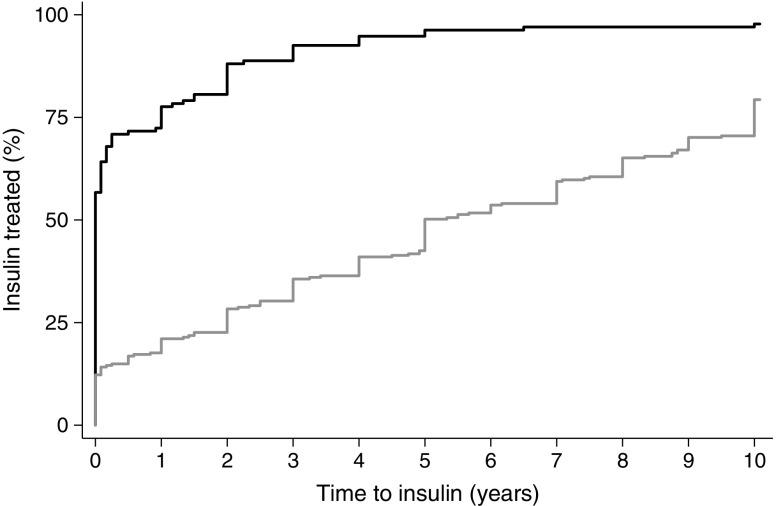
Twenty-one per cent of participants with insulin-treated diabetes who were diagnosed after age 30 met the study criteria for type 1 diabetes. Of these participants, 38% did not receive insulin at diagnosis, of whom 47% self-reported type 2 diabetes. Rapid insulin requirement was highly predictive of severe endogenous insulin deficiency: 85% required insulin within 1 year of diagnosis, and 47% of all those initially treated without insulin who progressed to insulin treatment within 3 years of diagnosis had severe endogenous insulin deficiency. Participants with late-onset type 1 diabetes defined by development of severe insulin deficiency had similar clinical characteristics to those with young-onset type 1 diabetes. However, those with later onset type 1 diabetes had a modestly lower type 1 diabetes genetic risk score (0.268 vs 0.279; p < 0.001 [expected type 2 diabetes population median, 0.231]), a higher islet autoantibody prevalence (GAD-, islet antigen 2 [IA2]- or zinc transporter protein 8 [ZnT8]-positive) of 78% at 13 years vs 62% at 26 years of diabetes duration; (p = 0.02), and were less likely to identify as having type 1 diabetes (79% vs 100%; p < 0.001) vs those with young-onset disease.
CONCLUSIONS/INTERPRETATION: Type 1 diabetes diagnosed over 30 years of age, defined by severe insulin deficiency, has similar clinical and biological characteristics to that occurring at younger ages, but is frequently not identified. Clinicians should be aware that patients progressing to insulin within 3 years of diagnosis have a high likelihood of type 1 diabetes, regardless of initial diagnosis.
目的/假设:迟发性 1 型糖尿病难以识别。使用 C 肽测量内源性胰岛素分泌可提供一种与治疗需求密切相关的糖尿病类型的金标准分类,该分类适用于长期糖尿病。我们旨在确定 30 岁后严重内源性胰岛素缺乏定义的 1 型糖尿病的患病率和特征,并评估这些个体在临床实践中是否被识别并作为 1 型糖尿病进行管理。
方法
我们评估了在糖尿病联盟研究中的 583 名年龄 30 岁以后诊断的胰岛素治疗糖尿病患者中,通过快速胰岛素需求(诊断后 3 年内)和严重内源性胰岛素缺乏(非空腹 C 肽 <200pmol/l)定义的 1 型糖尿病的特征。我们将这些特征与保留内源性胰岛素分泌(>600pmol/l)的参与者和 220 名 30 岁以下诊断为严重胰岛素缺乏的参与者进行了比较。
结果
在年龄 30 岁以后被诊断为胰岛素治疗的糖尿病患者中,21%符合 1 型糖尿病的研究标准。这些患者中,38%在诊断时未接受胰岛素治疗,其中 47%自报为 2 型糖尿病。快速胰岛素需求高度预测严重内源性胰岛素缺乏:85%在诊断后 1 年内需要胰岛素,所有在诊断后 3 年内开始胰岛素治疗但最初未经胰岛素治疗的患者中,有 47%存在严重内源性胰岛素缺乏。由严重胰岛素缺乏发展而来的迟发性 1 型糖尿病患者与早发性 1 型糖尿病患者具有相似的临床特征。然而,那些迟发性 1 型糖尿病患者的 1 型糖尿病遗传风险评分略低(0.268 对 0.279;p<0.001[预期 2 型糖尿病人群中位数,0.231]),胰岛自身抗体阳性率更高(GAD、胰岛抗原 2 [IA2]或锌转运蛋白 8 [ZnT8]阳性),在 13 年时为 78%,在 26 年时为 62%;(p=0.02),并且不太可能被认定为 1 型糖尿病(79%对 100%;p<0.001),而不是那些早发性疾病患者。
结论/解释:在 30 岁以上被诊断为严重胰岛素缺乏的 1 型糖尿病具有与年轻患者相似的临床和生物学特征,但常常未被识别。临床医生应注意,无论初始诊断如何,在诊断后 3 年内进展为胰岛素治疗的患者极有可能患有 1 型糖尿病。
 Zotero 插件