
不同模式的吸气肌训练作为慢性阻塞性肺疾病(COPD)患者常规治疗的附加手段的效果:一项随机对照试验的研究方案。
Effects of different modalities of inspiratory muscle training as an add-on to conventional treatment of patients with chronic obstructive pulmonary disease (COPD): study protocol for a randomized controlled trial.
机构信息
Laboratório de Desempenho PneumoCardioVascular e Músculos Respiratórios, Departamento de Fisioterapia, Universidade Federal do Rio Grande Do Norte (UFRN), Natal, Rio Grande do Norte, Brazil.
PneumoCardioVascular Lab/HUOL, Empresa Brasileira de Serviços Hospitalares - EBSERH), Universidade Federal do Rio Grande do Norte (UFRN), Natal, Rio Grande do Norte, Brazil.
出版信息
Trials. 2019 Apr 24;20(1):231. doi: 10.1186/s13063-019-3271-1.
BACKGROUND
Chronic obstructive pulmonary disease (COPD) leads to peripheral and respiratory muscle dysfunctions. Nowadays, inspiratory muscle training can be geared toward strength or endurance gains. This study aims to investigate the effects of an inspiratory muscle training (IMT) protocol using different therapeutic modalities to be implemented in pulmonary rehabilitation programs. The effects of IMT on exercise capacity were considered as the primary endpoint, and the effects of IMT on inspiratory muscle function, health-related quality of life, and daily physical activity level were considered as the secondary outcomes.
METHODS
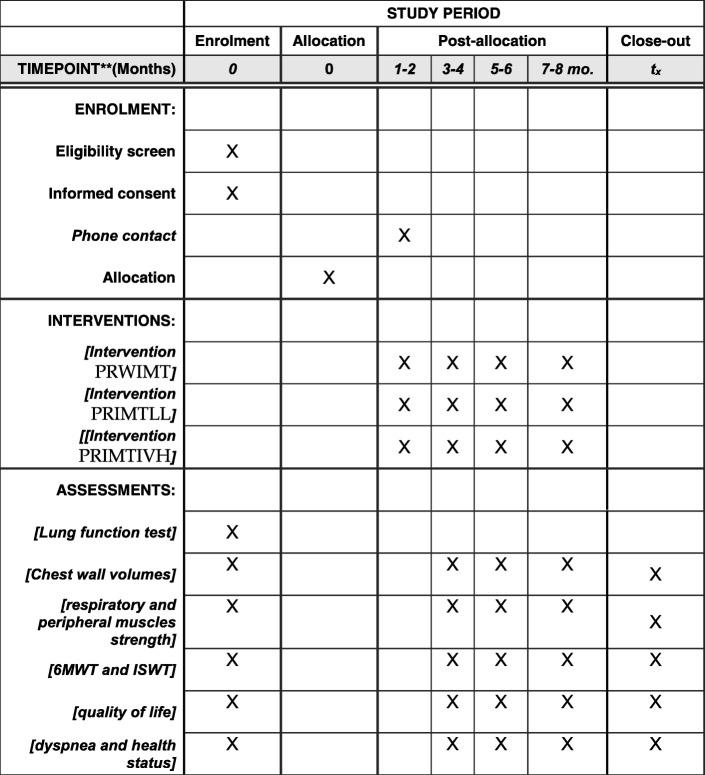
This study is a blinded-investigator randomized controlled clinical trial. Sixty subjects will be randomly allocated into three groups: (1) pulmonary rehabilitation (PR) associated with inspiratory muscle training without any load (PRWIMT), (2) PR associated with inspiratory muscle training with a linear load (PRIMTLL), and (3) PR associated with inspiratory muscle training with isocapnic voluntary hyperpnea (PRIMTIVH). The protocol will be performed 5 days a week (3 days with supervision) for 10 weeks. The study will assess anthropometric data, lung function, respiratory muscle strength, and functional capacity by the Incremental Shuttle Walking Test and the Six-Minute Walk Test, lung volumes during the submaximal endurance test, peripheral muscle strength of the upper and lower limbs, dyspnea, and quality of life related to health, before and after the training protocol. Normality will be tested using the Kolmogorov-Smirnov test, and variables will be compared by two-way analysis of variance. The significance level was set at p < 0.05. Ethics approval was obtained from the Institutional Ethics Committee in Research (1.663.411). The study results will be disseminated through presentation at specific scientific conferences and publication in peer-reviewed journals.
DISCUSSION
The different IMT protocols used in our study will be able to guide respiratory therapists to understand and to include in conventional PR programs the most effective respiratory muscle training type in subjects with COPD.
TRIAL REGISTRATION
Brazilian Clinical Trials Registry, RBR-94v6kd . Registered on 11 March 2017.
背景
慢性阻塞性肺疾病(COPD)可导致周围和呼吸肌功能障碍。如今,吸气肌训练可以针对力量或耐力的提高。本研究旨在探讨使用不同治疗模式的吸气肌训练(IMT)方案在肺康复计划中的应用效果。IMT 对运动能力的影响被认为是主要终点,而 IMT 对吸气肌功能、健康相关生活质量和日常体力活动水平的影响被认为是次要结果。
方法
这是一项盲法研究者随机对照临床试验。将 60 名受试者随机分为三组:(1)肺康复(PR)联合无负荷吸气肌训练(PRWIMT),(2)PR 联合线性负荷吸气肌训练(PRIMTLL),(3)PR 联合等二氧化碳自主过度通气吸气肌训练(PRIMTIVH)。方案将每周进行 5 天(3 天有监督),共 10 周。研究将在训练前后评估人体测量数据、肺功能、呼吸肌力量和功能容量(递增穿梭步行试验和 6 分钟步行试验)、亚极量耐力试验时的肺容积、上下肢外周肌肉力量、呼吸困难和与健康相关的生活质量,并通过双向方差分析比较各组间的差异。采用 Kolmogorov-Smirnov 检验进行正态性检验,变量间的比较采用双因素方差分析。显著性水平设为 p < 0.05。该研究已获得机构伦理委员会的研究伦理批准(1.663.411)。研究结果将通过在特定科学会议上的演讲和在同行评议期刊上的发表进行传播。
讨论
我们研究中使用的不同 IMT 方案将能够指导呼吸治疗师理解并将最有效的呼吸肌训练类型纳入 COPD 患者的常规 PR 方案中。
试验注册
巴西临床试验注册处,RBR-94v6kd。注册于 2017 年 3 月 11 日。

 Zotero 插件