
吸气肌训练,联合或不联合肺康复治疗,用于慢性阻塞性肺疾病(COPD)。
Inspiratory muscle training, with or without concomitant pulmonary rehabilitation, for chronic obstructive pulmonary disease (COPD).
机构信息
Faculty of Medicine, University of Sfax, Sfax, Tunisia.
Department of Respiratory Medicine, Hedi Chaker University Hospital, University of Sfax, Sfax, Tunisia.
出版信息
Cochrane Database Syst Rev. 2023 Jan 6;1(1):CD013778. doi: 10.1002/14651858.CD013778.pub2.
BACKGROUND
Inspiratory muscle training (IMT) aims to improve respiratory muscle strength and endurance. Clinical trials used various training protocols, devices and respiratory measurements to check the effectiveness of this intervention. The current guidelines reported a possible advantage of IMT, particularly in people with respiratory muscle weakness. However, it remains unclear to what extent IMT is clinically beneficial, especially when associated with pulmonary rehabilitation (PR). OBJECTIVES: To assess the effect of inspiratory muscle training (IMT) on chronic obstructive pulmonary disease (COPD), as a stand-alone intervention and when combined with pulmonary rehabilitation (PR).
SEARCH METHODS
We searched the Cochrane Airways trials register, CENTRAL, MEDLINE, Embase, PsycINFO, Cumulative Index to Nursing and Allied Health Literature (CINAHL) EBSCO, Physiotherapy Evidence Database (PEDro) ClinicalTrials.gov, and the World Health Organization International Clinical Trials Registry Platform on 20 October 2021. We also checked reference lists of all primary studies and review articles.
SELECTION CRITERIA
We included randomized controlled trials (RCTs) that compared IMT in combination with PR versus PR alone and IMT versus control/sham. We included different types of IMT irrespective of the mode of delivery. We excluded trials that used resistive devices without controlling the breathing pattern or a training load of less than 30% of maximal inspiratory pressure (PImax), or both.
DATA COLLECTION AND ANALYSIS
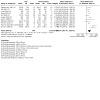
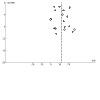
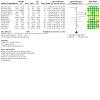
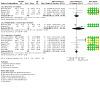
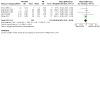
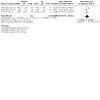
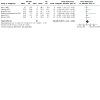
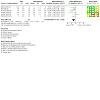
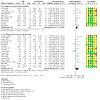
We used standard methods recommended by Cochrane including assessment of risk of bias with RoB 2. Our primary outcomes were dyspnea, functional exercise capacity and health-related quality of life. MAIN RESULTS: We included 55 RCTs in this review. Both IMT and PR protocols varied significantly across the trials, especially in training duration, loads, devices, number/ frequency of sessions and the PR programs. Only eight trials were at low risk of bias. PR+IMT versus PR We included 22 trials (1446 participants) in this comparison. Based on a minimal clinically important difference (MCID) of -1 unit, we did not find an improvement in dyspnea assessed with the Borg scale at submaximal exercise capacity (mean difference (MD) 0.19, 95% confidence interval (CI) -0.42 to 0.79; 2 RCTs, 202 participants; moderate-certainty evidence). We also found no improvement in dyspnea assessed with themodified Medical Research Council dyspnea scale (mMRC) according to an MCID between -0.5 and -1 unit (MD -0.12, 95% CI -0.39 to 0.14; 2 RCTs, 204 participants; very low-certainty evidence). Pooling evidence for the 6-minute walk distance (6MWD) showed an increase of 5.95 meters (95% CI -5.73 to 17.63; 12 RCTs, 1199 participants; very low-certainty evidence) and failed to reach the MCID of 26 meters. In subgroup analysis, we divided the RCTs according to the training duration and mean baseline PImax. The test for subgroup differences was not significant. Trials at low risk of bias (n = 3) demonstrated a larger effect estimate than the overall. The summary effect of the St George's Respiratory Questionnaire (SGRQ) revealed an overall total score below the MCID of 4 units (MD 0.13, 95% CI -0.93 to 1.20; 7 RCTs, 908 participants; low-certainty evidence). The summary effect of COPD Assessment Test (CAT) did not show an improvement in the HRQoL (MD 0.13, 95% CI -0.80 to 1.06; 2 RCTs, 657 participants; very low-certainty evidence), according to an MCID of -1.6 units. Pooling the RCTs that reported PImax showed an increase of 11.46 cmHO (95% CI 7.42 to 15.50; 17 RCTs, 1329 participants; moderate-certainty evidence) but failed to reach the MCID of 17.2 cmHO. In subgroup analysis, we did not find a difference between different training durations and between studies judged with and without respiratory muscle weakness. One abstract reported some adverse effects that were considered "minor and self-limited". IMT versus control/sham Thirty-seven RCTs with 1021 participants contributed to our second comparison. There was a trend towards an improvement when Borg was calculated at submaximal exercise capacity (MD -0.94, 95% CI -1.36 to -0.51; 6 RCTs, 144 participants; very low-certainty evidence). Only one trial was at a low risk of bias. Eight studies (nine arms) used the Baseline Dyspnea Index - Transition Dyspnea Index (BDI-TDI). Based on an MCID of +1 unit, they showed an improvement only with the 'total score' of the TDI (MD 2.98, 95% CI 2.07 to 3.89; 8 RCTs, 238 participants; very low-certainty evidence). We did not find a difference between studies classified as with and without respiratory muscle weakness. Only one trial was at low risk of bias. Four studies reported the mMRC, revealing a possible improvement in dyspnea in the IMT group (MD -0.59, 95% CI -0.76 to -0.43; 4 RCTs, 150 participants; low-certainty evidence). Two trials were at low risk of bias. Compared to control/sham, the MD in the 6MWD following IMT was 35.71 (95% CI 25.68 to 45.74; 16 RCTs, 501 participants; moderate-certainty evidence). Two studies were at low risk of bias. In subgroup analysis, we did not find a difference between different training durations and between studies judged with and without respiratory muscle weakness. Six studies reported theSGRQ total score, showing a larger effect in the IMT group (MD -3.85, 95% CI -8.18 to 0.48; 6 RCTs, 182 participants; very low-certainty evidence). The lower limit of the 95% CI exceeded the MCID of -4 units. Only one study was at low risk of bias. There was an improvement in life quality with CAT (MD -2.97, 95% CI -3.85 to -2.10; 2 RCTs, 86 participants; moderate-certainty evidence). One trial was at low risk of bias. Thirty-two RCTs reported PImax, showing an improvement without reaching the MCID (MD 14.57 cmHO, 95% CI 9.85 to 19.29; 32 RCTs, 916 participants; low-certainty evidence). In subgroup analysis, we did not find a difference between different training durations and between studies judged with and without respiratory muscle weakness. None of the included RCTs reported adverse events.
AUTHORS' CONCLUSIONS: IMT may not improve dyspnea, functional exercise capacity and life quality when associated with PR. However, IMT is likely to improve these outcomes when provided alone. For both interventions, a larger effect in participants with respiratory muscle weakness and with longer training durations is still to be confirmed.
背景
呼吸肌训练(IMT)旨在提高呼吸肌的力量和耐力。临床试验采用了各种训练方案、设备和呼吸测量方法来检查这种干预的效果。目前的指南报告了 IMT 的可能优势,特别是在呼吸肌无力的人群中。然而,IMT 在临床上是否有益仍不清楚,尤其是当与肺康复(PR)联合应用时。
目的
评估吸气肌训练(IMT)对慢性阻塞性肺疾病(COPD)的影响,作为单独的干预措施以及与肺康复(PR)联合应用时的效果。
检索方法
我们检索了 Cochrane Airways 试验注册库、CENTRAL、MEDLINE、Embase、PsycINFO、Cumulative Index to Nursing and Allied Health Literature(CINAHL)EBSCO、Physiotherapy Evidence Database(PEDro)、ClinicalTrials.gov 和世界卫生组织国际临床试验注册平台,检索日期为 2021 年 10 月 20 日。我们还检查了所有初级研究和综述文章的参考文献列表。
入选标准
我们纳入了比较 IMT 联合 PR 与 PR 单独应用以及 IMT 与对照组/假治疗的随机对照试验(RCT)。我们纳入了不同类型的 IMT,无论其传递模式如何。我们排除了仅使用不控制呼吸模式或训练负荷低于最大吸气压力(PImax)30%的阻力设备的试验,或同时排除这两种设备的试验。
数据收集和分析
我们使用了 Cochrane 推荐的标准方法,包括使用 RoB 2 评估偏倚风险。我们的主要结局是呼吸困难、功能运动能力和健康相关生活质量。
主要结果
我们纳入了 55 项 RCT。试验之间的 PR 方案和 IMT 方案差异很大,特别是在训练持续时间、负荷、设备、治疗次数和 PR 方案方面。只有八项试验的偏倚风险较低。
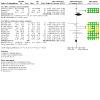
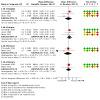
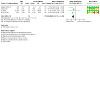
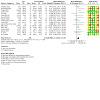
PR+IMT 与 PR:我们纳入了 22 项试验(1446 名参与者)的比较。基于最小临床重要差异(MCID)为-1 单位,我们在亚最大运动能力时使用 Borg 量表评估的呼吸困难没有改善(MD 0.19,95%置信区间(CI)-0.42 至 0.79;2 项 RCT,202 名参与者;中等确定性证据)。我们也没有发现改良的医学研究委员会呼吸困难量表(mMRC)评估的呼吸困难改善,根据 MCID 为-0.5 至-1 单位(MD-0.12,95%CI-0.39 至 0.14;2 项 RCT,204 名参与者;非常低确定性证据)。汇总的 6 分钟步行距离(6MWD)表明增加了 5.95 米(95%CI-5.73 至 17.63;12 项 RCT,1199 名参与者;非常低确定性证据),但未达到 26 米的 MCID。在亚组分析中,我们根据训练持续时间和平均基线 PImax 将 RCT 分组。亚组间差异检验无统计学意义。低偏倚风险(n=3)的试验显示出更大的估计效果。圣乔治呼吸问卷(SGRQ)的总评分汇总显示,总评分低于 MCID 的 4 个单位(MD 0.13,95%CI-0.93 至 1.20;7 项 RCT,908 名参与者;低确定性证据)。COPD 评估测试(CAT)的总评分汇总显示,HRQoL 没有改善(MD 0.13,95%CI-0.80 至 1.06;2 项 RCT,657 名参与者;非常低确定性证据),根据 MCID-1.6 个单位。汇总报告 PImax 的 RCT 显示 PImax 增加了 11.46 cmHO(95%CI 7.42 至 15.50;17 项 RCT,1329 名参与者;中等确定性证据),但未达到 MCID 的 17.2 cmHO。在亚组分析中,我们没有发现不同训练持续时间和有或没有呼吸肌无力的研究之间的差异。一篇摘要报告了一些被认为“轻微且自限性”的不良反应。
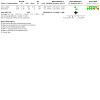
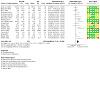
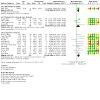
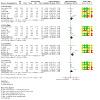
IMT 与对照组/假治疗:37 项 RCT(1021 名参与者)的比较纳入了我们的第二个比较。当 Borg 在亚最大运动能力时计算时,IMT 有改善的趋势(MD-0.94,95%CI-1.36 至-0.51;6 项 RCT,144 名参与者;非常低确定性证据)。只有一项试验的偏倚风险较低。八项研究(九组)使用了基线呼吸困难指数-过渡呼吸困难指数(BDI-TDI)。基于 MCID 的+1 单位,他们发现 TDI 的“总分”只有改善(MD 2.98,95%CI 2.07 至 3.89;8 项 RCT,238 名参与者;非常低确定性证据)。我们没有发现有或没有呼吸肌无力的研究之间的差异。只有一项试验的偏倚风险较低。四项研究报告了 mMRC,发现 IMT 组呼吸困难可能有所改善(MD-0.59,95%CI-0.76 至-0.43;4 项 RCT,150 名参与者;低确定性证据)。只有两项试验的偏倚风险较低。与对照组/假治疗相比,IMT 后 6MWD 的 MD 为 35.71(95%CI 25.68 至 45.74;16 项 RCT,501 名参与者;中等确定性证据)。只有两项试验的偏倚风险较低。在亚组分析中,我们没有发现不同训练持续时间和有或没有呼吸肌无力的研究之间的差异。六项研究报告了 SGRQ 总分,表明 IMT 组的效果更大(MD-3.85,95%CI-8.18 至 0.48;6 项 RCT,182 名参与者;非常低确定性证据)。95%CI 的下限超过了 MCID 的-4 个单位。只有一项试验的偏倚风险较低。CAT 显示生活质量有所改善(MD-2.97,95%CI-3.85 至-2.10;2 项 RCT,86 名参与者;中等确定性证据)。只有一项试验的偏倚风险较低。32 项 RCT 报告了 PImax,显示出未达到 MCID 的改善(MD 14.57 cmHO,95%CI 9.85 至 19.29;32 项 RCT,916 名参与者;低确定性证据)。在亚组分析中,我们没有发现不同训练持续时间和有或没有呼吸肌无力的研究之间的差异。
纳入的 RCT 均未报告不良反应。
作者结论
当与 PR 联合应用时,IMT 可能不会改善呼吸困难、功能运动能力和生活质量。然而,当单独应用 IMT 时,它可能会改善这些结果。对于这两种干预措施,在有呼吸肌无力的参与者和训练持续时间较长的参与者中,更大的效果仍有待证实。


















 Zotero 插件