
转录组谱分析揭示胃食管交界处腺癌的三种分子表型。
Transcriptomic profiling reveals three molecular phenotypes of adenocarcinoma at the gastroesophageal junction.
机构信息
MRC Cancer Unit, Hutchison/MRC Research Centre, University of Cambridge, Cambridge, United Kingdom.
Department of Gastroenterology, Hepatology and Infectious Diseases, Otto-von-Guericke University, Magdeburg, Germany.
出版信息
Int J Cancer. 2019 Dec 15;145(12):3389-3401. doi: 10.1002/ijc.32384. Epub 2019 May 17.
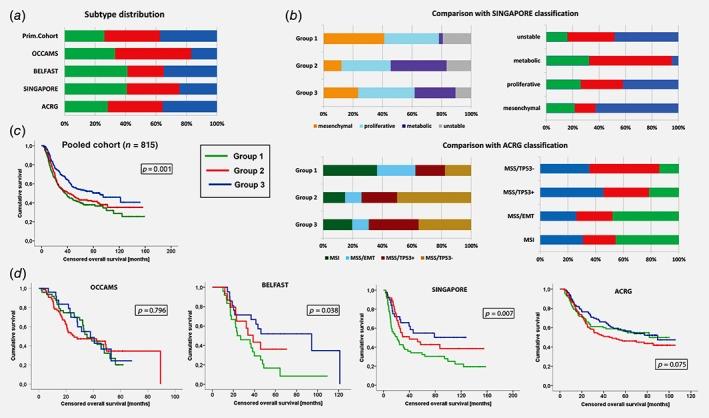
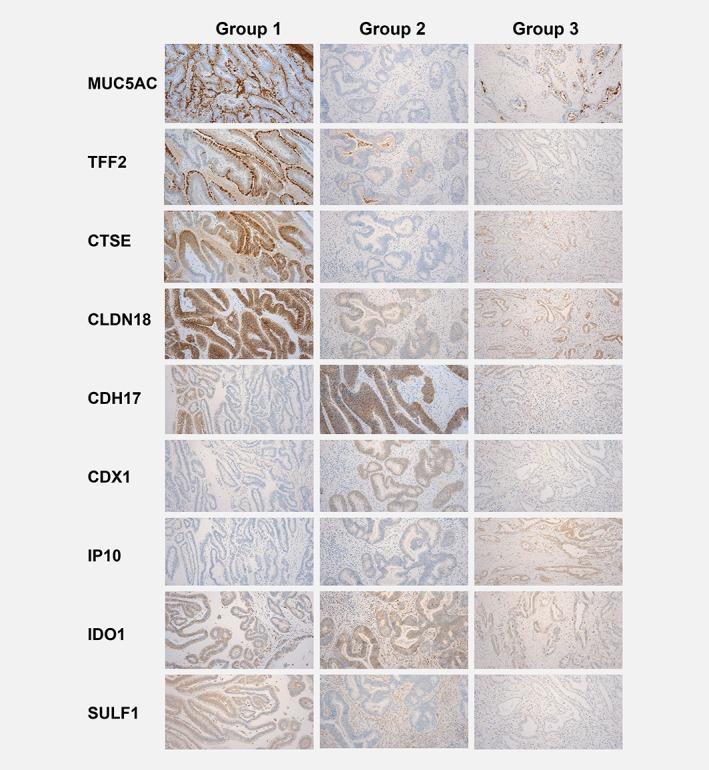
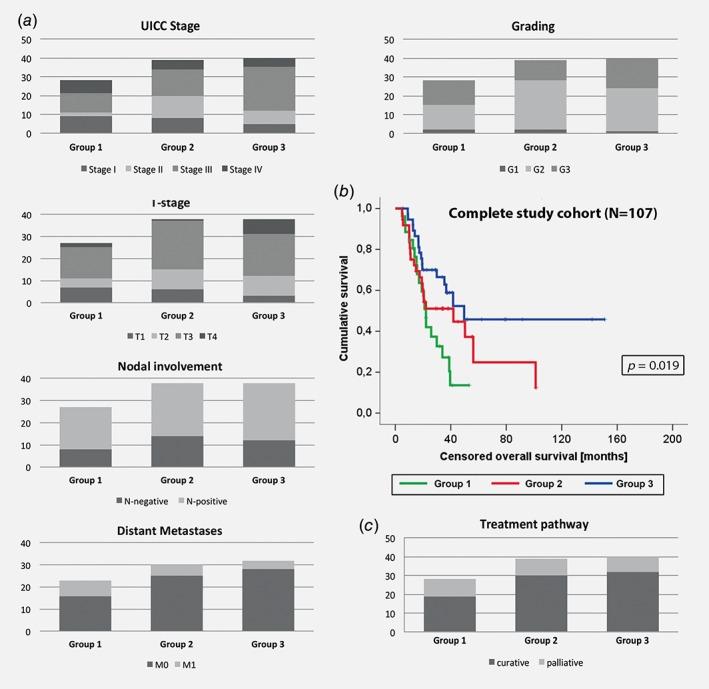
Cancers occurring at the gastroesophageal junction (GEJ) are classified as predominantly esophageal or gastric, which is often difficult to decipher. We hypothesized that the transcriptomic profile might reveal molecular subgroups which could help to define the tumor origin and behavior beyond anatomical location. The gene expression profiles of 107 treatment-naïve, intestinal type, gastroesophageal adenocarcinomas were assessed by the Illumina-HTv4.0 beadchip. Differential gene expression (limma), unsupervised subgroup assignment (mclust) and pathway analysis (gage) were undertaken in R statistical computing and results were related to demographic and clinical parameters. Unsupervised assignment of the gene expression profiles revealed three distinct molecular subgroups, which were not associated with anatomical location, tumor stage or grade (p > 0.05). Group 1 was enriched for pathways involved in cell turnover, Group 2 was enriched for metabolic processes and Group 3 for immune-response pathways. Patients in group 1 showed the worst overall survival (p = 0.019). Key genes for the three subtypes were confirmed by immunohistochemistry. The newly defined intrinsic subtypes were analyzed in four independent datasets of gastric and esophageal adenocarcinomas with transcriptomic data available (RNAseq data: OCCAMS cohort, n = 158; gene expression arrays: Belfast, n = 63; Singapore, n = 191; Asian Cancer Research Group, n = 300). The subgroups were represented in the independent cohorts and pooled analysis confirmed the prognostic effect of the new subtypes. In conclusion, adenocarcinomas at the GEJ comprise three distinct molecular phenotypes which do not reflect anatomical location but rather inform our understanding of the key pathways expressed.
胃食管交界处(GEJ)发生的癌症分为主要食管或胃型,这通常很难确定。我们假设转录组谱可能揭示分子亚群,这有助于确定肿瘤起源和行为超出解剖位置。通过 Illumina-HTv4.0 珠芯片评估了 107 例未经治疗的、肠型、胃食管腺癌的基因表达谱。在 R 统计计算中进行了差异基因表达(limma)、无监督亚组分配(mclust)和途径分析(gage),并将结果与人口统计学和临床参数相关联。基因表达谱的无监督分配揭示了三个不同的分子亚群,这些亚群与解剖位置、肿瘤分期或分级无关(p > 0.05)。第 1 组富含与细胞更替相关的途径,第 2 组富含代谢过程,第 3 组富含免疫反应途径。第 1 组的患者总体生存最差(p = 0.019)。通过免疫组织化学证实了三种亚型的关键基因。在有转录组数据可用的四个独立胃腺癌和食管腺癌数据集(RNAseq 数据:OCCAMS 队列,n = 158;基因表达阵列:Belfast,n = 63;新加坡,n = 191;亚洲癌症研究组,n = 300)中分析了新定义的内在亚型。在独立队列和汇总分析中均存在亚组,证实了新亚型的预后作用。总之,GEJ 处的腺癌包含三种不同的分子表型,这些表型不反映解剖位置,而是告知我们对表达的关键途径的理解。


 Zotero 插件