
抗疟功能免疫对青蒿素衍生物治疗疗效研究中寄生虫清除衡量标准的贡献。
Contribution of Functional Antimalarial Immunity to Measures of Parasite Clearance in Therapeutic Efficacy Studies of Artemisinin Derivatives.
机构信息
Burnet Institute, Melbourne, Australia.
Centre for Epidemiology and Biostatistics, Melbourne School of Population and Global Health, Melbourne, Australia.
出版信息
J Infect Dis. 2019 Aug 30;220(7):1178-1187. doi: 10.1093/infdis/jiz247.
BACKGROUND
Antibodies to the blood stages of malaria parasites enhance parasite clearance and antimalarial efficacy. The antibody subclass and functions that contribute to parasite clearance during antimalarial treatment and their relationship to malaria transmission intensity have not been characterized.
METHODS
Levels of immunoglobulin G (IgG) subclasses and C1q fixation in response to Plasmodium falciparum merozoite antigens (erythrocyte-binding antigen [EBA] 175RIII-V, merozoite surface protein 2 [MSP-2], and MSP-142) and opsonic phagocytosis of merozoites were measured in a multinational trial assessing the efficacy of artesunate therapy across 11 Southeast Asian sites. Regression analyses assessed the effects of antibody seropositivity on the parasite clearance half-life (PC½), having a PC½ of ≥5 hours, and having parasitemia 3 days after treatment.
RESULTS
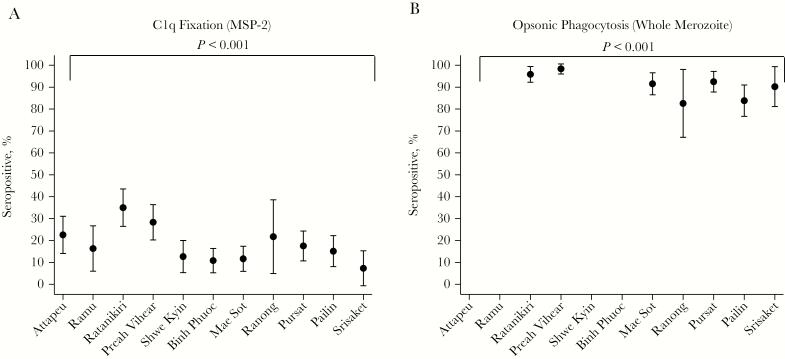
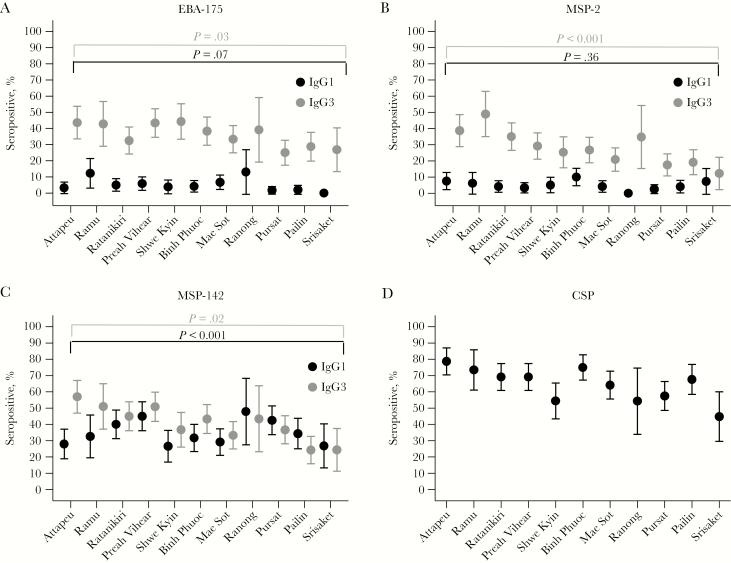
IgG3, followed by IgG1, was the predominant IgG subclass detected (seroprevalence range, 5%-35% for IgG1 and 27%-41% for IgG3), varied across study sites, and was lowest in study sites with the lowest transmission intensity and slowest mean PC½. IgG3, C1q fixation, and opsonic-phagocytosis seropositivity were associated with a faster PC½ (range of the mean reduction in PC½, 0.47-1.16 hours; P range, .001-.03) and a reduced odds of having a PC½ of ≥5 hours and having parasitemia 3 days after treatment.
CONCLUSIONS
The prevalence of IgG3, complement-fixing antibodies, and merozoite phagocytosis vary according to transmission intensity, are associated with faster parasite clearance, and may be sensitive surrogates of an augmented clearance capacity of infected erythrocytes. Determining the functional immune mechanisms associated with parasite clearance will improve characterization of artemisinin resistance.
背景
疟原虫血期抗体可增强寄生虫清除率和抗疟疗效。在抗疟治疗过程中,促进寄生虫清除的抗体亚类和功能,以及它们与疟疾传播强度的关系尚未得到明确。
方法
在评估青蒿琥酯治疗效果的多国试验中,于 11 个东南亚研究点测量了针对恶性疟原虫裂殖子抗原(红细胞结合抗原 175RIII-V[EBA-175RIII-V]、裂殖子表面蛋白 2[MSP-2]和 MSP-142)的免疫球蛋白 G(IgG)亚类和 C1q 固定水平以及裂殖体的调理吞噬作用。回归分析评估了抗体血清阳性对寄生虫清除半衰期(PC½)、PC½≥5 小时和治疗后 3 天出现寄生虫血症的影响。
结果
IgG3 随后是 IgG1,是检测到的主要 IgG 亚类(IgG1 的血清阳性率范围为 5%至 35%,IgG3 的血清阳性率范围为 27%至 41%),在研究点之间存在差异,在传播强度最低和平均 PC½最慢的研究点最低。IgG3、C1q 固定和调理吞噬作用血清阳性与更快的 PC½(PC½平均降低范围为 0.47 至 1.16 小时;P 范围为 0.001 至 0.03)和降低的 PC½≥5 小时和治疗后 3 天出现寄生虫血症的几率相关。
结论
根据传播强度,IgG3、补体结合抗体和裂殖体吞噬作用的流行率不同,与寄生虫清除速度加快有关,可能是受感染红细胞清除能力增强的敏感替代指标。确定与寄生虫清除相关的功能免疫机制将改善对青蒿素耐药性的特征描述。
 Zotero 插件