
感染的低复杂性与肯尼亚和坦桑尼亚的分子持续性相关。
Low Complexity of Infection Is Associated With Molecular Persistence of in Kenya and Tanzania.
作者信息
Topazian Hillary M, Moser Kara A, Ngasala Billy, Oluoch Peter O, Forconi Catherine S, Mhamilawa Lwidiko E, Aydemir Ozkan, Kharabora Oksana, Deutsch-Feldman Molly, Read Andrew F, Denton Madeline, Lorenzo Antonio, Mideo Nicole, Ogutu Bernhards, Moormann Ann M, Mårtensson Andreas, Odwar Boaz, Bailey Jeffrey A, Akala Hoseah, Ong'echa John Michael, Juliano Jonathan J
机构信息
Department of Infectious Disease Epidemiology, Imperial College, London, United Kingdom.
Institute for Global Health and Infectious Diseases, University of North Carolina, Chapel Hill, NC, United States.
出版信息
Front Epidemiol. 2022 Jun 6;2:852237. doi: 10.3389/fepid.2022.852237. eCollection 2022.
BACKGROUND
resistance to artemisinin-based combination therapies (ACTs) is a threat to malaria elimination. ACT-resistance in Asia raises concerns for emergence of resistance in Africa. While most data show high efficacy of ACT regimens in Africa, there have been reports describing declining efficacy, as measured by both clinical failure and prolonged parasite clearance times.
METHODS
Three hundred children aged 2-10 years with uncomplicated infection were enrolled in Kenya and Tanzania after receiving treatment with artemether-lumefantrine. Blood samples were taken at 0, 24, 48, and 72 h, and weekly thereafter until 28 days post-treatment. Parasite and host genetics were assessed, as well as clinical, behavioral, and environmental characteristics, and host anti-malarial serologic response.
RESULTS
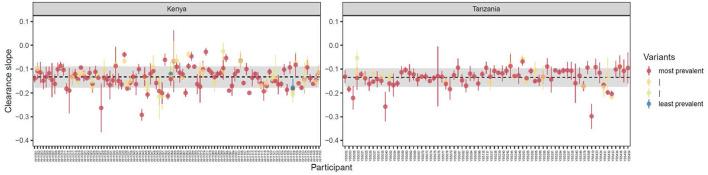
While there was a broad range of clearance rates at both sites, 85% and 96% of Kenyan and Tanzanian samples, respectively, were qPCR-positive but microscopy-negative at 72 h post-treatment. A greater complexity of infection (COI) was negatively associated with qPCR-detectable parasitemia at 72 h (OR: 0.70, 95% CI: 0.53-0.94), and a greater baseline parasitemia was marginally associated with qPCR-detectable parasitemia (1,000 parasites/uL change, OR: 1.02, 95% CI: 1.01-1.03). Demographic, serological, and host genotyping characteristics showed no association with qPCR-detectable parasitemia at 72 h. Parasite haplotype-specific clearance slopes were grouped around the mean with no association detected between specific haplotypes and slower clearance rates.
CONCLUSIONS
Identifying risk factors for slow clearing infections, such as COI, are essential for ongoing surveillance of ACT treatment failure in Kenya, Tanzania, and more broadly in sub-Saharan Africa.
背景
对以青蒿素为基础的联合疗法(ACTs)产生耐药性是疟疾消除工作面临的一个威胁。亚洲出现的ACT耐药性引发了人们对非洲出现耐药性的担忧。虽然大多数数据显示ACT方案在非洲具有很高的疗效,但也有报告称,从临床治疗失败和寄生虫清除时间延长这两方面衡量,其疗效在下降。
方法
在肯尼亚和坦桑尼亚,300名2至10岁患有非复杂性感染的儿童在接受蒿甲醚-本芴醇治疗后被纳入研究。在治疗后0、24、48和72小时采集血样,此后每周采集一次,直至治疗后28天。对寄生虫和宿主的遗传学进行评估,同时评估临床、行为和环境特征以及宿主抗疟疾血清学反应。
结果
虽然两个地点的清除率范围很广,但在治疗后72小时,肯尼亚和坦桑尼亚的样本分别有85%和96%通过定量聚合酶链反应(qPCR)检测呈阳性但显微镜检查呈阴性。感染复杂性(COI)越高,在72小时时qPCR可检测到的寄生虫血症呈负相关(比值比:0.70,95%置信区间:0.53 - 0.94),基线寄生虫血症越高,与qPCR可检测到的寄生虫血症呈微弱相关(每微升1000个寄生虫的变化,比值比:1.02,95%置信区间:1.01 - 1.03)。人口统计学、血清学和宿主基因分型特征与72小时时qPCR可检测到的寄生虫血症无关联。寄生虫单倍型特异性清除斜率围绕平均值分组,未检测到特定单倍型与较慢清除率之间存在关联。
结论
识别清除感染缓慢的风险因素,如COI,对于在肯尼亚、坦桑尼亚以及更广泛的撒哈拉以南非洲地区持续监测ACT治疗失败情况至关重要。

 Zotero 插件