
谷氨酰胺向脯氨酸的转化与乳腺癌对谷氨酰胺酶抑制的反应有关。
Glutamine to proline conversion is associated with response to glutaminase inhibition in breast cancer.
机构信息
Department of Circulation and Medical Imaging, Norwegian University of Science and Technology (NTNU), 7489, Trondheim, Norway.
Department of Tumor Biology, Institute for Cancer Research, Oslo University Hospital, Oslo, Norway.
出版信息
Breast Cancer Res. 2019 May 14;21(1):61. doi: 10.1186/s13058-019-1141-0.
INTRODUCTION
Glutaminase inhibitors target cancer cells by blocking the conversion of glutamine to glutamate, thereby potentially interfering with anaplerosis and synthesis of amino acids and glutathione. The drug CB-839 has shown promising effects in preclinical experiments and is currently undergoing clinical trials in several human malignancies, including triple-negative breast cancer (TNBC). However, response to glutaminase inhibitors is variable and there is a need for identification of predictive response biomarkers. The aim of this study was to determine how glutamine is utilized in two patient-derived xenograft (PDX) models of breast cancer representing luminal-like/ER+ (MAS98.06) and basal-like/triple-negative (MAS98.12) breast cancer and to explore the metabolic effects of CB-839 treatment.
EXPERIMENTAL
MAS98.06 and MAS98.12 PDX mice received CB-839 (200 mg/kg) or drug vehicle two times daily p.o. for up to 28 days (n = 5 per group), and the effect on tumor growth was evaluated. Expression of 60 genes and seven glutaminolysis key enzymes were determined using gene expression microarray analysis and immunohistochemistry (IHC), respectively, in untreated tumors. Uptake and conversion of glutamine were determined in the PDX models using HR MAS MRS after i.v. infusion of [5-C] glutamine when the models had received CB-839 (200 mg/kg) or vehicle for 2 days (n = 5 per group).
RESULTS
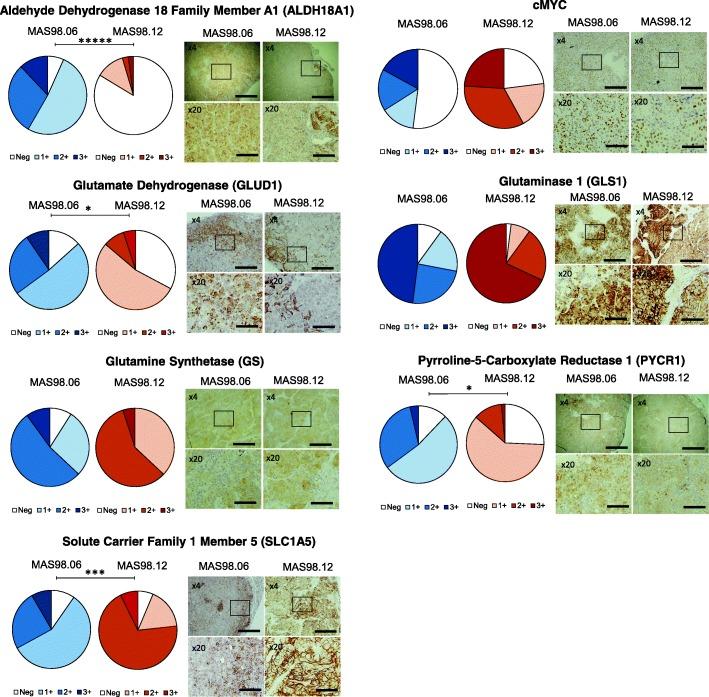
Tumor growth measurements showed that CB-839 significantly inhibited tumor growth in MAS98.06 tumors, but not in MAS98.12 tumors. Gene expression and IHC analysis indicated a higher proline synthesis from glutamine in untreated MAS98.06 tumors. This was confirmed by HR MAS MRS of untreated tumors demonstrating that MAS98.06 used glutamine to produce proline, glutamate, and alanine, and MAS98.12 to produce glutamate and lactate. In both models, treatment with CB-839 resulted in accumulation of glutamine. In addition, CB-839 caused depletion of alanine, proline, and glutamate ([1-13C] glutamate) in the MAS98.06 model.
CONCLUSION
Our findings indicate that TNBCs may not be universally sensitive to glutaminase inhibitors. The major difference in the metabolic fate of glutamine between responding MAS98.06 xenografts and non-responding MAS98.12 xenografts is the utilization of glutamine for production of proline. We therefore suggest that addiction to proline synthesis from glutamine is associated with response to CB-839 in breast cancer. The effect of glutaminase inhibition in two breast cancer patient-derived xenograft (PDX) models. C HR MAS MRS analysis of tumor tissue from CB-839-treated and untreated models receiving C-labeled glutamine ([5-C] Gln) shows that the glutaminase inhibitor CB-839 is causing an accumulation of glutamine (arrow up) in two PDX models representing luminal-like breast cancer (MAS98.06) and basal-like breast cancer (MAS98.12). In MAS98.06 tumors, CB-839 is in addition causing depletion of proline ([5-C] Pro), alanine ([1-C] Ala), and glutamate ([1-C] Glu), which could explain why CB-839 causes tumor growth inhibition in MAS98.06 tumors, but not in MAS98.12 tumors.
简介
谷氨酰胺酶抑制剂通过阻断谷氨酰胺转化为谷氨酸,从而潜在干扰氨甲酰磷酸合成和氨基酸及谷胱甘肽的合成,以此靶向癌细胞。药物 CB-839 在临床前实验中显示出良好的效果,目前正在几种人类恶性肿瘤中进行临床试验,包括三阴性乳腺癌(TNBC)。然而,对谷氨酰胺酶抑制剂的反应是可变的,因此需要确定预测反应的生物标志物。本研究旨在确定两种代表腔型/ER+(MAS98.06)和基底样/三阴性(MAS98.12)乳腺癌的患者来源异种移植(PDX)模型中谷氨酰胺的利用情况,并探索 CB-839 治疗的代谢影响。
实验
MAS98.06 和 MAS98.12 PDX 小鼠接受 CB-839(200mg/kg)或药物载体每日两次口服治疗,最多 28 天(每组 5 只),并评估对肿瘤生长的影响。未处理的肿瘤分别使用基因表达微阵列分析和免疫组织化学(IHC)来确定 60 个基因和七种谷氨酰胺分解关键酶的表达。在 PDX 模型中,在模型接受 CB-839(200mg/kg)或载体治疗 2 天后,通过静脉内输注[5-C]谷氨酰胺后进行 HR MAS MRS,以确定谷氨酰胺的摄取和转化。
结果
肿瘤生长测量表明,CB-839 显著抑制 MAS98.06 肿瘤的生长,但不抑制 MAS98.12 肿瘤的生长。基因表达和 IHC 分析表明,未处理的 MAS98.06 肿瘤中,谷氨酰胺的脯氨酸合成更高。未处理的肿瘤的 HR MAS MRS 证实了这一点,表明 MAS98.06 利用谷氨酰胺产生脯氨酸、谷氨酸和丙氨酸,而 MAS98.12 利用谷氨酰胺产生谷氨酸和乳酸。在两种模型中,CB-839 治疗导致谷氨酰胺的积累。此外,CB-839 导致 MAS98.06 模型中丙氨酸、脯氨酸和谷氨酸([1-13C]谷氨酸)的消耗。
结论
我们的研究结果表明,TNBC 可能对谷氨酰胺酶抑制剂并不普遍敏感。对谷氨酰胺代谢命运有反应的 MAS98.06 异种移植物和无反应的 MAS98.12 异种移植物之间的主要区别是利用谷氨酰胺产生脯氨酸。因此,我们建议从谷氨酰胺中合成脯氨酸的成瘾与 CB-839 在乳腺癌中的反应相关。两种乳腺癌患者来源异种移植(PDX)模型中谷氨酰胺酶抑制剂的作用。C HR MAS MRS 分析接受 C 标记谷氨酰胺([5-C]Gln)的 CB-839 治疗和未处理模型的肿瘤组织显示,谷氨酰胺酶抑制剂 CB-839 导致两种 PDX 模型(代表腔型乳腺癌(MAS98.06)和基底样乳腺癌(MAS98.12))中谷氨酰胺的积累(箭头向上)。在 MAS98.06 肿瘤中,CB-839 还导致脯氨酸([5-C]Pro)、丙氨酸([1-C]Ala)和谷氨酸([1-C]Glu)的消耗,这可以解释为什么 CB-839 导致 MAS98.06 肿瘤的生长抑制,但不导致 MAS98.12 肿瘤的生长抑制。



 Zotero 插件