
敲低缺氧诱导因子 1α(HIF-1α)促进卵巢癌细胞自噬并抑制磷脂酰肌醇 3-激酶(PI3K)/AKT/雷帕霉素靶蛋白(mTOR)信号通路。
Knockdown of Hypoxia-Inducible Factor 1α (HIF-1α) Promotes Autophagy and Inhibits Phosphatidylinositol 3-Kinase (PI3K)/AKT/Mammalian Target of Rapamycin (mTOR) Signaling Pathway in Ovarian Cancer Cells.
机构信息
Department of Gynecology and Obstetrics, Renmin Hospital of Wuhan University, Wuhan, Hubei, China (mainland).
出版信息
Med Sci Monit. 2019 Jun 8;25:4250-4263. doi: 10.12659/MSM.915730.
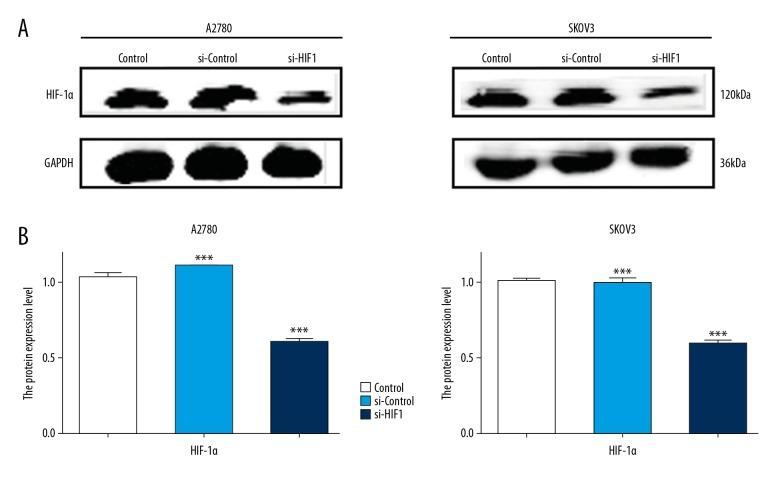
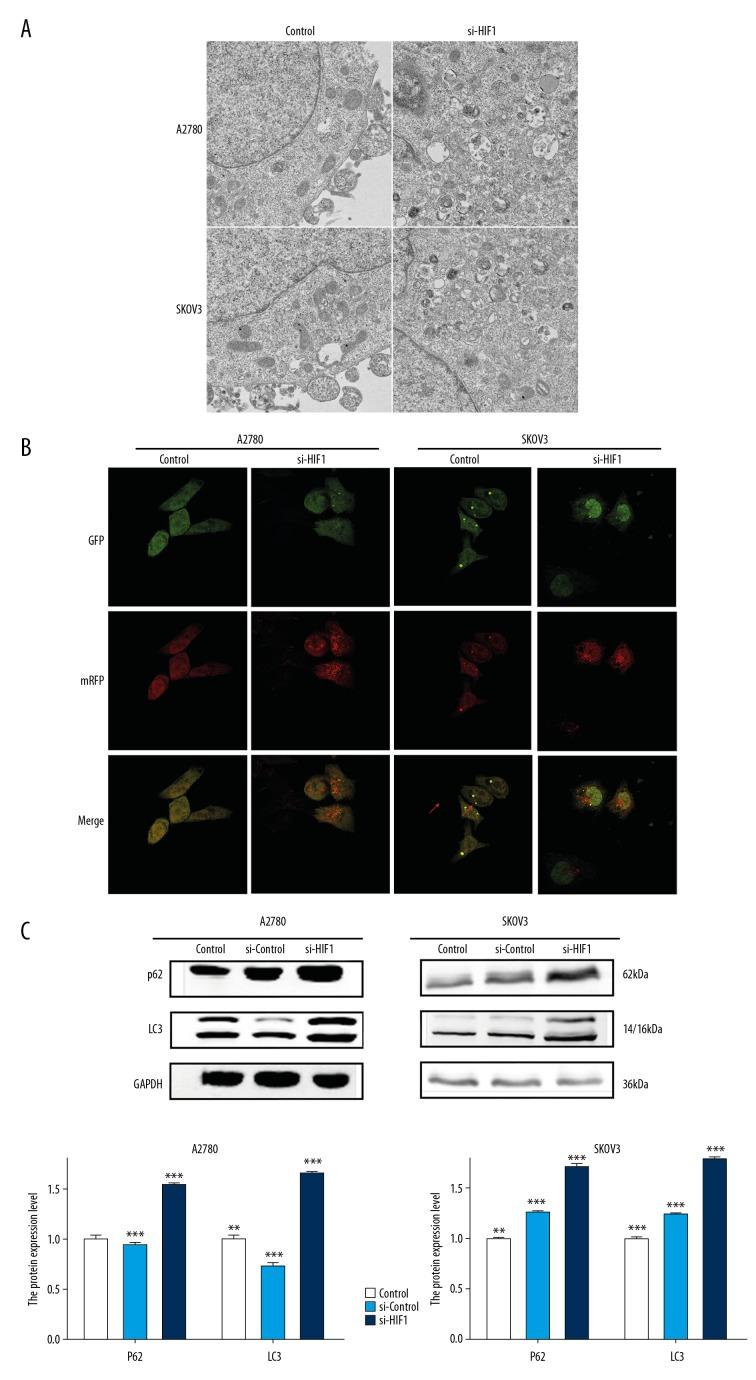
BACKGROUND Ovarian cancer has the highest mortality rate among all female genital tumors because of its insidious onset and drug resistance. Hypoxia-inducible factor 1alpha (HIF-1alpha), one of the best-studied oncogenes, plays an important part in tumor adaptation to microenvironmental hypoxia and was found to be overexpressed in several malignancies, including ovarian cancer. Previous studies found that the effect of HIF-1alpha on cancers may be correlated with autophagy and some signaling pathways, such as PI3K/AKT/mTOR, in several tumors. However, the function and potential mechanism have not been clearly defined. MATERIAL AND METHODS The expression of HIF-1alpha in ovarian cancer tissues were detected by immunohistochemistry. HIF-1alpha was knocked down by siRNA transfection. Cell viability was examined by CCK8 and colony formation assay. Apoptosis and autophagy were detected with flow cytometry, transmission electron microscopy, and laser scanning confocal microscopy, respectively. The proteins related to autophagy and PI3K/AKT/mTOR were detected through Western blot analysis. RESULTS HIF-1alpha was expressed at higher levels in epithelial or metastatic ovarian cancer tissue than in normal fallopian tube tissue. When HIF-1alpha was knocked down by siRNA in A2780 and SKOV3 cells, the viability of ovarian cancer cells was weakened, but the apoptosis and autophagy were strengthened. Accordingly, autophagosome formation increased and the expression of autophagy-related proteins LC3 and P62 increased in HIF-1alpha knockdown cells. The PI3K/Akt/mTOR signaling pathway was also found to be inactivated in HIF-1alpha knockdown cells. CONCLUSIONS These findings show that knockdown of HIF-1alpha promoted autophagy and inhibited the PI3K/AKT/mTOR signaling pathway in ovarian cancer cells.
背景
卵巢癌因其发病隐匿、耐药性强,导致死亡率居女性生殖系统肿瘤之首。缺氧诱导因子 1α(HIF-1α)是研究最深入的癌基因之一,在肿瘤适应微环境缺氧中发挥重要作用,在包括卵巢癌在内的多种恶性肿瘤中发现过度表达。先前的研究发现,HIF-1α 对癌症的影响可能与自噬和一些信号通路有关,如 PI3K/AKT/mTOR,在几种肿瘤中。然而,其功能和潜在机制尚未明确界定。
材料与方法
采用免疫组织化学法检测卵巢癌组织中 HIF-1α 的表达,用 siRNA 转染敲低 HIF-1α,通过 CCK8 和集落形成实验检测细胞活力,通过流式细胞术、透射电子显微镜和激光共聚焦显微镜分别检测细胞凋亡和自噬,通过 Western blot 分析检测自噬和 PI3K/AKT/mTOR 相关蛋白。
结果
HIF-1α 在卵巢癌上皮或转移性组织中的表达水平高于正常输卵管组织。当 A2780 和 SKOV3 细胞中的 HIF-1α 被 siRNA 敲低时,卵巢癌细胞的活力减弱,但凋亡和自噬增强。相应地,自噬体形成增加,HIF-1α 敲低细胞中的自噬相关蛋白 LC3 和 P62 的表达增加。还发现 HIF-1α 敲低细胞中的 PI3K/Akt/mTOR 信号通路失活。
结论
这些发现表明,敲低 HIF-1α 促进了卵巢癌细胞中的自噬并抑制了 PI3K/AKT/mTOR 信号通路。




 Zotero 插件