
壶腹癌的临床结局:单一癌症中心的经验
Clinical Outcome of Ampullary Carcinoma: Single Cancer Center Experience.
作者信息
Al-Jumayli Mohammed, Batool Amna, Middiniti Akshay, Saeed Anwaar, Sun Weijing, Al-Rajabi Raed, Baranda Joaquina, Kumer Sean, Schmitt Timothy, Chidharla Anusha, Kasi Anup
机构信息
Division of Medical Oncology, KU Cancer Center, The University of Kansas Health System, USA.
出版信息
J Oncol. 2019 May 2;2019:3293509. doi: 10.1155/2019/3293509. eCollection 2019.
INTRODUCTION
Ampullary cancers represent a subset of periampullary cancers, comprising only 0.2% all gastrointestinal cancers. Localized disease is primarily managed by a surgical intervention, called pancreaticoduodenectomy (PD), followed in many cases by the administration of adjuvant chemotherapy (CT) or chemoradiation therapy (CRT). However, there are no clear evidence-based guidelines to aid in selecting both the modality and regimen of adjuvant therapy for resected Ampullary carcinoma.
METHODS
We retrospectively analyzed 54 patients at KU Cancer Center, who had undergone endoscopic resection or pancreaticoduodenectomy (PD) for Ampullary cancer from June 2006 to July 2016. We obtained patients' baseline characteristics, clinical presentation, pathology, treatment modality, recurrence pattern, and survival outcomes. The time-to-events data were compared using Kaplan-Meier methods. A univariate and multivariate Cox proportional hazards regression was performed to evaluate factors associated with overall survival (OS) and generate hazard ratios (HR).
RESULTS
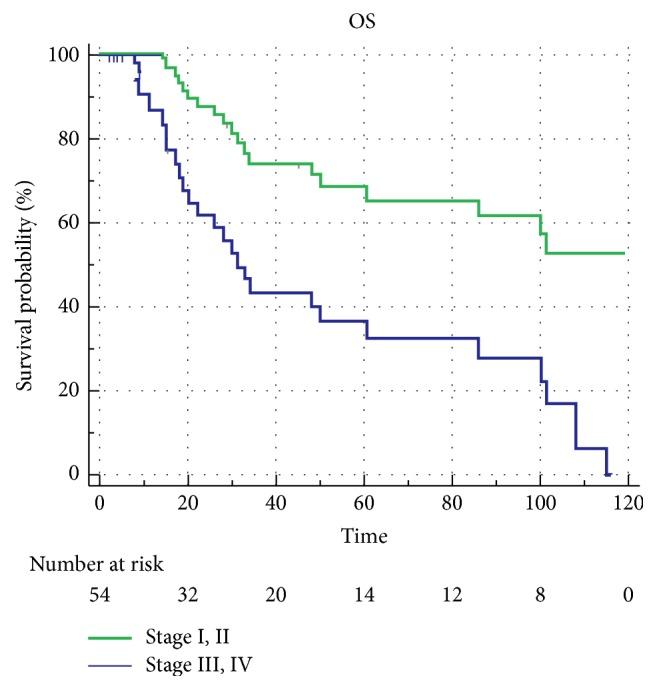
The mean age of the 54 patients was 68 (37-90). 38 (70%) were males and 16 (30%) were females. Most of the patients were Caucasian (76%). Approximately half of all patients had a history of smoking, 20% had alcohol abuse, and 13% had pancreatitis. Among the 54 patients with localized cancers, 9 (16%) were treated definitively with nonoperative therapies, usually due to a prohibitive comorbidity profile, performance status, or unresectable tumor. 45 out of 54 patients (83%) underwent surgery. Of the 45 patients who underwent surgery, 18 patients (40% of the study cohort) received adjuvant therapy due to concerns for advanced disease as determined by the treating physician. 13 patients (24%) received adjuvant CT and 5 patients (9.2%) received CRT. The remaining 27 patients (50%) underwent surgery alone. The median OS for the entire study cohort was 30 months. When compared to surgery alone, adjuvant therapy with either CT or CRT had no statistically significant difference in terms of progression-free survival (=0.56) or overall survival (=0.80). In univariate Cox proportional hazards regression analysis, high-risk features like peripancreatic extension (16%) and perineural invasion (26%) were found to be associated with poor OS. Lymph node metastasis (29%) did not significantly affect OS (HR 1.42, 95% CI [0.73-1.86]; =0.84). Lymphovascular invasion (29%) was not associated with poor OS (HR 1.22, 95% CI [0.52, 2.96]; =0.76). In multivariate Cox regression analysis, only age group>70 years was significantly associated with OS , while other factors, including the receipt of adjuvant therapy, lymph nodes, positive margin, and lymphovascular, perineural, and peripancreatic involvement, were not significantly associated with OS. These results are likely due to small sample size.
CONCLUSIONS
Despite numerous advances in both cancer care and research, efforts in rare malignancies such as Ampullary cancer remain very challenging with a clear lack of an evidence-based standard of care treatment paradigm. Although adding adjuvant therapies such as chemotherapy or chemoradiotherapy is likely to improve survival in high-risk disease, there is no standardized regimen for the treatment of Ampullary cancer. More research is required to elucidate whether statistically and clinically relevant differences exist that may warrant a change in the current adjuvant treatment strategies.
引言
壶腹癌是壶腹周围癌的一个子集,仅占所有胃肠道癌的0.2%。局限性疾病主要通过一种名为胰十二指肠切除术(PD)的外科手术进行治疗,许多情况下随后还会进行辅助化疗(CT)或放化疗(CRT)。然而,目前尚无明确的循证指南来帮助选择切除术后壶腹癌辅助治疗的方式和方案。
方法
我们回顾性分析了堪萨斯大学癌症中心的54例患者,这些患者在2006年6月至2016年7月期间因壶腹癌接受了内镜切除或胰十二指肠切除术(PD)。我们获取了患者的基线特征、临床表现、病理、治疗方式、复发模式和生存结果。采用Kaplan-Meier方法比较事件发生时间数据。进行单因素和多因素Cox比例风险回归分析,以评估与总生存期(OS)相关的因素并生成风险比(HR)。
结果
54例患者的平均年龄为68岁(37 - 90岁)。38例(70%)为男性,16例(30%)为女性。大多数患者为白种人(76%)。约一半的患者有吸烟史,20%有酗酒史,13%有胰腺炎病史。在54例局限性癌症患者中,9例(16%)因合并症严重、身体状况不佳或肿瘤无法切除而接受了非手术确定性治疗。54例患者中有45例(83%)接受了手术。在接受手术的45例患者中,18例(占研究队列的40%)因主治医生判定为晚期疾病而接受了辅助治疗。13例患者(24%)接受了辅助CT治疗,5例患者(9.2%)接受了CRT治疗。其余27例患者(50%)仅接受了手术。整个研究队列的中位总生存期为30个月。与单纯手术相比,辅助CT或CRT治疗在无进展生存期(P = 0.56)或总生存期(P = 0.80)方面无统计学显著差异。在单因素Cox比例风险回归分析中,发现胰周侵犯(16%)和神经周围侵犯(26%)等高风险特征与较差的总生存期相关。淋巴结转移(29%)对总生存期无显著影响(HR 1.42,95% CI [0.73 - 1.86];P = 0.84)。淋巴管侵犯(29%)与较差的总生存期无关(HR 1.22,95% CI [0.52, 2.96];P = 0.76)。在多因素Cox回归分析中,只有年龄>70岁与总生存期显著相关,而其他因素,包括辅助治疗的接受情况、淋巴结、切缘阳性以及淋巴管、神经周围和胰周受累情况,与总生存期均无显著关联。这些结果可能是由于样本量较小。
结论
尽管癌症治疗和研究取得了诸多进展,但对于壶腹癌等罕见恶性肿瘤的研究仍极具挑战性,明显缺乏基于证据的标准治疗模式。虽然添加化疗或放化疗等辅助治疗可能会改善高危疾病的生存率,但目前尚无标准化的壶腹癌治疗方案。需要更多的研究来阐明是否存在统计学和临床相关差异,从而可能需要改变当前的辅助治疗策略。


 Zotero 插件