
癌症治疗中的免疫原性细胞死亡:现有和新兴的诱导剂。
Immunogenic cell death in cancer therapy: Present and emerging inducers.
机构信息
Department of Orthopaedics, Shanghai Bone Tumor Institute, Shanghai General Hospital, Shanghai Jiao Tong University School of Medicine, Shanghai, China.
Fourth Clinical College, Xinxiang Medical University, Henan, China.
出版信息
J Cell Mol Med. 2019 Aug;23(8):4854-4865. doi: 10.1111/jcmm.14356. Epub 2019 Jun 18.
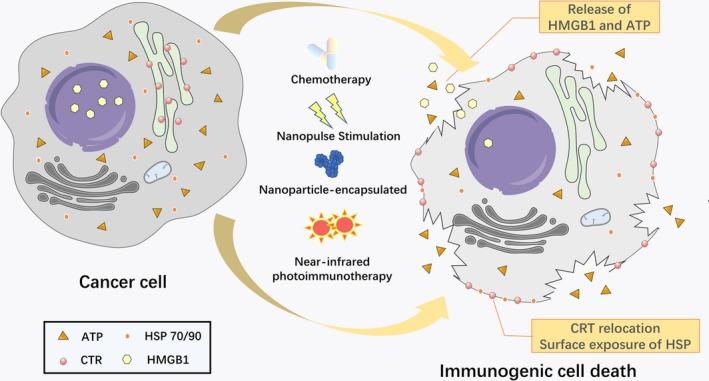
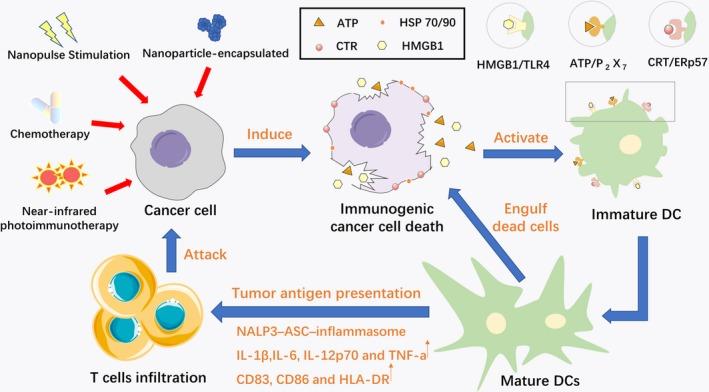
In the tumour microenvironment (TME), immunogenic cell death (ICD) plays a major role in stimulating the dysfunctional antitumour immune system. Chronic exposure of damage-associated molecular patterns (DAMPs) attracts receptors and ligands on dendritic cells (DCs) and activates immature DCs to transition to a mature phenotype, which promotes the processing of phagocytic cargo in DCs and accelerates the engulfment of antigenic components by DCs. Consequently, via antigen presentation, DCs stimulate specific T cell responses that kill more cancer cells. The induction of ICD eventually results in long-lasting protective antitumour immunity. Through the exploration of ICD inducers, recent studies have shown that there are many novel modalities with the ability to induce immunogenic cancer cell death. In this review, we mainly discussed and summarized the emerging methods for inducing immunogenic cancer cell death. Concepts and molecular mechanisms relevant to antitumour effects of ICD are also briefly discussed.
在肿瘤微环境 (TME) 中,免疫原性细胞死亡 (ICD) 在刺激功能失调的抗肿瘤免疫中起着重要作用。损伤相关分子模式 (DAMPs) 的慢性暴露会吸引树突状细胞 (DC) 上的受体和配体,并激活未成熟的 DC 向成熟表型转变,这促进了 DC 中吞噬性货物的处理,并加速了 DC 对抗原性成分的吞噬。因此,通过抗原呈递,DC 刺激特异性 T 细胞反应,杀死更多的癌细胞。ICD 的诱导最终导致持久的保护性抗肿瘤免疫。通过对 ICD 诱导剂的探索,最近的研究表明,有许多新的方法能够诱导免疫原性的癌细胞死亡。在这篇综述中,我们主要讨论和总结了诱导免疫原性癌细胞死亡的新方法。同时也简要讨论了与 ICD 抗肿瘤作用相关的概念和分子机制。

 Zotero 插件