
突触处病理 tau 与小胶质细胞的交汇。
Intersection of pathological tau and microglia at the synapse.
机构信息
Axon Neuroscience R&D Services SE, Bratislava, Slovak Republic.
Institute of Neuroimmunology, Slovak Academy of Sciences, Bratislava, Slovak Republic.
出版信息
Acta Neuropathol Commun. 2019 Jul 5;7(1):109. doi: 10.1186/s40478-019-0754-y.
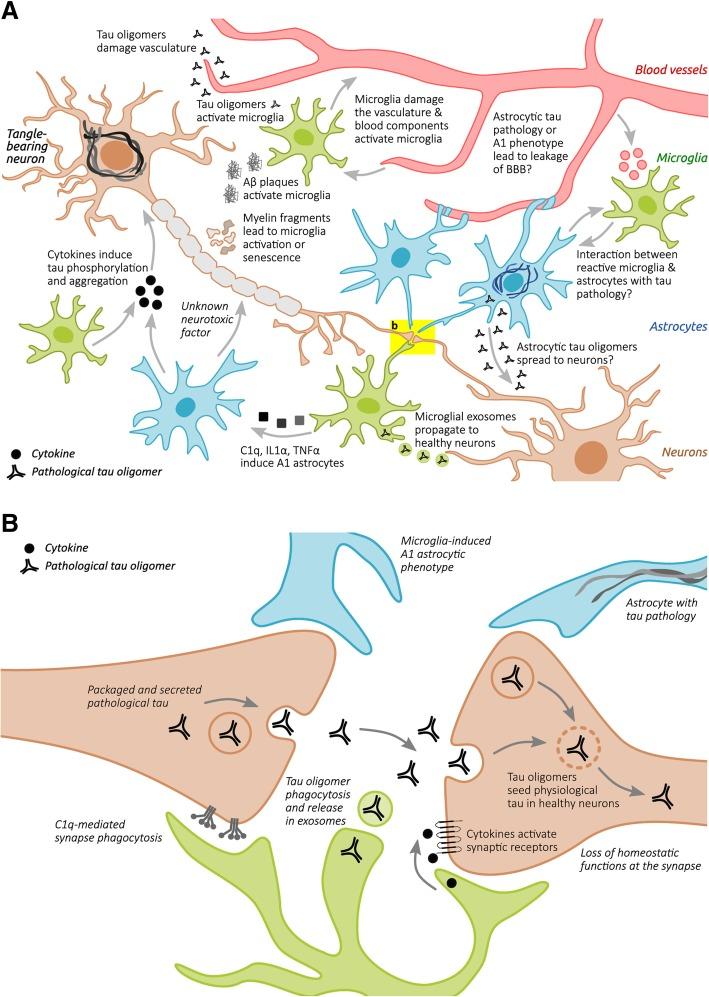
Tauopathies are a heterogenous class of diseases characterized by cellular accumulation of aggregated tau and include diseases such as Alzheimer's disease (AD), progressive supranuclear palsy and chronic traumatic encephalopathy. Tau pathology is strongly linked to neurodegeneration and clinical symptoms in tauopathy patients. Furthermore, synapse loss is an early pathological event in tauopathies and is the strongest correlate of cognitive decline. Tau pathology is additionally associated with chronic neuroinflammatory processes, such as reactive microglia, astrocytes, and increased levels of pro-inflammatory molecules (e.g. complement proteins, cytokines). Recent studies show that as the principal immune cells of the brain, microglia play a particularly important role in the initiation and progression of tau pathology and associated neurodegeneration. Furthermore, AD risk genes such as Triggering receptor expressed on myeloid cells 2 (TREM2) and Apolipoprotein E (APOE) are enriched in the innate immune system and modulate the neuroinflammatory response of microglia to tau pathology. Microglia can play an active role in synaptic dysfunction by abnormally phagocytosing synaptic compartments of neurons with tau pathology. Furthermore, microglia are involved in synaptic spreading of tau - a process which is thought to underlie the progressive nature of tau pathology propagation through the brain. Spreading of pathological tau is also the predominant target for tau-based immunotherapy. Active tau vaccines, therapeutic tau antibodies and other approaches targeting the immune system are actively explored as treatment options for AD and other tauopathies. This review describes the role of microglia in the pathobiology of tauopathies and the mechanism of action of potential therapeutics targeting the immune system in tauopathies.
tau 病是一类以细胞内聚集的 tau 为特征的异质性疾病,包括阿尔茨海默病 (AD)、进行性核上性麻痹和慢性创伤性脑病等疾病。tau 病理学与 tau 病患者的神经退行性变和临床症状密切相关。此外,突触丧失是 tau 病的早期病理事件,是认知能力下降的最强相关因素。tau 病理学还与慢性神经炎症过程有关,如反应性小胶质细胞、星形胶质细胞和促炎分子(如补体蛋白、细胞因子)水平升高。最近的研究表明,小胶质细胞作为大脑的主要免疫细胞,在 tau 病理学的发生和进展以及相关的神经退行性变中起着特别重要的作用。此外,AD 风险基因,如髓样细胞触发受体 2 (TREM2) 和载脂蛋白 E (APOE),在先天免疫系统中富集,并调节小胶质细胞对 tau 病理学的神经炎症反应。小胶质细胞可以通过异常吞噬具有 tau 病理学的神经元的突触区,在突触功能障碍中发挥积极作用。此外,小胶质细胞参与 tau 的突触传播,这一过程被认为是 tau 病理学通过大脑传播的进行性的基础。病理性 tau 的传播也是基于 tau 的免疫疗法的主要靶点。活性 tau 疫苗、治疗性 tau 抗体和其他针对免疫系统的方法被积极探索作为 AD 和其他 tau 病的治疗选择。本综述描述了小胶质细胞在 tau 病发病机制中的作用以及针对 tau 病免疫系统的潜在治疗方法的作用机制。

 Zotero 插件