
人类贸易引入新宿主塑造了刚地弓形虫谱系的现存分布。
The introduction of new hosts with human trade shapes the extant distribution of Toxoplasma gondii lineages.
机构信息
INSERM, Univ. Limoges, CHU Limoges, UMR 1094, Tropical Neuroepidemiology, Institute of Epidemiology and Tropical Neurology, GEIST, Limoges, France.
CBGP, IRD, CIRAD, INRA, Montpellier SupAgro, Univ. Montpellier, Cedex, France.
出版信息
PLoS Negl Trop Dis. 2019 Jul 11;13(7):e0007435. doi: 10.1371/journal.pntd.0007435. eCollection 2019 Jul.
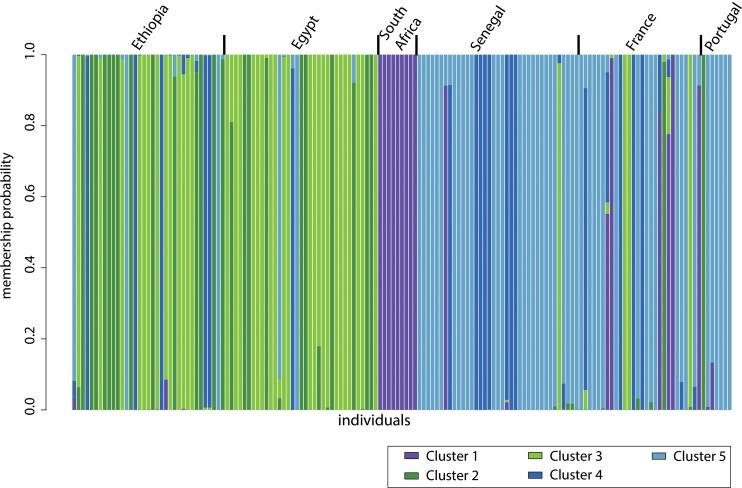
Toxoplasma gondii is a zoonotic protozoan with a worldwide occurrence, but the determinants of the current pattern in the geographical distribution of T. gondii lineages and strains remain poorly understood. To test the influence of human trade on T. gondii populations, we conducted a population genetic study of 72 T. gondii animal isolates from Senegal, a West African country in which the ongoing inland progress of invasive murine hosts (introduced in port cities of Senegal since the 16th century by European sailors) is well described. Isolates were mainly collected on free-range poultry, which are considered as relevant bioindicators of T. gondii strain diversity in the domestic environment. Sampling was conducted in two port cities of Senegal (Dakar and Saint-Louis) and in one inland region (Kedougou). Population genetic analyses using 15 microsatellite markers revealed different patterns between port cities where lineages non-virulent for mice (type II, type III, and Africa 4) were predominant, and Kedougou where the mouse-virulent Africa 1 lineage was the most common. By considering the current spatial pattern in the inland progress of invasive rodents in Senegal, our results suggest that the invasive house mouse Mus musculus domesticus counter-selects the Africa 1 lineage in the invaded areas. The comparison of the microsatellite alleles of type II strains from Senegal to type II strains from other areas in Africa and Western Europe, using discriminant analysis of principal components and Network analysis, point to a mainly Western European origin of the type II lineage in Senegal. Collectively, these findings suggest that human-mediated intercontinental migrations of murine hosts are important vectors of T. gondii strains. Differential susceptibility of endemic and introduced murine hosts to various T. gondii strains probably determines the persistence of these strains in the environment, and therefore their availability for human and animal infection.
刚地弓形虫是一种全球性分布的动物源性原虫,但目前关于弓形虫谱系和菌株地理分布模式的决定因素仍知之甚少。为了检验人类贸易对弓形虫种群的影响,我们对来自塞内加尔的 72 个弓形虫动物分离株进行了种群遗传研究,塞内加尔是一个西非国家,入侵的鼠类宿主(自 16 世纪以来,由欧洲水手在塞内加尔的港口城市引入)在内陆的持续推进情况已有详细描述。分离株主要采集于散养家禽,这些家禽被认为是家庭环境中弓形虫菌株多样性的相关生物标志物。采样在塞内加尔的两个港口城市(达喀尔和圣路易)和一个内陆地区(凯杜古)进行。使用 15 个微卫星标记进行种群遗传分析显示,在港口城市(流行对鼠类不致病的谱系 II、III 和非洲 4)和内陆的凯杜古(流行对鼠类致病的非洲 1 谱系)之间存在不同的模式。考虑到入侵啮齿动物在内陆推进的当前空间模式,我们的研究结果表明,入侵的家鼠 Mus musculus domesticus 在入侵地区对非洲 1 谱系产生了反选择。使用主成分判别分析和网络分析,对来自塞内加尔的 II 型菌株的微卫星等位基因与来自非洲和西欧其他地区的 II 型菌株进行比较,结果表明塞内加尔的 II 型谱系主要来自西欧。综合这些发现表明,人类介导的啮齿动物宿主的洲际迁移是弓形虫菌株的重要载体。地方性和引入性鼠类宿主对各种弓形虫菌株的不同敏感性可能决定了这些菌株在环境中的持久性,因此也决定了它们对人类和动物感染的可用性。


 Zotero 插件