
吸烟不会加速白细胞端粒损耗:18个纵向队列的荟萃分析。
Smoking does not accelerate leucocyte telomere attrition: a meta-analysis of 18 longitudinal cohorts.
作者信息
Bateson Melissa, Aviv Abraham, Bendix Laila, Benetos Athanase, Ben-Shlomo Yoav, Bojesen Stig E, Cooper Cyrus, Cooper Rachel, Deary Ian J, Hägg Sara, Harris Sarah E, Kark Jeremy D, Kronenberg Florian, Kuh Diana, Labat Carlos, Martin-Ruiz Carmen M, Meyer Craig, Nordestgaard Børge G, Penninx Brenda W J H, Pepper Gillian V, Révész Dóra, Said M Abdullah, Starr John M, Syddall Holly, Thomson William Murray, van der Harst Pim, Whooley Mary, von Zglinicki Thomas, Willeit Peter, Zhan Yiqiang, Nettle Daniel
机构信息
Centre for Behaviour and Evolution and Institute of Neuroscience, Newcastle University, Newcastle upon Tyne NE2 4HH, UK.
Center of Human Development and Aging, New Jersey Medical School, Rutgers University, Newark, NJ 07103, USA.
出版信息
R Soc Open Sci. 2019 Jun 5;6(6):190420. doi: 10.1098/rsos.190420. eCollection 2019 Jun.
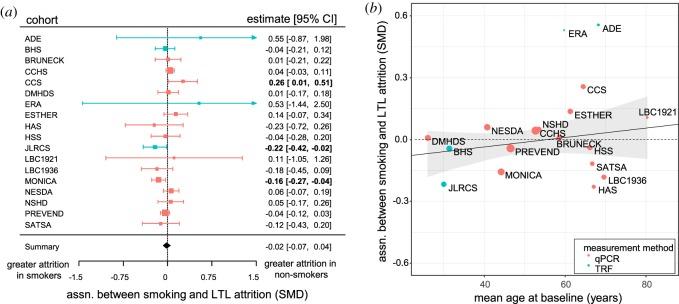
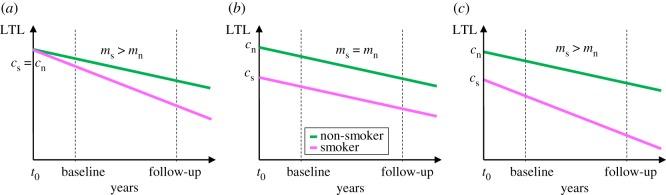
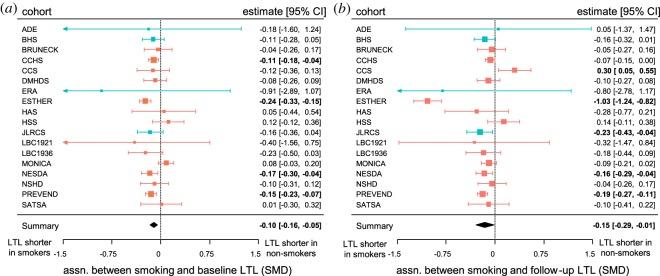
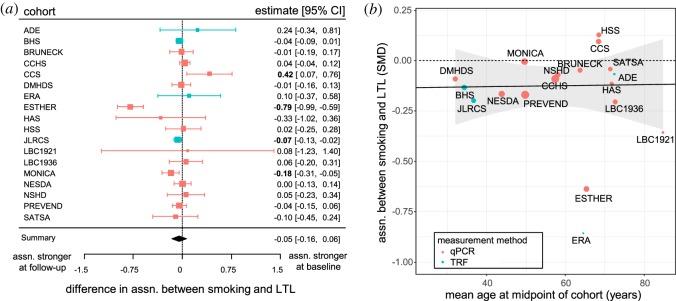
Smoking is associated with shorter leucocyte telomere length (LTL), a biomarker of increased morbidity and reduced longevity. This association is widely interpreted as evidence that smoking causes accelerated LTL attrition in adulthood, but the evidence for this is inconsistent. We analysed the association between smoking and LTL dynamics in 18 longitudinal cohorts. The dataset included data from 12 579 adults (4678 current smokers and 7901 non-smokers) over a mean follow-up interval of 8.6 years. Meta-analysis confirmed a cross-sectional difference in LTL between smokers and non-smokers, with mean LTL 84.61 bp shorter in smokers (95% CI: 22.62 to 146.61). However, LTL attrition was only 0.51 bp yr faster in smokers than in non-smokers (95% CI: -2.09 to 1.08), a difference that equates to only 1.32% of the estimated age-related loss of 38.33 bp yr. Assuming a linear effect of smoking, 167 years of smoking would be required to generate the observed cross-sectional difference in LTL. Therefore, the difference in LTL between smokers and non-smokers is extremely unlikely to be explained by a linear, causal effect of smoking. Selective adoption, whereby individuals with short telomeres are more likely to start smoking, needs to be considered as a more plausible explanation for the observed pattern of telomere dynamics.
吸烟与较短的白细胞端粒长度(LTL)相关,LTL是发病率增加和寿命缩短的生物标志物。这种关联被广泛解释为吸烟导致成年期LTL加速损耗的证据,但支持这一观点的证据并不一致。我们分析了18个纵向队列中吸烟与LTL动态变化之间的关联。数据集包括12579名成年人(4678名当前吸烟者和7901名非吸烟者)的数据,平均随访间隔为8.6年。荟萃分析证实吸烟者与非吸烟者之间LTL存在横断面差异,吸烟者的平均LTL短84.61个碱基对(95%置信区间:22.62至146.61)。然而,吸烟者的LTL损耗仅比非吸烟者每年快0.51个碱基对(95%置信区间:-2.09至1.08),这一差异仅相当于估计的每年38.33个碱基对的与年龄相关损耗的1.32%。假设吸烟具有线性效应,要产生观察到的LTL横断面差异需要167年的吸烟时间。因此,吸烟者与非吸烟者之间LTL的差异极不可能由吸烟的线性因果效应来解释。需要考虑选择性采纳这一因素,即端粒较短的个体更有可能开始吸烟,这是对观察到的端粒动态变化模式更合理的解释。
 Zotero 插件