
解整合素金属蛋白酶 8 作为一种潜在的胃癌早期诊断的血液生物标志物。
A Disintegrin and Metalloproteinase 8 as a Potential Blood Biomarker for Early Diagnosis of Gastric Cancer.
机构信息
Department of Laboratory Medicine, Gangnam Severance Hospital, Yonsei University College of Medicine, Seoul, Korea.
出版信息
Yonsei Med J. 2019 Aug;60(8):713-719. doi: 10.3349/ymj.2019.60.8.713.
PURPOSE
We aimed to evaluate the clinical significance of a disintegrin and metalloproteinase 8 (ADAM 8) as a potential blood biomarker for gastric cancer (GC).
MATERIALS AND METHODS
Blood ADAM 8 was measured by ELISA. Cytokines/chemokines [interleukin-23 (IL-23), stromal cell-derived factor 1α/CXC chemokine ligand 12 (SDF-1α/CXCL12), interleukin-8 (IL-8), and soluble CD40 ligand (sCD40L)] were measured by chemiluminescent immunoassay. They were compared among five groups; normal/gastritis, high-risk, early GC (EGC), advanced GC (AGC) without distant metastasis, and AGC with distant metastasis by one-way analysis of variance in both training (n=80) and validation dataset (n=241). Clinicopathological features of GC and GC-associated cytokines were evaluated for their correlations with blood ADAM 8. To evaluate the diagnostic accuracy to predict GC, receiver operating characteristic (ROC) curve and logistic regression were used.
RESULTS
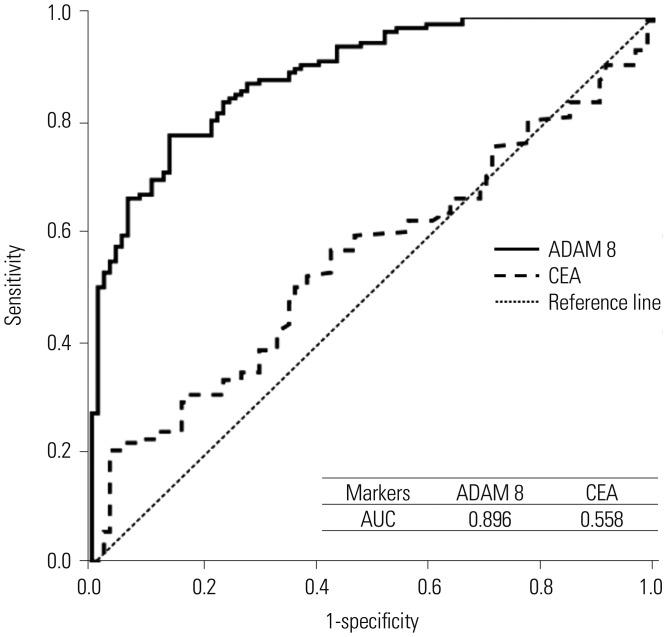
Blood ADAM 8 significantly increased along GC carcinogenesis in both training (ANOVA, <0.001) and validation dataset (<0.001). It was significantly higher in EGC compared to high-risk (post-hoc Bonferroni, =0.041) and normal (<0.001). It was also higher in AGC compared with high-risk (<0.001) and normal (<0.001) groups. However, no significant difference was found between cancer groups. Blood ADAM 8 was correlated with N-stage (Spearman's correlation, γ=0.320, =0.011), but not with T-stage or M-stage. Pearson's correlations showed blood ADAM 8 was closely correlated with pre-inflammatory cytokines, IL-23 (=0.036) and SDF-1α/CXCL12 (=0.037); however, it was not correlated with pro-angiogenic cytokine IL-8 (=0.313), and sCD40L (=0.702). ROC curve and logistic regression demonstrated that blood ADAM 8 showed higher diagnostic accuracy (sensitivity, 73.7%; specificity, 86.2%) than CEA (sensitivity, 23.1%; specificity, 91.4%). Combination of ADAM 8 and CEA further increased the diagnostic accuracy to predict GC (sensitivity, 81.8%; specificity, 84.0%).
CONCLUSION
Blood ADAM 8 is a promising biomarker for early detection of GC.
目的
我们旨在评估解整合素金属蛋白酶 8(ADAM8)作为一种潜在的胃癌(GC)血液生物标志物的临床意义。
材料和方法
通过 ELISA 测定血液 ADAM8。通过化学发光免疫测定测定细胞因子/趋化因子[白细胞介素-23(IL-23)、基质细胞衍生因子 1α/CXC 趋化因子配体 12(SDF-1α/CXCL12)、白细胞介素-8(IL-8)和可溶性 CD40 配体(sCD40L)]。通过单向方差分析在训练集(n=80)和验证数据集(n=241)中比较了五组人群(正常/胃炎、高危、早期 GC(EGC)、晚期 GC(AGC)无远处转移和 AGC 伴远处转移)。评估 GC 的临床病理特征和与 GC 相关的细胞因子与血液 ADAM8 的相关性。为了评估预测 GC 的诊断准确性,使用了接收者操作特征(ROC)曲线和逻辑回归。
结果
血液 ADAM8 在 GC 发生过程中呈显著增加趋势在训练集(方差分析,<0.001)和验证数据集(<0.001)中。与高危(事后 Bonferroni,=0.041)和正常(<0.001)相比,EGC 中 ADAM8 明显升高。与高危(<0.001)和正常(<0.001)相比,AGC 中 ADAM8 也升高。然而,癌症组之间没有发现显著差异。血液 ADAM8 与 N 期(Spearman 相关,γ=0.320,=0.011)相关,但与 T 期或 M 期不相关。Pearson 相关性表明血液 ADAM8 与前炎症细胞因子 IL-23(=0.036)和 SDF-1α/CXCL12(=0.037)密切相关;然而,它与促血管生成细胞因子 IL-8(=0.313)和 sCD40L(=0.702)不相关。ROC 曲线和逻辑回归表明,血液 ADAM8 比癌胚抗原(CEA)(敏感性,73.7%;特异性,86.2%)具有更高的诊断准确性。ADAM8 和 CEA 的联合进一步提高了预测 GC 的诊断准确性(敏感性,81.8%;特异性,84.0%)。
结论
血液 ADAM8 是一种很有前途的 GC 早期检测生物标志物。
 Zotero 插件