
甲硫氨酸代谢与甲基转移酶在跨物种衰老调控及寿命延长中的作用
Methionine metabolism and methyltransferases in the regulation of aging and lifespan extension across species.
作者信息
Parkhitko Andrey A, Jouandin Patrick, Mohr Stephanie E, Perrimon Norbert
机构信息
Department of Genetics, Blavatnik Institute, Harvard Medical School, Boston, Massachusetts.
Howard Hughes Medical Institute, Boston, Massachusetts.
出版信息
Aging Cell. 2019 Dec;18(6):e13034. doi: 10.1111/acel.13034. Epub 2019 Aug 28.
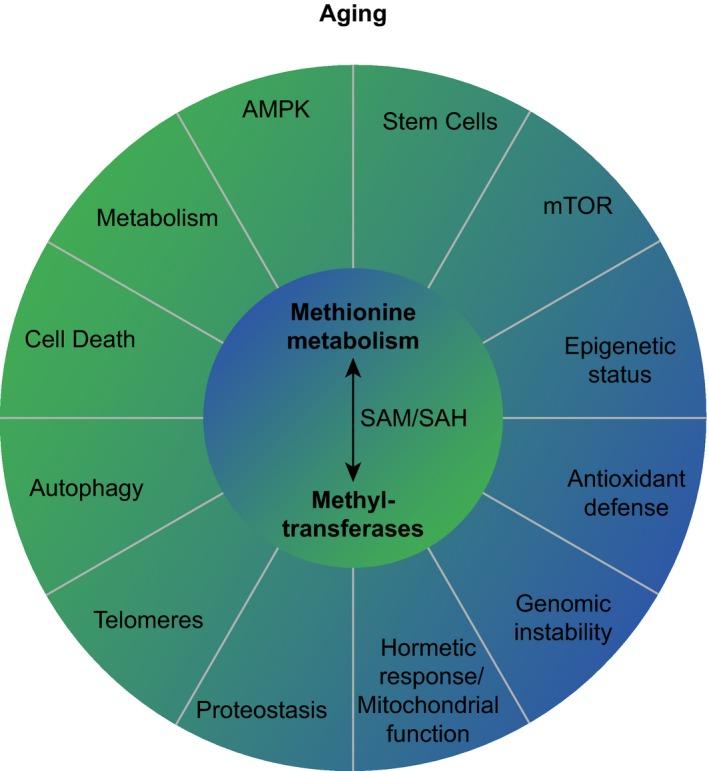
Methionine restriction (MetR) extends lifespan across different species and exerts beneficial effects on metabolic health and inflammatory responses. In contrast, certain cancer cells exhibit methionine auxotrophy that can be exploited for therapeutic treatment, as decreasing dietary methionine selectively suppresses tumor growth. Thus, MetR represents an intervention that can extend lifespan with a complementary effect of delaying tumor growth. Beyond its function in protein synthesis, methionine feeds into complex metabolic pathways including the methionine cycle, the transsulfuration pathway, and polyamine biosynthesis. Manipulation of each of these branches extends lifespan; however, the interplay between MetR and these branches during regulation of lifespan is not well understood. In addition, a potential mechanism linking the activity of methionine metabolism and lifespan is regulation of production of the methyl donor S-adenosylmethionine, which, after transferring its methyl group, is converted to S-adenosylhomocysteine. Methylation regulates a wide range of processes, including those thought to be responsible for lifespan extension by MetR. Although the exact mechanisms of lifespan extension by MetR or methionine metabolism reprogramming are unknown, it may act via reducing the rate of translation, modifying gene expression, inducing a hormetic response, modulating autophagy, or inducing mitochondrial function, antioxidant defense, or other metabolic processes. Here, we review the mechanisms of lifespan extension by MetR and different branches of methionine metabolism in different species and the potential for exploiting the regulation of methyltransferases to delay aging.
甲硫氨酸限制(MetR)可延长不同物种的寿命,并对代谢健康和炎症反应产生有益影响。相比之下,某些癌细胞表现出甲硫氨酸营养缺陷,这可用于治疗,因为减少饮食中的甲硫氨酸可选择性抑制肿瘤生长。因此,MetR是一种既能延长寿命又具有延缓肿瘤生长互补作用的干预措施。除了在蛋白质合成中的作用外,甲硫氨酸还参与复杂的代谢途径,包括甲硫氨酸循环、转硫途径和多胺生物合成。对这些分支中的每一个进行调控都能延长寿命;然而,在寿命调控过程中,MetR与这些分支之间的相互作用尚不清楚。此外,将甲硫氨酸代谢活性与寿命联系起来的一个潜在机制是对甲基供体S-腺苷甲硫氨酸产生的调控,S-腺苷甲硫氨酸在转移甲基后会转化为S-腺苷同型半胱氨酸。甲基化调节广泛的过程,包括那些被认为是MetR延长寿命所负责的过程。尽管MetR或甲硫氨酸代谢重编程延长寿命的确切机制尚不清楚,但它可能通过降低翻译速率、修饰基因表达、诱导应激反应、调节自噬或诱导线粒体功能、抗氧化防御或其他代谢过程来发挥作用。在这里,我们综述了MetR和甲硫氨酸代谢不同分支在不同物种中延长寿命的机制,以及利用甲基转移酶调控来延缓衰老的潜力。


 Zotero 插件