
特发性肺纤维化患者抗纤维化药物的药物维持率和停药预测因素:一项真实世界的观察性研究。
Medication persistence rates and predictive factors for discontinuation of antifibrotic agents in patients with idiopathic pulmonary fibrosis: a real-world observational study.
机构信息
Department of Medicine and Clinical Science, Graduate School of Medicine, Yamaguchi University, 1-1-1 Minami-kogushi, Ube, Yamaguchi, 755-8505, Japan.
Department of Respiratory Medicine and Infectious Disease, Graduate School of Medicine, Yamaguchi University, Ube, Japan.
出版信息
Ther Adv Respir Dis. 2019 Jan-Dec;13:1753466619872890. doi: 10.1177/1753466619872890.
BACKGROUND
In patients with idiopathic pulmonary fibrosis (IPF), continuing treatment with antifibrotic agents is crucial to decrease the reduction of forced vital capacity and mortality rate. However, predictive factors for the discontinuation of antifibrotic agents are unknown. This study aims to investigate the clinical characteristics and predictive factors for the discontinuation of antifibrotic agents in patients with IPF.
METHODS
This was a double-center retrospective study that enrolled patients with IPF treated with pirfenidone or nintedanib between 2009 and 2017. We compared clinical parameters between the medication-continuing group and the discontinued group. The predictive factors were determined using Cox proportional hazards analyses.
RESULTS
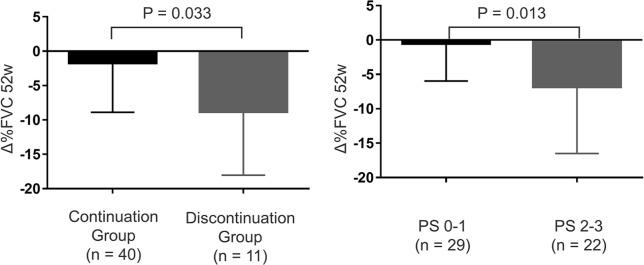
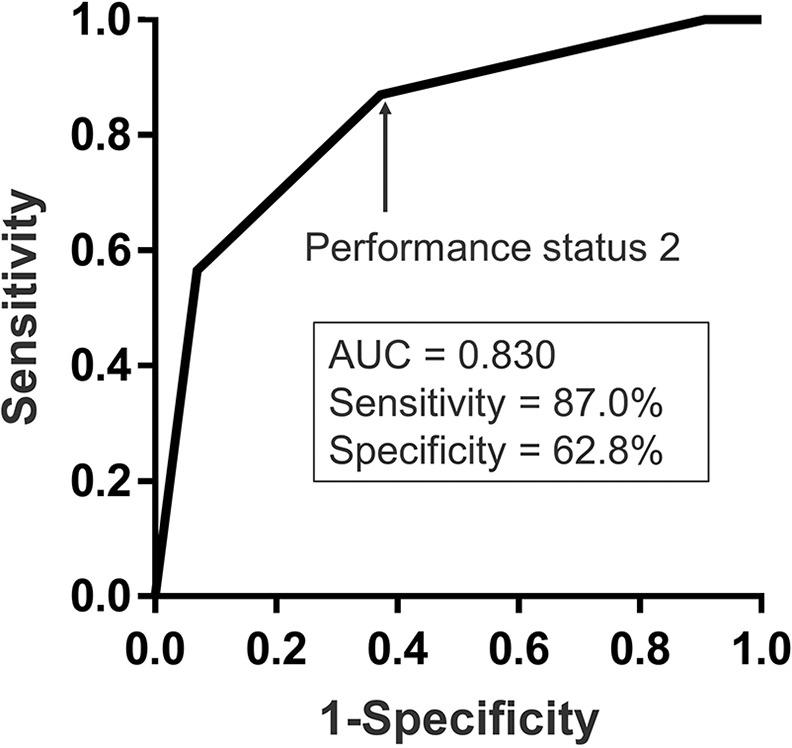
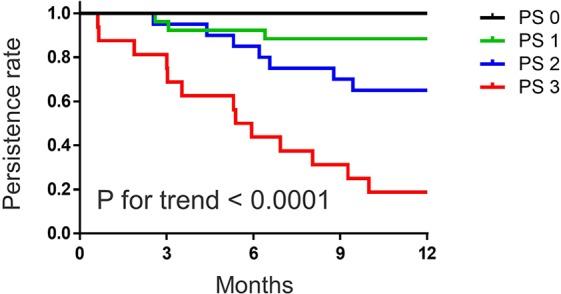
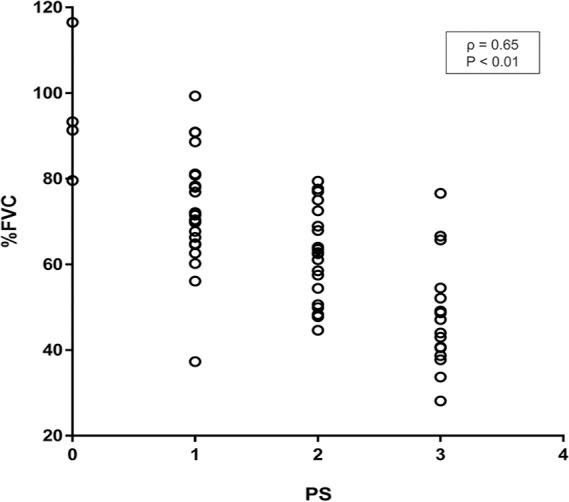
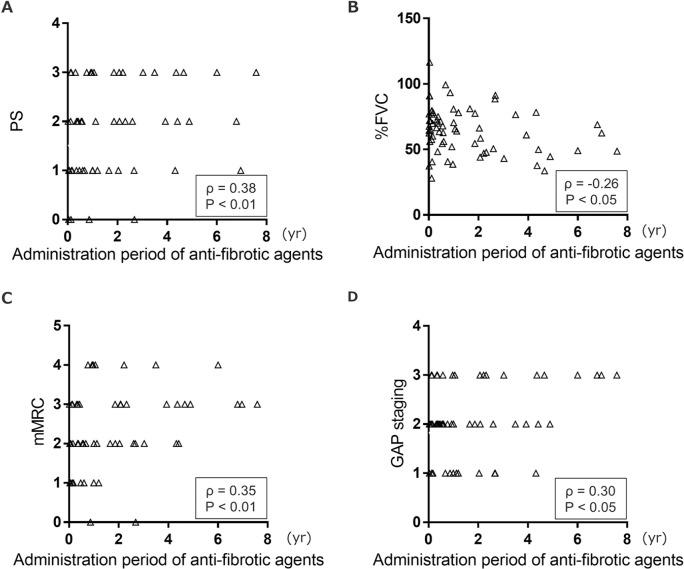
A total of 66 subjects were included: 43 received pirfenidone and 23 received nintedanib. At 1 year, 23 of 66 patients had discontinued due to adverse events ( = 12), disease progression ( = 9), or death ( = 2). The characteristics of the discontinuation group were poor performance status (PS) and delay from diagnosis to treatment. In the receiver operating characteristic (ROC) analysis associated with the discontinuation of antifibrotic agents, PS was the highest area under the ROC curve (AUC) value (cut-off value, 2; AUC, 0.83; specificity, 63%; sensitivity, 87%). This finding was consistent even when analyzing, except for examples of death and adjusting for the type of antifibrotic agent. The treatment persistence rate by PS was PS 0-1 = 90%, PS 2 = 65%, and PS 3 = 19%. Analysis of the relationship between PS and administration period of antifibrotic agents revealed that delays from diagnosis to treatment led to worsening of dyspnea, a decline in lung function, and deterioration of PS.
CONCLUSIONS
PS may be informative for predicting discontinuation of medication. Our data reinforced the importance of early initiation of antifibrotic treatment, and we suggest PS should be used as a guide for starting antifibrotic agents in everyday practice.
背景
在特发性肺纤维化(IPF)患者中,继续使用抗纤维化药物对于降低用力肺活量下降率和死亡率至关重要。然而,抗纤维化药物停药的预测因素尚不清楚。本研究旨在探讨 IPF 患者抗纤维化药物停药的临床特征和预测因素。
方法
这是一项双中心回顾性研究,纳入了 2009 年至 2017 年期间接受吡非尼酮或尼达尼布治疗的 IPF 患者。我们比较了药物继续组和停药组之间的临床参数。使用 Cox 比例风险分析确定预测因素。
结果
共纳入 66 例患者:43 例接受吡非尼酮治疗,23 例接受尼达尼布治疗。在 1 年时,66 例患者中有 23 例因不良事件(n=12)、疾病进展(n=9)或死亡(n=2)停药。停药组的特征是较差的表现状态(PS)和从诊断到治疗的延迟。在与抗纤维化药物停药相关的受试者工作特征(ROC)分析中,PS 的 ROC 曲线下面积(AUC)值最高(截断值,2;AUC,0.83;特异性,63%;敏感性,87%)。即使在分析时排除死亡病例并调整抗纤维化药物的类型,结果仍然一致。根据 PS 进行的治疗持续率为 PS 0-1=90%,PS 2=65%,PS 3=19%。PS 与抗纤维化药物使用期间的关系分析表明,从诊断到治疗的延迟导致呼吸困难恶化、肺功能下降和 PS 恶化。
结论
PS 可能有助于预测停药。我们的数据强化了早期开始抗纤维化治疗的重要性,我们建议 PS 应作为日常实践中开始抗纤维化药物的指导。

 Zotero 插件