
膜处理去除微塑料。
Membrane Processes for Microplastic Removal.
机构信息
National Research Council-Institute on Membrane Technology (ITM-CNR) c/o University of Calabria, Cubo 17C, Via Pietro BUCCI, 87036 Rende (CS), Italy.
出版信息
Molecules. 2019 Nov 15;24(22):4148. doi: 10.3390/molecules24224148.
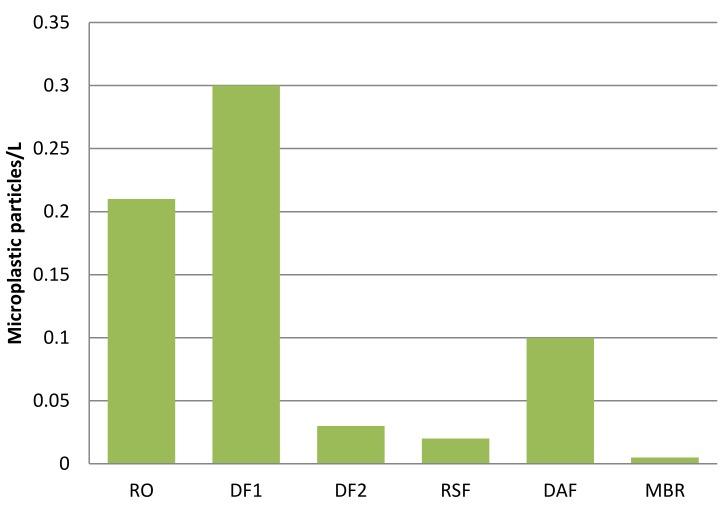
Plastic pollution of the aquatic environment is a major concern considering the disastrous impact on the environment and on human beings. The significant and continuous increase in the production of plastics causes an enormous amount of plastic waste on the land entering the aquatic environment. Furthermore, wastewater treatment plants (WWTPs) are reported as the main source of microplastic and nanoplastic in the effluents, since they are not properly designed for this purpose. The application of advanced wastewater treatment technologies is mandatory to avoid effluent contamination by plastics. A concrete solution can be represented by membrane technologies as tertiary treatment of effluents in integrated systems for wastewater treatment, in particular, for the plastic particles with a smaller size (< 100 nm). In this review, a survey of the membrane processes applied in the plastic removal is analyzed and critically discussed. From the literature analysis, it was found that the removal of microplastic by membrane technology is still insufficient, and without the use of specially designed approaches, with the exception of membrane bioreactors (MBRs).
考虑到对环境和人类造成的灾难性影响,水环境污染中的塑料污染是一个主要关注点。塑料产量的显著且持续增加导致大量陆地塑料垃圾进入水生态环境。此外,污水处理厂(WWTP)被报道为废水中微塑料和纳米塑料的主要来源,因为它们并非为此目的而专门设计。必须应用先进的废水处理技术以避免废水受塑料污染。膜技术可以作为集成废水处理系统中的三级处理方法,为具体解决这个问题提供了一个切实可行的方案,特别是针对较小尺寸(<100nm)的塑料颗粒。在本综述中,分析并批判性地讨论了应用于去除塑料的膜工艺。从文献分析中发现,膜技术去除微塑料的效果仍然不足,而且如果不采用专门设计的方法,除了膜生物反应器(MBR)之外,效果都不太理想。



 Zotero 插件