
评估马拉维地区和中心医院治疗成人骨干外伤性股骨干骨折的能力。
Assessing the capacity of Malawi's district and central hospitals to manage traumatic diaphyseal femoral fractures in adults.
机构信息
Harvard Combined Orthopaedic Residency Program, Boston, MA, United States of America.
The Orthopaedic and Arthritis Center for Outcomes Research, Brigham and Women's Hospital, Boston, MA, United States of America.
出版信息
PLoS One. 2019 Nov 20;14(11):e0225254. doi: 10.1371/journal.pone.0225254. eCollection 2019.
BACKGROUND
The burden of musculoskeletal trauma is growing worldwide, disproportionately affecting low-income countries like Malawi. However, resources required to manage musculoskeletal trauma remain inadequate. A detailed understanding of the current capacity of Malawian public hospitals to manage musculoskeletal trauma is unknown and necessary for effective trauma system development planning.
METHODS
We developed a list of infrastructure, manpower, and material resources used during treatment of adult femoral shaft fractures-a representative injury managed non-operatively and operatively in Malawi. We identified, by consensus of at least 7 out of 10 experts, which items were essential at district and central hospitals. We surveyed orthopaedic providers in person at all 25 district and 4 central hospitals in Malawi on the presence, availability, and reasons for unavailability of essential resources. We validated survey responses by performing simultaneous independent on-site assessments of 25% of the hospitals.
RESULTS
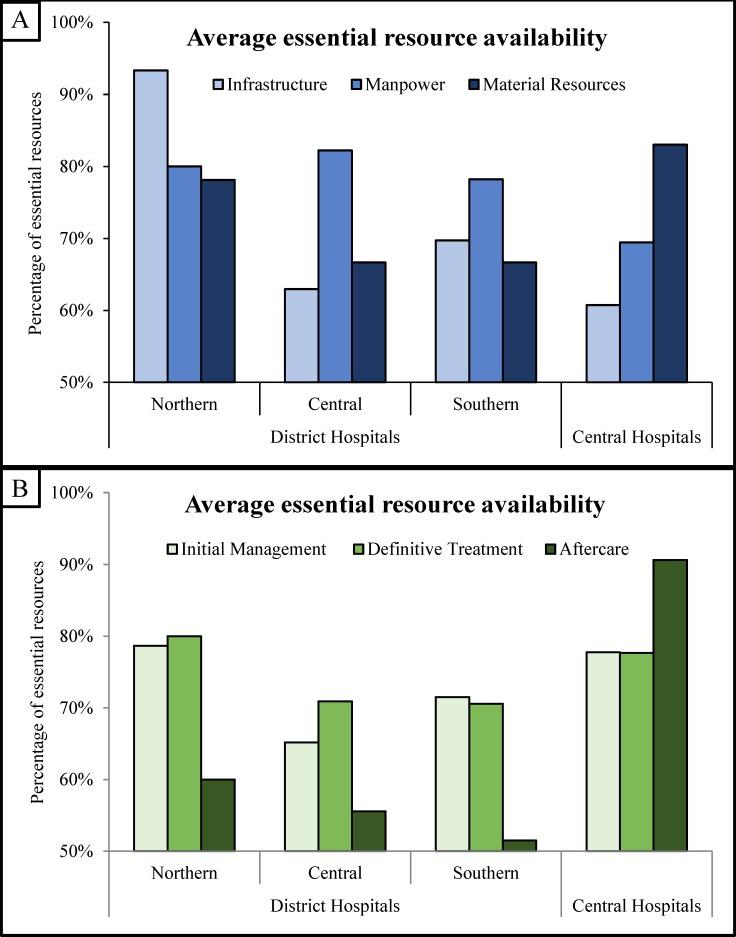
No district or central hospital in Malawi had available all the essential resources to adequately manage femoral fractures. On average, district hospitals had 71% (range 41-90%) of essential resources, with at least 15 of 25 reporting unavailability of inpatient ward nurses, x-ray, external fixators, gauze and bandages, and walking assistive devices. District hospitals offered only non-operative treatment, though 24/25 reported barriers to performing skeletal traction. Central hospitals reported an average of 76% (71-85%) of essential resources, with at least 2 of 4 hospitals reporting unavailability of full blood count, inpatient hospital beds, a procedure room, an operating room, casualty/A&E department clinicians, orthopaedic clinicians, a circulating nurse, inpatient ward nurses, electrocardiograms, x-ray, suture, and walking assistive devices. All four central hospitals reported barriers to performing skeletal traction. Operative treatment of femur fracture with a reliable supply of implants was available at 3/4 hospitals, though 2/3 were dependent entirely on foreign donations.
CONCLUSION
We identified critical deficiencies in infrastructure, manpower, and essential resources at district and central hospitals in Malawi. Our findings provide evidence-based guidance on how to improve the musculoskeletal trauma system in Malawi, by identifying where and why essential resources were unavailable when needed.
背景
肌肉骨骼创伤的负担在全球范围内不断增加,对马拉维等低收入国家的影响尤为严重。然而,管理肌肉骨骼创伤所需的资源仍然不足。目前尚不清楚马拉维公立医院管理肌肉骨骼创伤的能力,这对于制定有效的创伤系统发展规划是必要的。
方法
我们制定了一份基础设施、人力和材料资源清单,用于治疗成人股骨干骨折-一种在马拉维非手术和手术治疗的代表性损伤。我们通过至少 7 位专家中的 10 位达成共识,确定了在地区和中心医院中哪些项目是必不可少的。我们在马拉维的所有 25 个地区医院和 4 个中心医院对骨科医生进行了实地调查,了解基本资源的存在、可用性以及不可用的原因。我们通过对 25%的医院进行同时的独立现场评估来验证调查结果。
结果
马拉维没有一家地区或中心医院拥有足够的基本资源来充分管理股骨干骨折。平均而言,地区医院拥有 71%(范围为 41-90%)的基本资源,至少有 25 家医院中有 15 家报告缺乏住院病房护士、X 光、外固定器、纱布和绷带以及助行器。地区医院仅提供非手术治疗,但 24/25 家医院报告了实施骨牵引的障碍。中心医院报告的基本资源平均为 76%(71-85%),至少有 2 家医院报告了全血细胞计数、住院病床、治疗室、手术室、急诊/急救部门医生、骨科医生、巡回护士、住院病房护士、心电图、X 光、缝线和助行器的不可用。四家中心医院均报告了实施骨牵引的障碍。三家中心医院提供了可信赖的植入物供应来治疗股骨骨折,但其中两家完全依赖外国捐赠。
结论
我们发现马拉维地区和中心医院在基础设施、人力和基本资源方面存在严重不足。我们的研究结果提供了循证指导,说明如何通过确定何时何地以及为何需要基本资源,但无法获得这些资源,从而改善马拉维的肌肉骨骼创伤系统。

 Zotero 插件