
嵌合抗原受体修饰的自然杀伤细胞治疗胶质母细胞瘤:将固有效应细胞转化为癌症免疫治疗的精准工具。
CAR-Engineered NK Cells for the Treatment of Glioblastoma: Turning Innate Effectors Into Precision Tools for Cancer Immunotherapy.
机构信息
Institute for Neurooncology, Goethe University, Frankfurt am Main, Germany.
Frankfurt Cancer Institute, Goethe University, Frankfurt am Main, Germany.
出版信息
Front Immunol. 2019 Nov 14;10:2683. doi: 10.3389/fimmu.2019.02683. eCollection 2019.
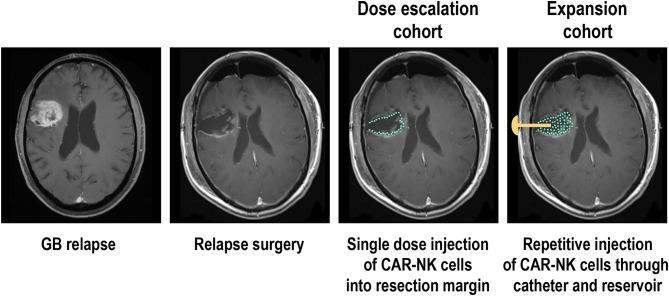
Glioblastoma (GB) is the most common and aggressive primary brain tumor in adults and currently incurable. Despite multimodal treatment regimens, median survival in unselected patient cohorts is <1 year, and recurrence remains almost inevitable. Escape from immune surveillance is thought to contribute to the development and progression of GB. While GB tumors are frequently infiltrated by natural killer (NK) cells, these are actively suppressed by the GB cells and the GB tumor microenvironment. Nevertheless, activation with cytokines can restore cytolytic activity of NK cells against GB, indicating that NK cells have potential for adoptive immunotherapy of GB if potent cytotoxicity can be maintained . NK cells contribute to cancer immune surveillance not only by their direct natural cytotoxicity which is triggered rapidly upon stimulation through germline-encoded cell surface receptors, but also by modulating T-cell mediated antitumor immune responses through maintaining the quality of dendritic cells and enhancing the presentation of tumor antigens. Furthermore, similar to T cells, specific recognition and elimination of cancer cells by NK cells can be markedly enhanced through expression of chimeric antigen receptors (CARs), which provides an opportunity to generate NK-cell therapeutics of defined specificity for cancer immunotherapy. Here, we discuss effects of the GB tumor microenvironment on NK-cell functionality, summarize early treatment attempts with activated NK cells, and describe relevant CAR target antigens validated with CAR-T cells. We then outline preclinical approaches that employ CAR-NK cells for GB immunotherapy, and give an overview on the ongoing clinical development of ErbB2 (HER2)-specific CAR-NK cells currently applied in a phase I clinical trial in glioblastoma patients.
胶质母细胞瘤(GB)是成人中最常见和侵袭性最强的原发性脑肿瘤,目前无法治愈。尽管采用了多模式治疗方案,但未经选择的患者队列的中位生存期<1 年,且复发几乎不可避免。逃避免疫监视被认为是导致 GB 发生和发展的原因之一。尽管 GB 肿瘤经常被自然杀伤(NK)细胞浸润,但这些细胞被 GB 细胞和 GB 肿瘤微环境积极抑制。尽管如此,通过细胞因子激活可以恢复 NK 细胞对 GB 的细胞毒性活性,表明 NK 细胞如果能够维持有效的细胞毒性,则具有用于 GB 过继免疫治疗的潜力。NK 细胞通过其直接的天然细胞毒性为癌症免疫监视做出贡献,这种细胞毒性在通过种系编码的细胞表面受体快速刺激后立即被触发,并且通过维持树突状细胞的质量和增强肿瘤抗原的呈递来调节 T 细胞介导的抗肿瘤免疫反应。此外,与 T 细胞类似,NK 细胞通过表达嵌合抗原受体(CAR)可以显著增强对癌细胞的特异性识别和消除,这为针对癌症免疫治疗生成具有明确特异性的 NK 细胞治疗提供了机会。在这里,我们讨论了 GB 肿瘤微环境对 NK 细胞功能的影响,总结了早期用激活的 NK 细胞进行的治疗尝试,并描述了用 CAR-T 细胞验证的相关 CAR 靶抗原。然后,我们概述了使用 CAR-NK 细胞进行 GB 免疫治疗的临床前方法,并概述了目前正在胶质母细胞瘤患者中进行的 I 期临床试验中应用的针对 ErbB2(HER2)的特异性 CAR-NK 细胞的临床开发情况。

 Zotero 插件