
miRNAs 与氧化应激在神经退行性疾病中的相互作用
Interplay between MicroRNAs and Oxidative Stress in Neurodegenerative Diseases.
机构信息
Institute of Biotechnology, HiLIFE, University of Helsinki, 00014 Helsinki, Finland.
Institute of Molecular Biology and Genetics, NASU, Kyiv 03143, Ukraine.
出版信息
Int J Mol Sci. 2019 Nov 30;20(23):6055. doi: 10.3390/ijms20236055.
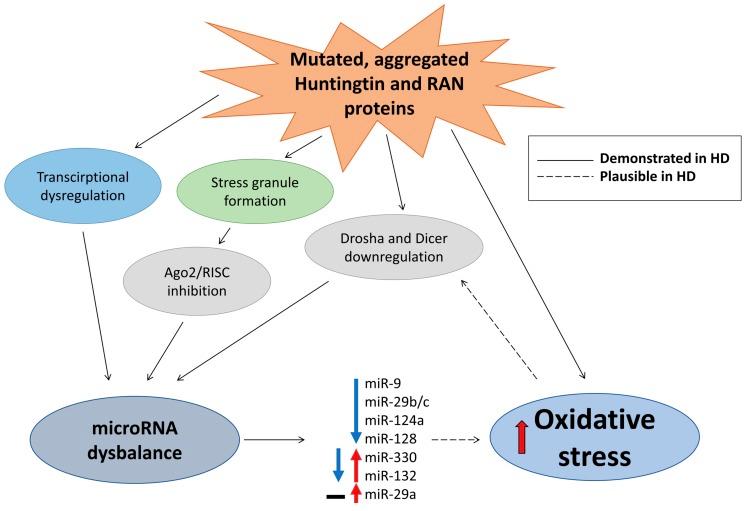
MicroRNAs are post-transcriptional regulators of gene expression, crucial for neuronal differentiation, survival, and activity. Age-related dysregulation of microRNA biogenesis increases neuronal vulnerability to cellular stress and may contribute to the development and progression of neurodegenerative diseases. All major neurodegenerative disorders are also associated with oxidative stress, which is widely recognized as a potential target for protective therapies. Albeit often considered separately, microRNA networks and oxidative stress are inextricably entwined in neurodegenerative processes. Oxidative stress affects expression levels of multiple microRNAs and, conversely, microRNAs regulate many genes involved in an oxidative stress response. Both oxidative stress and microRNA regulatory networks also influence other processes linked to neurodegeneration, such as mitochondrial dysfunction, deregulation of proteostasis, and increased neuroinflammation, which ultimately lead to neuronal death. Modulating the levels of a relatively small number of microRNAs may therefore alleviate pathological oxidative damage and have neuroprotective activity. Here, we review the role of individual microRNAs in oxidative stress and related pathways in four neurodegenerative conditions: Alzheimer's (AD), Parkinson's (PD), Huntington's (HD) disease, and amyotrophic lateral sclerosis (ALS). We also discuss the problems associated with the use of oversimplified cellular models and highlight perspectives of studying microRNA regulation and oxidative stress in human stem cell-derived neurons.
微小 RNA 是基因表达的转录后调控因子,对于神经元的分化、存活和活性至关重要。与年龄相关的微小 RNA 生物发生失调会增加神经元对细胞应激的易感性,并可能导致神经退行性疾病的发生和发展。所有主要的神经退行性疾病也与氧化应激有关,氧化应激被广泛认为是一种潜在的保护治疗靶点。尽管经常被分开考虑,但微小 RNA 网络和氧化应激在神经退行性过程中是不可分割地交织在一起的。氧化应激会影响多种微小 RNA 的表达水平,而反过来,微小 RNA 也调节许多参与氧化应激反应的基因。氧化应激和微小 RNA 调节网络也会影响与神经退行性变相关的其他过程,如线粒体功能障碍、蛋白质稳态失调和神经炎症增加,最终导致神经元死亡。因此,调节相对少数微小 RNA 的水平可能减轻病理性氧化损伤并具有神经保护活性。在这里,我们回顾了在四种神经退行性疾病(阿尔茨海默病(AD)、帕金森病(PD)、亨廷顿病(HD)和肌萎缩侧索硬化症(ALS))中,单个微小 RNA 在氧化应激和相关途径中的作用。我们还讨论了使用过于简化的细胞模型所带来的问题,并强调了在人类干细胞衍生神经元中研究微小 RNA 调节和氧化应激的前景。


 Zotero 插件