
急性髓系白血病中的 FLT3 突变:超越抑制剂开发的治疗范例。
FLT3 mutations in acute myeloid leukemia: Therapeutic paradigm beyond inhibitor development.
机构信息
Department of Hematology and Oncology, Nagoya University Graduate School of Medicine, Nagoya, Japan.
出版信息
Cancer Sci. 2020 Feb;111(2):312-322. doi: 10.1111/cas.14274. Epub 2019 Dec 30.
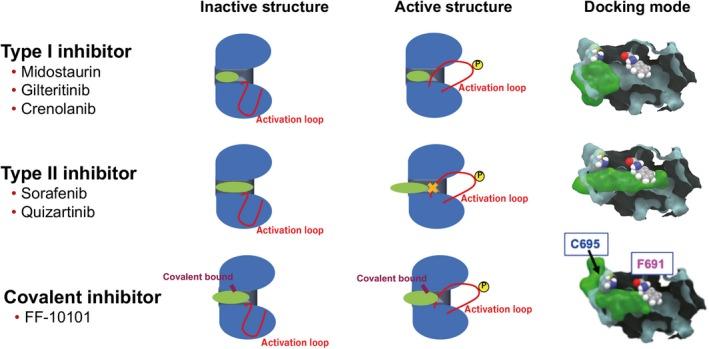
FMS-like tyrosine kinase 3 (FLT3) is a type III receptor tyrosine kinase that plays an important role in hematopoietic cell survival, proliferation and differentiation. The most clinically important point is that mutation of the FLT3 gene is the most frequent genetic alteration and a poor prognostic factor in acute myeloid leukemia (AML) patients. There are two major types of FLT3 mutations: internal tandem duplication mutations in the juxtamembrane domain (FLT3-ITD) and point mutations or deletion in the tyrosine kinase domain (FLT3-TKD). Both mutant FLT3 molecules are activated through ligand-independent dimerization and trans-phosphorylation. Mutant FLT3 induces the activation of multiple intracellular signaling pathways, mainly STAT5, MAPK and AKT signals, leading to cell proliferation and anti-apoptosis. Because high-dose chemotherapy and allogeneic hematopoietic stem cell transplantation cannot sufficiently improve the prognosis, clinical development of FLT3 kinase inhibitors expected. Although several FLT3 inhibitors have been developed, it takes more than 20 years from the first identification of FLT3 mutations until FLT3 inhibitors become clinically available for AML patients with FLT3 mutations. To date, three FLT3 inhibitors have been clinically approved as monotherapy or combination therapy with conventional chemotherapeutic agents in Japan and/or Europe and United states. However, several mechanisms of resistance to FLT3 inhibitors have already become apparent during their clinical trials. The resistance mechanisms are complex and emerging resistant clones are heterogenous. Further basic and clinical studies are required to establish the best therapeutic strategy for AML patients with FLT3 mutations.
FMS 样酪氨酸激酶 3(FLT3)是一种 III 型受体酪氨酸激酶,在造血细胞的存活、增殖和分化中发挥重要作用。最具临床意义的是,FLT3 基因的突变是急性髓系白血病(AML)患者中最常见的遗传改变和预后不良因素。FLT3 基因突变主要有两种类型:跨膜区(FLT3-ITD)内串联重复突变和酪氨酸激酶区(FLT3-TKD)点突变或缺失。两种突变的 FLT3 分子通过配体非依赖性二聚化和转磷酸化而被激活。突变的 FLT3 诱导多种细胞内信号通路的激活,主要是 STAT5、MAPK 和 AKT 信号,导致细胞增殖和抗凋亡。由于高剂量化疗和异基因造血干细胞移植不能充分改善预后,因此临床开发 FLT3 激酶抑制剂。尽管已经开发了几种 FLT3 抑制剂,但从首次鉴定 FLT3 突变到 FLT3 抑制剂可用于 FLT3 突变的 AML 患者,这一过程历时超过 20 年。迄今为止,三种 FLT3 抑制剂已在日本和/或欧洲和美国被临床批准用于 AML 患者的单药治疗或与常规化疗药物联合治疗。然而,在临床试验中已经出现了几种对 FLT3 抑制剂的耐药机制。耐药机制复杂,出现的耐药克隆具有异质性。需要进一步进行基础和临床研究,以确定 FLT3 突变的 AML 患者的最佳治疗策略。


 Zotero 插件