
暴露于户外空气污染及其与人类健康相关的后果:证据差距图谱。
Exposure to outdoor air pollution and its human-related health outcomes: an evidence gap map.
机构信息
Department of Management Science and Engineering, Tongji University, Shanghai, China.
Department of Comparative Politics, Shanghai Jiaotong University, Shanghai, China
出版信息
BMJ Open. 2019 Dec 11;9(12):e031312. doi: 10.1136/bmjopen-2019-031312.
OBJECTIVES
Outdoor air pollution is a serious environmental problem worldwide. Current systematic reviews (SRs) and meta-analyses (MAs) mostly focused on some specific health outcomes or some specific air pollution.
DESIGN
This evidence gap map (EGM) is to identify existing gaps from SRs and MAs and report them in broad topic areas.
DATA SOURCES
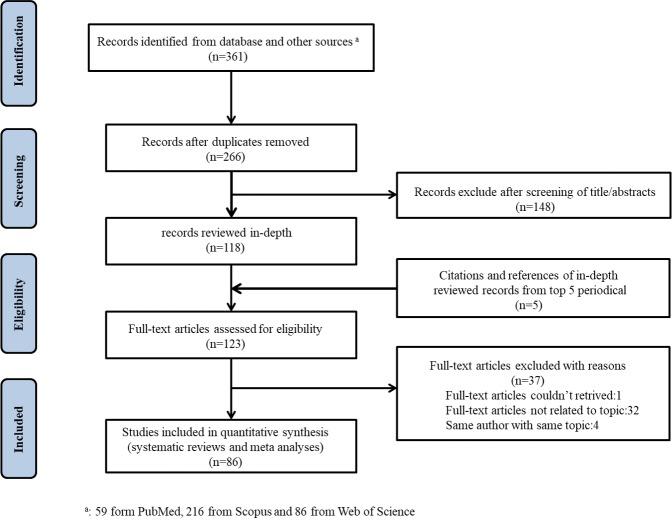
PubMed, Cochrane, Scopus and Web of Science were searched from their inception until June 2018. Citations and reference lists were traced.
ELIGIBILITY CRITERIA
SRs and MAs that investigated the impact of outdoor air pollution on human health outcomes were collected. This study excluded original articles and qualitative review articles.
DATA EXTRACTION AND SYNTHESIS
Characteristics of the included SRs and MAs were extracted and summarised. Extracted data included authors, publication year, location of the corresponding author(s), publication journal discipline, study design, study duration, sample size, study region, target population, types of air pollution and health outcomes.
RESULTS
Asia and North America published 93% of SRs and MAs included in this EGM. 31% of the SRs and MAs (27/86) included primary studies conducted in 5-10 countries. Their publication trends have increased during the last 10 years. A total of 2864 primary studies was included. The median number of included primary studies was 20 (range, 7-167). Cohort studies, case cross-over studies and time-series studies were the top three most used study designs. The mostly researched population was the group of all ages (46/86, 53%). Cardiovascular diseases, respiratory diseases and health service records were mostly reported. A lack of definite diagnostic criteria, unclear reporting of air pollution exposure and time period of primary studies were the main research gaps.
CONCLUSIONS
This EGM provided a visual overview of health outcomes affected by outdoor air pollution exposure. Future research should focus on chronic diseases, cancer and mental disorders.
目的
室外空气污染是全球范围内一个严重的环境问题。目前的系统评价 (SR) 和荟萃分析 (MA) 主要集中在某些特定的健康结果或某些特定的空气污染上。
设计
本证据差距图 (EGM) 旨在确定来自 SR 和 MA 的现有差距,并在广泛的主题领域中报告这些差距。
数据来源
从成立之初到 2018 年 6 月,检索了 PubMed、Cochrane、Scopus 和 Web of Science。跟踪了参考文献和引文。
入选标准
收集了调查室外空气污染对人类健康结果影响的 SR 和 MA。本研究排除了原始文章和定性综述文章。
数据提取和综合
提取并总结了纳入的 SR 和 MA 的特征。提取的数据包括作者、出版年份、通讯作者所在地、出版期刊学科、研究设计、研究持续时间、样本量、研究区域、目标人群、空气污染类型和健康结果。
结果
亚洲和北美的 SR 和 MA 占本 EGM 纳入的 93%。31%(27/86)的 SR 和 MA 包含在 5-10 个国家进行的初步研究。它们的出版趋势在过去 10 年中有所增加。共有 2864 项原始研究被纳入。纳入的原始研究数量中位数为 20(范围,7-167)。队列研究、病例交叉研究和时间序列研究是使用最多的三种研究设计。研究最多的人群是所有年龄段的人群(46/86,53%)。心血管疾病、呼吸道疾病和健康服务记录是报道最多的疾病。缺乏明确的诊断标准、空气污染暴露和原始研究时间范围的报告不明确是主要的研究差距。
结论
本 EGM 提供了一个室外空气污染暴露影响健康结果的直观概述。未来的研究应侧重于慢性病、癌症和精神障碍。



 Zotero 插件