
通过纳米流式细胞术对六种细胞外囊泡分离方法的质量和效率评估
Quality and efficiency assessment of six extracellular vesicle isolation methods by nano-flow cytometry.
作者信息
Tian Ye, Gong Manfei, Hu Yunyun, Liu Haisheng, Zhang Wenqiang, Zhang Miaomiao, Hu Xiuxiu, Aubert Dimitri, Zhu Shaobin, Wu Lina, Yan Xiaomei
机构信息
MOE Key Laboratory of Spectrochemical Analysis & Instrumentation, Key Laboratory for Chemical Biology of Fujian Province, Collaborative Innovation Center of Chemistry for Energy Materials, Department of Chemical Biology, College of Chemistry and Chemical Engineering, Xiamen University, Xiamen, People's Republic of China.
NanoFCM Co., Ltd, Nottingham, UK.
出版信息
J Extracell Vesicles. 2019 Nov 29;9(1):1697028. doi: 10.1080/20013078.2019.1697028. eCollection 2020.
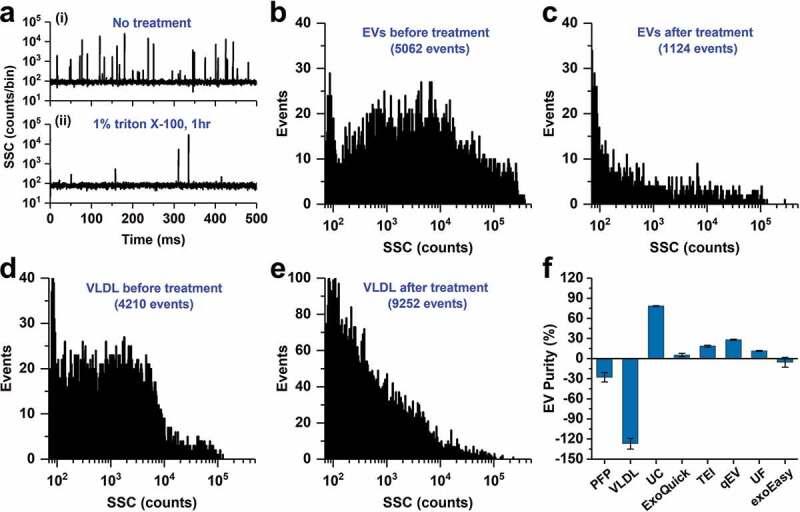
Extracellular vesicles (EVs) have sparked tremendous interest owing to their prominent potential in diagnostics and therapeutics. Isolation of EVs from complex biological fluids with high purity is essential to the accurate analysis of EV cargo. Unfortunately, generally used isolation techniques do not offer good separation of EVs from non-EV contaminants. Hence, it is important to have a standardized method to characterise the properties of EV preparations, including size distribution, particle concentration, purity and phenotype. Employing a laboratory-built nano-flow cytometer (nFCM) that enables multiparameter analysis of single EVs as small as 40 nm, here we report a new benchmark to the quality and efficiency assessment of EVs isolated from plasma, one of the most difficult body fluids to work with. The performance of five widely used commercial isolation kits was examined and compared with the traditional differential ultracentrifugation (UC). Two to four orders of magnitude higher particle concentrations were observed for EV preparations from platelet-free plasma (PFP) by kits when compared with the EV preparation by UC, yet the purity was much lower. Meanwhile, the particle size distribution profiles of EV preparations by kits closely resembled those of PFP whereas the EV preparation by UC showed a broader size distribution at relatively large particle size. When these kits were used to isolate EVs from vesicle-depleted PFP (VD-PFP), comparable particle counts were obtained with their corresponding EV preparations from PFP, which confirmed again the isolation of a large quantity of non-vesicular contaminants. As CD9, CD63 and CD81 also exist in the plasma matrix, single-particle phenotyping of EVs offers distinct advantage in the validation of EVs compared with ensemble-averaged approaches, such as Western blot analysis. nFCM allows us to compare different isolation techniques without prejudice.
细胞外囊泡(EVs)因其在诊断和治疗方面的巨大潜力而引发了极大的关注。从复杂生物流体中高纯度分离EVs对于准确分析EVs的内容物至关重要。不幸的是,一般使用的分离技术无法很好地将EVs与非EV污染物分离。因此,拥有一种标准化方法来表征EV制剂的特性非常重要,这些特性包括大小分布、颗粒浓度、纯度和表型。我们使用实验室自制的纳米流式细胞仪(nFCM),该仪器能够对小至40纳米的单个EVs进行多参数分析,在此报告了一种用于评估从血浆(最难处理的体液之一)中分离的EVs的质量和效率的新基准。我们检测了五种广泛使用的商业分离试剂盒的性能,并与传统的差速超速离心法(UC)进行了比较。与通过UC制备的EVs相比,试剂盒从无血小板血浆(PFP)中制备的EV制剂观察到的颗粒浓度高出两到四个数量级,但其纯度要低得多。同时,试剂盒制备的EV制剂的颗粒大小分布曲线与PFP的非常相似,而通过UC制备的EV制剂在相对较大的颗粒尺寸处显示出更宽的大小分布。当使用这些试剂盒从无囊泡PFP(VD-PFP)中分离EVs时,其相应的来自PFP的EV制剂获得了相当的颗粒计数,这再次证实分离出了大量非囊泡污染物。由于CD9、CD63和CD81也存在于血浆基质中,与整体平均方法(如蛋白质印迹分析)相比,EVs的单颗粒表型分析在EVs的验证中具有明显优势。nFCM使我们能够毫无偏见地比较不同的分离技术。




 Zotero 插件