
端粒相关标志物在癌症中的应用。
Telomere-related Markers for Cancer.
机构信息
Center for Reproductive Medicine, Shandong University, Jinan, 250012, China.
Central Research Laboratory, Shandong University Second Hospital, Jinan, 250033, China.
出版信息
Curr Top Med Chem. 2020;20(6):410-432. doi: 10.2174/1568026620666200106145340.
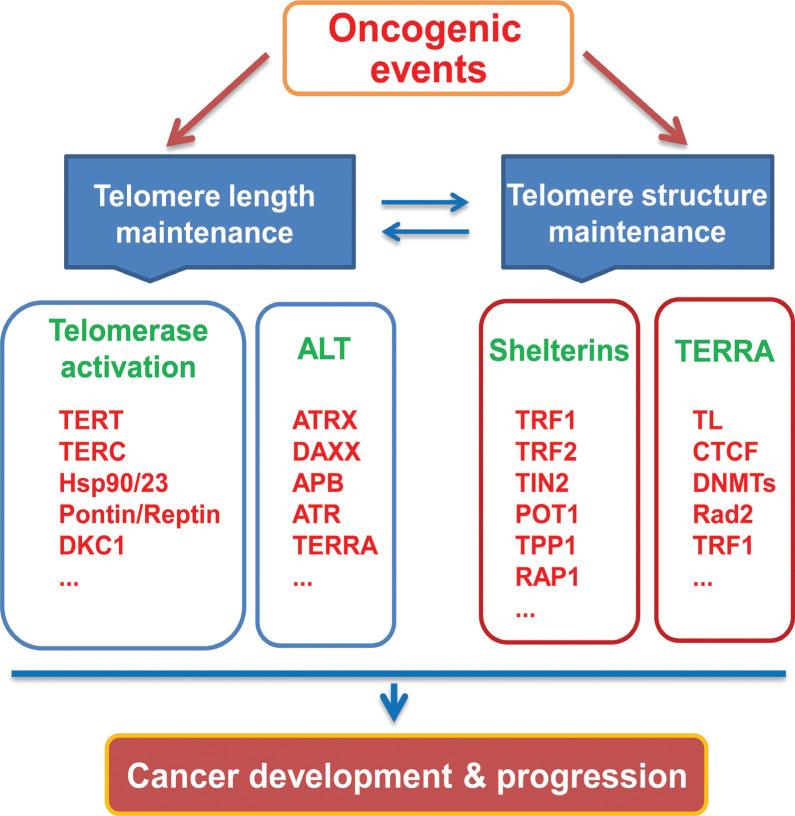
Telomeres are structurally nucleoprotein complexes at termini of linear chromosomes and essential to chromosome stability/integrity. In normal human cells, telomere length erodes progressively with each round of cell divisions, which serves as an important barrier to uncontrolled proliferation and malignant transformation. In sharp contrast, telomere maintenance is a key feature of human malignant cells and required for their infinite proliferation and maintenance of other cancer hallmarks as well. Thus, a telomere-based anti-cancer strategy has long been suggested. However, clinically efficient and specific drugs targeting cancer telomere-maintenance have still been in their infancy thus far. To achieve this goal, it is highly necessary to elucidate how exactly cancer cells maintain functional telomeres. In the last two decades, numerous studies have provided profound mechanistic insights, and the identified mechanisms include the aberrant activation of telomerase or the alternative lengthening of telomere pathway responsible for telomere elongation, dysregulation and mutation of telomereassociated factors, and other telomere homeostasis-related signaling nodes. In the present review, these various strategies employed by malignant cells to regulate their telomere length, structure and function have been summarized, and potential implications of these findings in the rational development of telomere- based cancer therapy and other clinical applications for precision oncology have been discussed.
端粒是线性染色体末端的结构性核蛋白复合物,对染色体的稳定性/完整性至关重要。在正常的人类细胞中,端粒长度随着每一轮细胞分裂逐渐缩短,这是阻止不受控制的增殖和恶性转化的重要障碍。相比之下,端粒维持是人类恶性细胞的一个关键特征,也是它们无限增殖和维持其他癌症特征所必需的。因此,基于端粒的抗癌策略早已被提出。然而,迄今为止,针对癌症端粒维持的临床有效且特异性的药物仍处于起步阶段。为了实现这一目标,非常有必要阐明癌细胞究竟如何维持功能性端粒。在过去的二十年中,许多研究提供了深刻的机制见解,所确定的机制包括端粒酶的异常激活或负责端粒延长的端粒延长途径的替代延长、端粒相关因子的失调和突变,以及其他与端粒稳态相关的信号节点。在本综述中,总结了恶性细胞用来调节端粒长度、结构和功能的各种策略,并讨论了这些发现对基于端粒的癌症治疗的合理发展以及精准肿瘤学的其他临床应用的潜在意义。
 Zotero 插件