
基础组织病理学决定培养的人原代近端肾小管上皮细胞对氧化应激的反应。
Underlying Histopathology Determines Response to Oxidative Stress in Cultured Human Primary Proximal Tubular Epithelial Cells.
机构信息
NHMRC CKD CRE (CKD.QLD), University of Queensland, Brisbane 4029, Queensland, Australia.
Faculty of Medicine, University of Queensland, Brisbane 4006, Queensland, Australia.
出版信息
Int J Mol Sci. 2020 Jan 15;21(2):560. doi: 10.3390/ijms21020560.
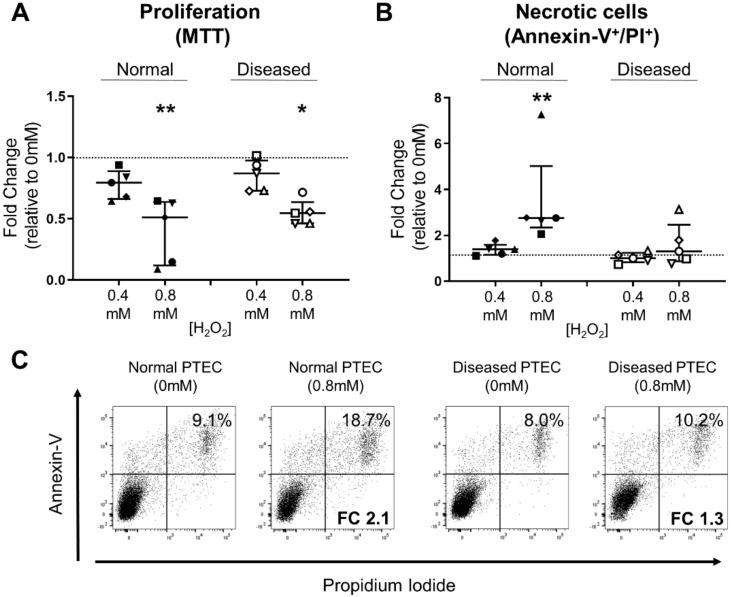
Proximal tubular epithelial cells (PTEC) are key players in the progression of kidney diseases. PTEC studies to date have primarily used mouse models and transformed human PTEC lines. However, the translatability of these models to human kidney disease has been questioned. In this study, we investigated the phenotypic and functional response of human primary PTEC to oxidative stress, an established driver of kidney disease. Furthermore, we examined the functional contribution of the underlying histopathology of the cortical tissue used to generate our PTEC. We demonstrated that human primary PTEC from both histologically 'normal' and 'diseased' cortical tissue responded to HO-induced oxidative stress with significantly elevated mitochondrial superoxide levels, DNA damage, and significantly decreased proliferation. The functional response of 'normal' PTEC to oxidative stress mirrored the reported pathogenesis of human kidney disease, with significantly attenuated mitochondrial function and increased cell death. In contrast, 'diseased' PTEC were functionally resistant to oxidative stress, with maintenance of mitochondrial function and cell viability. This selective survival of 'diseased' PTEC under oxidizing conditions is reminiscent of the in vivo persistence of maladaptive PTEC following kidney injury. We are now exploring the impact that these differential PTEC responses have in the therapeutic targeting of oxidative stress pathways.
近端肾小管上皮细胞 (PTEC) 是肾脏疾病进展的关键参与者。迄今为止,PTEC 的研究主要使用小鼠模型和转化的人 PTEC 系。然而,这些模型在人类肾脏疾病中的转化能力一直受到质疑。在这项研究中,我们研究了人原代 PTEC 对氧化应激的表型和功能反应,氧化应激是肾脏疾病的一个既定驱动因素。此外,我们还研究了用于生成我们的 PTEC 的皮质组织的潜在组织病理学对功能的贡献。我们证明,来自组织学上“正常”和“患病”皮质组织的人原代 PTEC 对 HO 诱导的氧化应激均表现出显著升高的线粒体超氧化物水平、DNA 损伤和显著降低的增殖。“正常”PTEC 对氧化应激的功能反应反映了人类肾脏疾病的报道发病机制,线粒体功能明显减弱,细胞死亡增加。相比之下,“患病”PTEC 对氧化应激具有功能抗性,线粒体功能和细胞活力得以维持。这种“患病”PTEC 在氧化条件下的选择性存活让人联想到肾损伤后适应性 PTEC 在体内的持续存在。我们现在正在探索这些不同的 PTEC 反应对氧化应激途径的治疗靶向的影响。


 Zotero 插件