
人近端肾小管上皮细胞来源的小细胞外囊泡介导缺氧性肾损伤中肾小管同步铁死亡。
Human proximal tubular epithelial cell-derived small extracellular vesicles mediate synchronized tubular ferroptosis in hypoxic kidney injury.
机构信息
Conjoint Internal Medicine Laboratory, Chemical Pathology, Pathology Queensland, Brisbane, Queensland, Australia; Kidney Health Service, Royal Brisbane and Women's Hospital, Brisbane, Queensland, Australia.
Conjoint Internal Medicine Laboratory, Chemical Pathology, Pathology Queensland, Brisbane, Queensland, Australia; Kidney Health Service, Royal Brisbane and Women's Hospital, Brisbane, Queensland, Australia; Department of Internal Medicine, Chonnam National University Hospital, Gwangju, Republic of Korea; Department of Internal Medicine, Chonnam National University Medical School, Gwangju, Republic of Korea.
出版信息
Redox Biol. 2024 Apr;70:103042. doi: 10.1016/j.redox.2024.103042. Epub 2024 Jan 14.
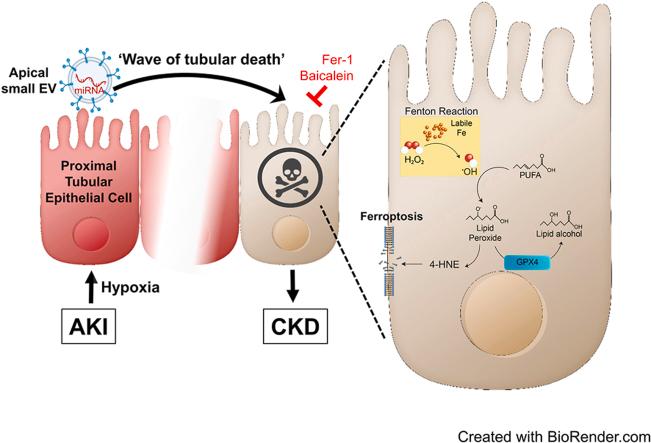
Hypoxia is the key pathobiological trigger of tubular oxidative stress and cell death that drives the transition of acute kidney injury (AKI) to chronic kidney disease (CKD). The mitochondrial-rich proximal tubular epithelial cells (PTEC) are uniquely sensitive to hypoxia and thus, are pivotal in propagating the sustained tubular loss of AKI-to-CKD transition. Here, we examined the role of PTEC-derived small extracellular vesicles (sEV) in propagating the 'wave of tubular death'. Ex vivo patient-derived PTEC were cultured under normoxia (21 % O) and hypoxia (1 % O) on Transwell inserts for isolation and analysis of sEV secreted from apical versus basolateral PTEC surfaces. Increased numbers of sEV were secreted from the apical surface of hypoxic PTEC compared with normoxic PTEC. No differences in basolateral sEV numbers were observed between culture conditions. Biological pathway analysis of hypoxic-apical sEV cargo identified distinct miRNAs linked with cellular injury pathways. In functional assays, hypoxic-apical sEV selectively induced ferroptotic cell death (↓glutathione peroxidase-4, ↑lipid peroxidation) in autologous PTEC compared with normoxic-apical sEV. The addition of ferroptosis inhibitors, ferrostatin-1 and baicalein, attenuated PTEC ferroptosis. RNAse A pretreatment of hypoxic-apical sEV also abrogated PTEC ferroptosis, demonstrating a role for sEV RNA in ferroptotic 'wave of death' signalling. In line with these in vitro findings, in situ immunolabelling of diagnostic kidney biopsies from AKI patients with clinical progression to CKD (AKI-to-CKD transition) showed evidence of ferroptosis propagation (increased numbers of ACSL4 PTEC), while urine-derived sEV (usEV) from these 'AKI-to-CKD transition' patients triggered PTEC ferroptosis (↑lipid peroxidation) in functional studies. Our data establish PTEC-derived apical sEV and their intravesicular RNA as mediators of tubular lipid peroxidation and ferroptosis in hypoxic kidney injury. This concept of how tubular pathology is propagated from the initiating insult into a 'wave of death' provides novel therapeutic check-points for targeting AKI-to-CKD transition.
缺氧是肾小管氧化应激和细胞死亡的关键病理生物学触发因素,驱动急性肾损伤 (AKI) 向慢性肾脏病 (CKD) 的转变。富含线粒体的近端肾小管上皮细胞 (PTEC) 对缺氧特别敏感,因此在传播 AKI 向 CKD 转变的持续肾小管丢失中起着关键作用。在这里,我们研究了 PTEC 衍生的小细胞外囊泡 (sEV) 在传播“肾小管死亡波”中的作用。将来自患者的原代 PTEC 在 Transwell 插入物中于常氧 (21% O) 和缺氧 (1% O) 下培养,以分离和分析从顶端到基底外侧 PTEC 表面分泌的 sEV。与常氧 PTEC 相比,缺氧 PTEC 分泌的 sEV 数量增加。在培养条件之间未观察到基底外侧 sEV 数量的差异。缺氧-顶端 sEV 货物的生物途径分析确定了与细胞损伤途径相关的独特 miRNA。在功能测定中,与常氧-顶端 sEV 相比,缺氧-顶端 sEV 选择性地诱导自体 PTEC 发生铁死亡 (↓谷胱甘肽过氧化物酶-4,↑脂质过氧化)。添加铁死亡抑制剂,ferrostatin-1 和白杨素,可减轻 PTEC 的铁死亡。用 RNAse A 预处理缺氧-顶端 sEV 也可消除 PTEC 的铁死亡,表明 sEV RNA 在铁死亡“死亡波”信号传导中起作用。与这些体外发现一致,对具有临床进展为 CKD 的 AKI 患者的诊断性肾活检进行原位免疫标记(AKI 向 CKD 转变)显示出铁死亡传播的证据(PTEC 中 ACSL4 数量增加),而来自这些“AKI 向 CKD 转变”患者的尿衍生 sEV (usEV) 在功能研究中引发 PTEC 铁死亡(↑脂质过氧化)。我们的数据确立了 PTEC 衍生的顶端 sEV 及其腔内 RNA 作为缺氧肾损伤中肾小管脂质过氧化和铁死亡的介质。这种肾小管病理学如何从起始损伤传播到“死亡波”的概念为靶向 AKI 向 CKD 转变提供了新的治疗检查点。
 Zotero 插件