
端粒酶特异性溶瘤腺病毒的免疫调节作用与抗 PD1 抗体协同增强抗肿瘤疗效。
Immune Modulation by Telomerase-Specific Oncolytic Adenovirus Synergistically Enhances Antitumor Efficacy with Anti-PD1 Antibody.
机构信息
Department of Gastroenterological Surgery, Okayama University Graduate School of Medicine, Dentistry and Pharmaceutical Sciences, Okayama 700-8558, Japan.
Department of Gastroenterological Surgery, Okayama University Graduate School of Medicine, Dentistry and Pharmaceutical Sciences, Okayama 700-8558, Japan; Center for Innovative Clinical Medicine, Okayama University Hospital, Okayama 700-8558, Japan.
出版信息
Mol Ther. 2020 Mar 4;28(3):794-804. doi: 10.1016/j.ymthe.2020.01.003. Epub 2020 Jan 10.
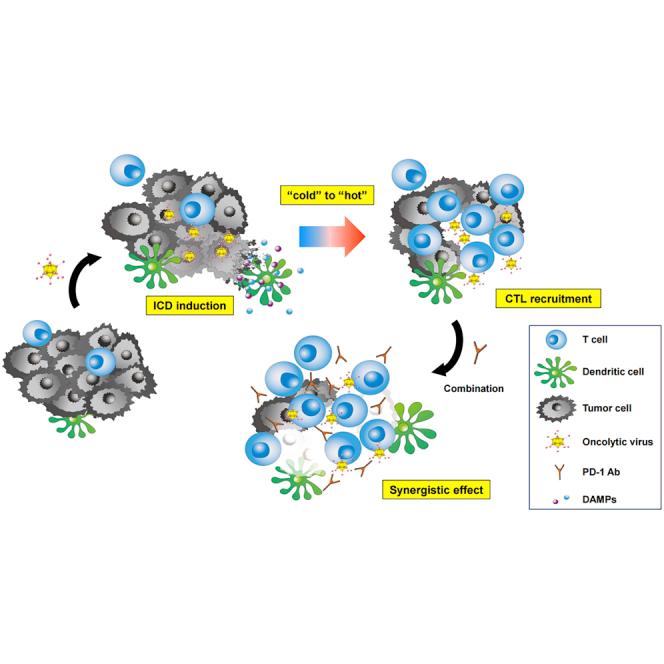
The clinical benefit of monotherapy involving immune checkpoint inhibitors (ICIs) such as anti-programmed death-1 antibody (PD-1 Ab) is limited to small populations. We previously developed a telomerase-specific oncolytic adenovirus, Telomelysin (OBP-301), the safety of which was confirmed in a phase I clinical study. Here, we examined the potential of OBP-502, an OBP-301 variant, as an agent for inducing immunogenic cell death (ICD) and synergistically enhancing the efficacy of OBP-502 with PD-1 Ab using CT26 murine colon cancer and PAN02 murine pancreatic cancer cell lines. OBP-502 induced the release of ICD molecules such as adenosine triphosphate (ATP) and high-mobility group box protein 1 (HMGB1) from CT26 and PAN02 cells, leading to recruitment of CD8-positive lymphocytes and inhibition of Foxp3-positive lymphocyte infiltration into tumors. Combination therapy involving OBP-502 intratumoral administration and PD-1 Ab systemic administration significantly suppressed the growth of not only OBP-502-treated tumors but also tumors not treated with OBP-502 (so-called abscopal effect) in CT26 and PAN02 bilateral subcutaneous tumor models, in which active recruitment of CD8-positve lymphocytes was observed even in tumors not treated with OBP-502. This combined efficacy was similar to that observed in a CT26 rectal orthotopic tumor model involving liver metastases. In conclusion, telomerase-specific oncolytic adenoviruses are promising candidates for combined therapies with ICIs.
单药免疫检查点抑制剂(ICIs)治疗的临床获益仅限于一小部分人群,如抗程序性死亡受体-1 抗体(PD-1 Ab)。我们之前开发了一种端粒酶特异性溶瘤腺病毒 Telomelysin(OBP-301),其安全性已在 I 期临床试验中得到证实。在此,我们研究了 OBP-502(OBP-301 的一种变体)作为诱导免疫原性细胞死亡(ICD)的潜在药物的作用,并使用 CT26 结肠癌细胞和 PAN02 胰腺癌细胞系,研究了 OBP-502 与 PD-1 Ab 联合应用的效果。OBP-502 诱导 CT26 和 PAN02 细胞释放 ICD 分子,如三磷酸腺苷(ATP)和高迁移率族蛋白 B1(HMGB1),导致 CD8+阳性淋巴细胞的募集,并抑制 Foxp3+阳性淋巴细胞浸润肿瘤。OBP-502 瘤内给药联合 PD-1 Ab 全身给药治疗不仅显著抑制了 OBP-502 治疗的肿瘤的生长,而且抑制了未用 OBP-502 治疗的肿瘤(所谓的远隔效应)的生长,在 CT26 和 PAN02 双侧皮下肿瘤模型中观察到 CD8+阳性淋巴细胞的活性募集,即使在未用 OBP-502 治疗的肿瘤中也是如此。这种联合疗效与 CT26 直肠原位肿瘤模型中肝转移的疗效相似。总之,端粒酶特异性溶瘤腺病毒是与 ICI 联合治疗的有前途的候选药物。
 Zotero 插件