
真菌细胞壁:,,和物种。 (你提供的原文似乎不完整,请检查补充完整后以便能更准确翻译。)
The Fungal Cell Wall: , , and Species.
作者信息
Garcia-Rubio Rocio, de Oliveira Haroldo C, Rivera Johanna, Trevijano-Contador Nuria
机构信息
Center for Discovery and Innovation, Hackensack Meridian Health, Nutley, NJ, United States.
Instituto Carlos Chagas, Fundação Oswaldo Cruz (Fiocruz), Curitiba, Brazil.
出版信息
Front Microbiol. 2020 Jan 9;10:2993. doi: 10.3389/fmicb.2019.02993. eCollection 2019.
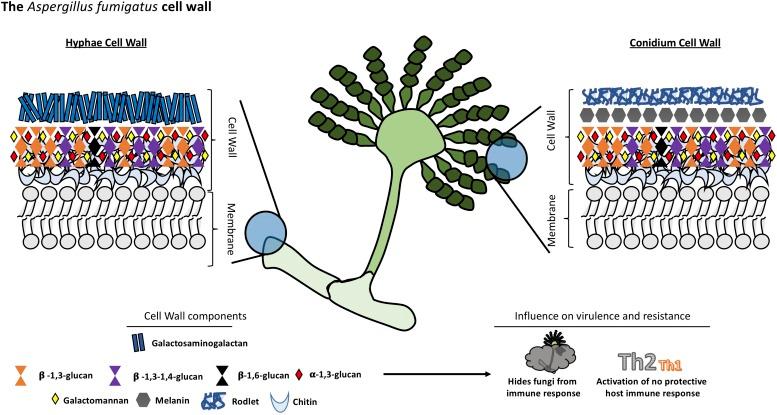
The fungal cell wall is located outside the plasma membrane and is the cell compartment that mediates all the relationships of the cell with the environment. It protects the contents of the cell, gives rigidity and defines the cellular structure. The cell wall is a skeleton with high plasticity that protects the cell from different stresses, among which osmotic changes stand out. The cell wall allows interaction with the external environment since some of its proteins are adhesins and receptors. Since, some components have a high immunogenic capacity, certain wall components can drive the host's immune response to promote fungus growth and dissemination. The cell wall is a characteristic structure of fungi and is composed mainly of glucans, chitin and glycoproteins. As the components of the fungal cell wall are not present in humans, this structure is an excellent target for antifungal therapy. In this article, we review recent data on the composition and synthesis, influence of the components of the cell wall in fungi-host interaction and the role as a target for the next generation of antifungal drugs in yeasts ( and ) and filamentous fungi ().
真菌细胞壁位于质膜之外,是介导细胞与环境所有关系的细胞区室。它保护细胞内容物,赋予细胞刚性并确定细胞结构。细胞壁是具有高可塑性的骨架,可保护细胞免受不同压力,其中渗透变化尤为突出。细胞壁允许与外部环境相互作用,因为其一些蛋白质是粘附素和受体。由于某些成分具有高免疫原性,某些细胞壁成分可驱动宿主的免疫反应以促进真菌生长和传播。细胞壁是真菌的特征性结构,主要由葡聚糖、几丁质和糖蛋白组成。由于真菌细胞壁的成分在人类中不存在,因此该结构是抗真菌治疗的极佳靶点。在本文中,我们综述了关于酵母(和)及丝状真菌()中细胞壁的组成与合成、细胞壁成分在真菌 - 宿主相互作用中的影响以及作为下一代抗真菌药物靶点的作用的最新数据。


 Zotero 插件