
免疫检查点抑制治疗癌症患者的 TCR 汇聚。
TCR Convergence in Individuals Treated With Immune Checkpoint Inhibition for Cancer.
机构信息
Thermo Fisher Scientific, South San Francisco, CA, United States.
OmniSeq Inc., Buffalo, NY, United States.
出版信息
Front Immunol. 2020 Jan 9;10:2985. doi: 10.3389/fimmu.2019.02985. eCollection 2019.
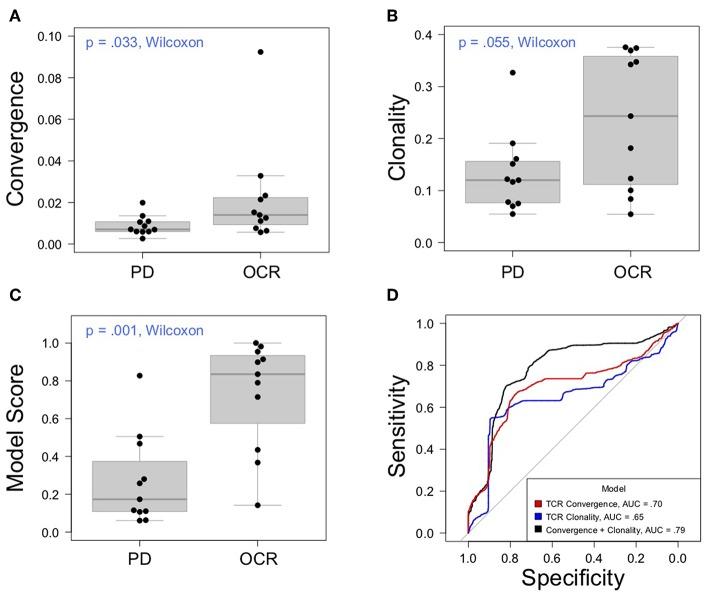
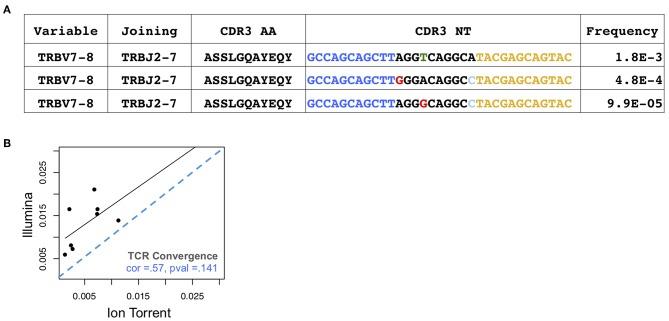
Tumor antigen-driven selection may expand T cells having T cell receptors (TCRs) of shared antigen specificity but different amino acid or nucleotide sequence in a process known as TCR convergence. Substitution sequencing errors introduced by TCRβ (TCRB) repertoire sequencing may create artifacts resembling TCR convergence. Given the anticipated differences in substitution error rates across different next-generation sequencing platforms, the choice of platform could be consequential. To test this, we performed TCRB sequencing on the same peripheral blood mononuclear cells (PBMC) from individuals with cancer receiving anti-CTLA-4 or anti-PD-1 using an Illumina-based approach (Sequenta) and an Ion Torrent-based approach (Oncomine TCRB-LR). While both approaches found similar TCR diversity, clonality, and clonal overlap, we found that Illumina-based sequencing resulted in higher TCR convergence than with the Ion Torrent approach. To build upon this initial observation we conducted a systematic comparison of Illumina-based TCRB sequencing assays, including those employing molecular barcodes, with the Oncomine assay, revealing differences in the frequency of convergent events, purportedly artifactual rearrangements, and sensitivity of detection. Finally, we applied the Ion Torrent-based approach to evaluate clonality and convergence in a cohort of individuals receiving anti-CTLA-4 blockade for cancer. We found that clonality and convergence independently predicted response and could be combined to improve the accuracy of a logistic regression classifier. These results demonstrate the importance of the sequencing platform in assessing TCRB convergence.
肿瘤抗原驱动的选择可能会在一个称为 TCR 收敛的过程中扩展具有共享抗原特异性但不同氨基酸或核苷酸序列的 T 细胞。TCRβ(TCRB)库测序引入的取代测序错误可能会产生类似于 TCR 收敛的假象。鉴于不同下一代测序平台的取代错误率存在预期差异,平台的选择可能会产生影响。为了验证这一点,我们使用基于 Illumina 的方法(Sequenta)和基于 Ion Torrent 的方法(Oncomine TCRB-LR)对接受抗 CTLA-4 或抗 PD-1 治疗的癌症患者的外周血单核细胞(PBMC)进行了 TCRB 测序。虽然这两种方法都发现了相似的 TCR 多样性、克隆性和克隆重叠性,但我们发现基于 Illumina 的测序比基于 Ion Torrent 的方法产生更高的 TCR 收敛性。为了在此初步观察的基础上进一步研究,我们对基于 Illumina 的 TCRB 测序检测方法进行了系统比较,包括那些使用分子条码的方法与 Oncomine 检测方法进行了比较,揭示了在汇聚事件、假定的人工重排和检测灵敏度的频率方面存在差异。最后,我们应用基于 Ion Torrent 的方法来评估接受抗 CTLA-4 阻断治疗癌症的个体的克隆性和收敛性。我们发现克隆性和收敛性独立地预测了反应,并且可以结合起来提高逻辑回归分类器的准确性。这些结果表明了测序平台在评估 TCRB 收敛性方面的重要性。

 Zotero 插件