
急性 ST 段抬高型心肌梗死幸存者的主动脉僵硬与梗死愈合。
Aortic Stiffness and Infarct Healing in Survivors of Acute ST-Segment-Elevation Myocardial Infarction.
机构信息
University Clinic of Internal Medicine III Cardiology and Angiology Medical University of Innsbruck Austria.
University Clinic of Radiology Medical University of Innsbruck Austria.
出版信息
J Am Heart Assoc. 2020 Feb 4;9(3):e014740. doi: 10.1161/JAHA.119.014740. Epub 2020 Jan 31.
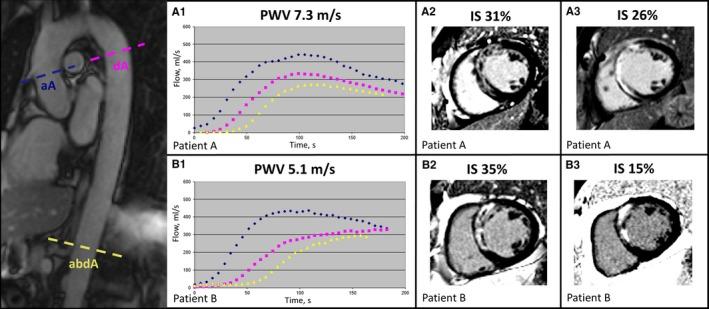
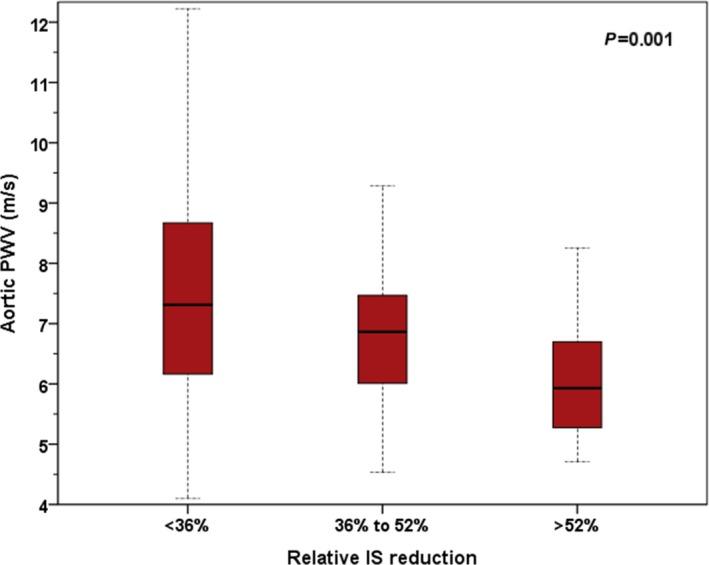
Background In survivors of acute ST-segment-elevation myocardial infarction (STEMI), increased aortic stiffness is associated with worse clinical outcome; however, the underlying pathomechanisms are incompletely understood. We aimed to investigate associations between aortic stiffness and infarct healing using comprehensive cardiac magnetic resonance imaging in patients with acute STEMI. Methods and Results This was a prospective observational study including 103 consecutive STEMI patients treated with primary percutaneous coronary intervention. Pulse wave velocity (PWV), the reference standard for aortic stiffness assessment, was determined by a validated phase-contrast cardiac magnetic resonance imaging protocol within the first week after STEMI. Infarct healing, defined as relative infarct size reduction from baseline to 4 months post-STEMI, was determined using late gadolinium-enhanced cardiac magnetic resonance. Median infarct size significantly decreased from 17% of left ventricular mass (interquartile range 9% to 28%) at baseline to 12% (6% to 17%) at 4-month follow-up (<0.001). Relative infarct size reduction was 36% (interquartile range 15% to 52%). Patients with a reduction >36% were younger (=0.01) and had lower baseline NT-proBNP (N-terminal pro-B-type natriuretic peptide) concentrations (=0.047) and aortic PWV values (=0.003). In a continuous (odds ratio 0.64 [95% CI, 0.49-0.84]; =0.001) as well as categorical (PWV <7 m/s; odds ratio 4.80 [95% CI, 1.89-12.20]; =0.001) multivariable logistic regression model, the relation between aortic PWV and relative infarct size reduction remained significant after adjustment for baseline infarct size, age, NT-proBNP, and C-reactive protein. Conclusions Aortic PWV independently predicted infarct size reduction as assessed by cardiac magnetic resonance, revealing a novel pathophysiological link between aortic stiffness and adverse infarct healing during the early phase after STEMI treated with contemporary primary percutaneous coronary intervention.
背景
在急性 ST 段抬高型心肌梗死(STEMI)幸存者中,主动脉僵硬度增加与更差的临床结局相关;然而,其潜在的病理机制尚不完全清楚。我们旨在通过急性 STEMI 患者的综合心脏磁共振成像来研究主动脉僵硬度与梗死愈合之间的关系。
方法和结果
这是一项前瞻性观察研究,纳入了 103 例接受直接经皮冠状动脉介入治疗的连续 STEMI 患者。在 STEMI 后第一周内,通过经过验证的相位对比心脏磁共振成像方案确定脉搏波速度(PWV),这是评估主动脉僵硬度的参考标准。通过延迟钆增强心脏磁共振成像确定从基线到 STEMI 后 4 个月的相对梗死面积缩小,即梗死愈合。中位数梗死面积从基线时左心室质量的 17%(四分位间距为 9%28%)显著下降至 4 个月随访时的 12%(6%17%)(<0.001)。相对梗死面积缩小 36%(四分位间距为 15%52%)。PWV 降低幅度>36%的患者年龄较小(=0.01),基线时 N 末端 B 型利钠肽前体(N-terminal pro-B-type natriuretic peptide,NT-proBNP)浓度较低(=0.047),主动脉 PWV 值较低(=0.003)。在连续(比值比 0.64 [95%可信区间,0.490.84];=0.001)和分类(PWV <7 m/s;比值比 4.80 [95%可信区间,1.89~12.20];=0.001)多变量逻辑回归模型中,在校正基线梗死面积、年龄、NT-proBNP 和 C 反应蛋白后,主动脉 PWV 与相对梗死面积缩小之间的关系仍然显著。
结论
主动脉 PWV 独立预测心脏磁共振评估的梗死面积缩小,揭示了在接受当代直接经皮冠状动脉介入治疗的 STEMI 后早期,主动脉僵硬度与不良梗死愈合之间存在新的病理生理学联系。
 Zotero 插件