
使用 16SrRNA 测序研究微生物组与结直肠癌易感性的关系。
Study of the Relationship between Microbiome and Colorectal Cancer Susceptibility Using 16SrRNA Sequencing.
机构信息
Institute of Infection, Immunology and Tumor Microenvironment, Hubei Province Key Laboratory of Occupational Hazard Identification and Control, Medical College, Wuhan University of Science and Technology, Wuhan 430065, China.
Department of Anesthesiology, The Third People's Hospital of Hubei Province, Wuhan 430030, China.
出版信息
Biomed Res Int. 2020 Jan 30;2020:7828392. doi: 10.1155/2020/7828392. eCollection 2020.
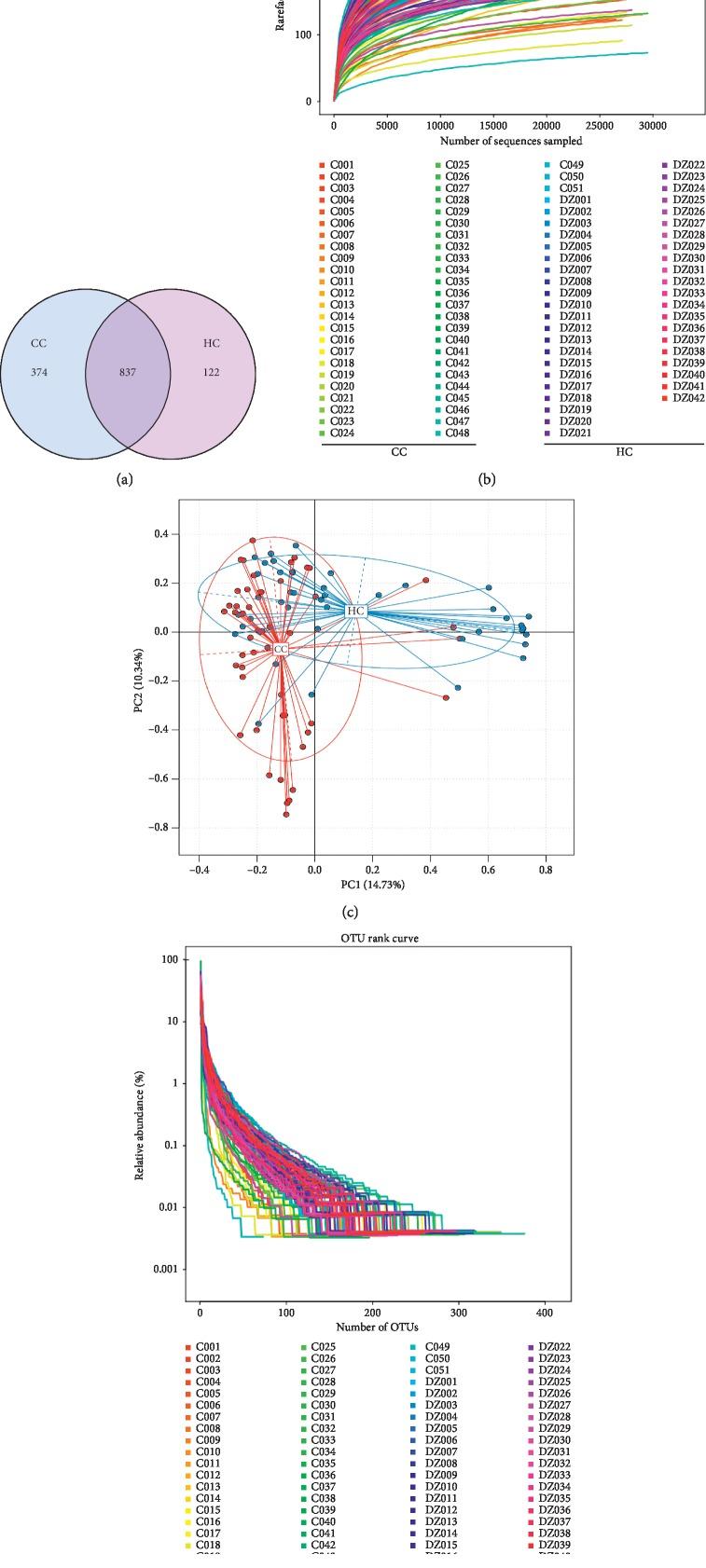
A lot of previous studies have recently reported that the gut microbiota influences the development of colorectal cancer (CRC) in Western countries, but the role of the gut microbiota in Chinese population must be investigated fully. The goal of this study was to determine the role of the gut microbiome in the initiation and development of CRC. We collected fecal samples of 206 Chinese individuals: 59 with (group P), 54 with (group A), 51 with (group CC), and 42 (group HC).16S ribosomal RNA (rRNA) was used to compare the microbiota community structures among healthy controls, patients with polyp, and those with adenoma or colorectal cancer. Our study proved that intestinal flora, as a specific indicator, showed significant differences in its diversity and composition. Sobs, Chao, and Ace indexes of group CC were significantly lower than those of the healthy control group (CC group: Sobs, Chao, and Ace indexes were 217.3 ± 69, 4265.1 ± 80.7, and 268.6 ± 78.1, respectively; HC group: Sobs, Chao, and Ace indexes were 228.8 ± 44.4, 272.9 ± 58.6, and 271.9 ± 57.2, respectively). When compared with the healthy individuals, the species richness and diversity of intestinal flora in patients with colorectal cancer were significantly reduced: PCA and PCoA both revealed that a significant separation in bacterial community composition between the CC group and HC group (with PCA using the first two principal component scores of PC1 14.73% and PC2 10.34% of the explained variance, respectively; PCoA : PC1 = 14%, PC2 = 9%, PC3 = 6%). Wilcox tests was used to analyze differences between the two groups, it reveals that (=0.000356), (=0.000001), (=0.000796), (=0.013421), (=0.005642) were phyla with significantly different distributions between cases and controls. The proportion of microorganism composition is varying at different stages of colon cancer development: (52.14%) and (35.88%) were enriched in the healthy individuals; on the phylum level, the abundance of (52.14%-53.92%-52.46%-47.06%) and (35.88%-29.73%-24.27%-25.36%) is decreasing with the development of health-polyp-adenomas-CRC, and the abundance of (9.33%-12.31%-16.51%-22.37%) is increasing. PCA and PCOA analysis showed there was no significant ( < 0.05) difference in species similarity between precancerous and carcinogenic states. However, the composition of the microflora in patients with precancerous lesions (including patients with adenoma and polyp) was proved to have no significant disparity ( < 0.05). Our study provides insights into new angles to dig out potential biomarkers in diagnosis and treatment of colorectal cancer and to provide scientific advice for a healthy lifestyle for the sake of gut microbiota.
最近有很多研究报告称,肠道微生物群会影响西方国家结直肠癌(CRC)的发展,但必须充分研究中国人群肠道微生物群的作用。本研究旨在确定肠道微生物群在 CRC 的发生和发展中的作用。我们收集了 206 名中国个体的粪便样本:59 名患有 CRC(组 P),54 名患有腺瘤(组 A),51 名患有息肉(组 CC),42 名健康对照(组 HC)。使用 16S rRNA 比较健康对照组、息肉患者和腺瘤或结直肠癌患者的微生物群落结构。我们的研究证明,肠道菌群作为一种特定指标,其多样性和组成存在显著差异。CC 组的 Sobs、Chao 和 Ace 指数明显低于健康对照组(CC 组:Sobs、Chao 和 Ace 指数分别为 217.3±69、4265.1±80.7 和 268.6±78.1;HC 组:Sobs、Chao 和 Ace 指数分别为 228.8±44.4、272.9±58.6 和 271.9±57.2)。与健康个体相比,结直肠癌患者肠道菌群的物种丰富度和多样性明显降低:PCA 和 PCoA 均表明 CC 组和 HC 组之间细菌群落组成存在显著分离(PCA 采用 PC1 和 PC2 的前两个主成分得分,分别解释了 14.73%和 10.34%的方差;PCoA:PC1=14%,PC2=9%,PC3=6%)。Wilcox 检验分析两组间的差异,结果表明(=0.000356),(=0.000001),(=0.000796),(=0.013421),(=0.005642)在病例和对照之间的分布存在显著差异。微生物组成比例在结直肠癌发展的不同阶段发生变化:(52.14%)和(35.88%)在健康个体中富集;在门水平上,(52.14%-53.92%-52.46%-47.06%)和(35.88%-29.73%-24.27%-25.36%)的丰度随着健康-息肉-腺瘤-CRC 的发展而降低,(9.33%-12.31%-16.51%-22.37%)的丰度增加。PCA 和 PCOA 分析表明,癌前和致癌状态下的物种相似性没有显著差异(<0.05)。然而,我们发现癌前病变(包括腺瘤和息肉)患者的微生物群组成没有显著差异(<0.05)。本研究为挖掘结直肠癌诊断和治疗中的潜在生物标志物提供了新的角度,并为肠道微生物群的健康生活方式提供了科学建议。



 Zotero 插件