
花色苷及其代谢物对动脉粥样硬化模型中黏附过程、E-选择素和 VEGF 产生的调节作用。
Modulation of Adhesion Process, E-Selectin and VEGF Production by Anthocyanins and Their Metabolites in an Model of Atherosclerosis.
机构信息
Università degli Studi di Milano, Department of Food, Environmental and Nutritional Sciences, Division of Human Nutrition, 20133 Milan, Italy.
School of Food and Agriculture, University of Maine, Orono, ME 04469, USA.
出版信息
Nutrients. 2020 Feb 28;12(3):655. doi: 10.3390/nu12030655.
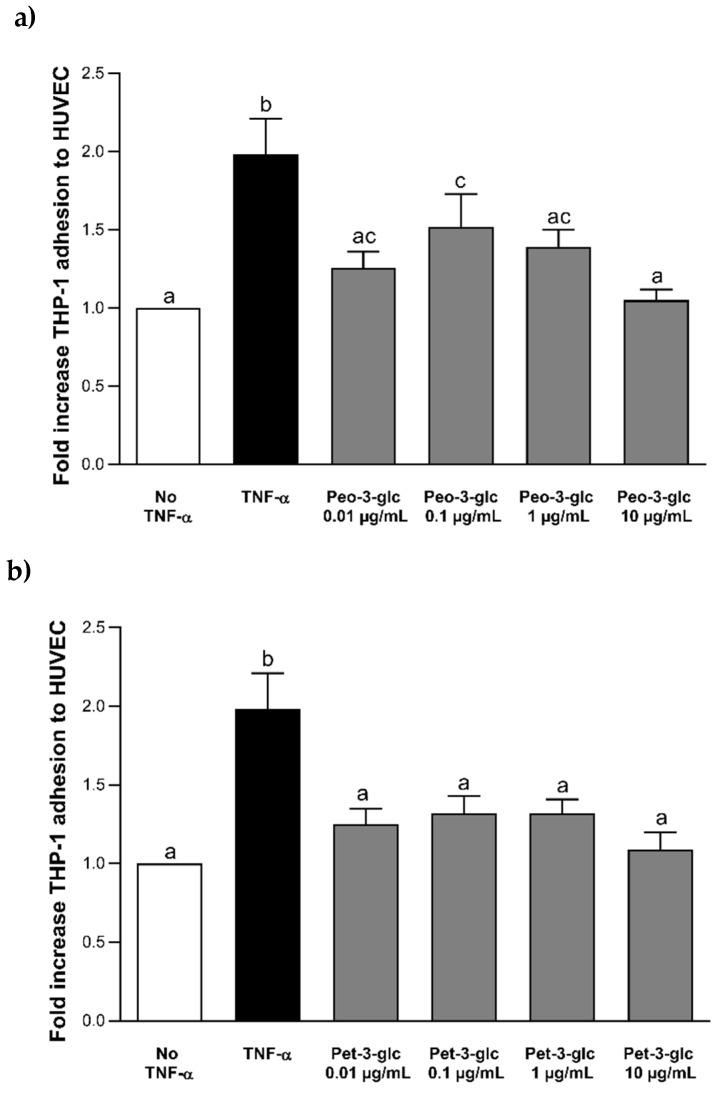
The present study aims to evaluate the ability of peonidin and petunidin-3-glucoside (Peo-3-glc and Pet-3-glc) and their metabolites (vanillic acid; VA and methyl-gallic acid; MetGA), to prevent monocyte (THP-1) adhesion to endothelial cells (HUVECs), and to reduce the production of vascular cell adhesion molecule (VCAM)-1, E-selectin and vascular endothelial growth factor (VEGF) in a stimulated pro-inflammatory environment, a pivotal step of atherogenesis. Tumor necrosis factor-α (TNF-α; 100 ng mL) was used to stimulate the adhesion of labelled monocytes (THP-1) to endothelial cells (HUVECs). Successively, different concentrations of Peo-3-glc and Pet-3-glc (0.02 µM, 0.2 µM, 2 µM and 20 µM), VA and MetGA (0.05 µM, 0.5 µM, 5 µM and 50 µM) were tested. After 24 h, VCAM-1, E-selectin and VEGF were quantified by ELISA, while the adhesion process was measured spectrophotometrically. Peo-3-glc and Pet-3-glc (from 0.02 µM to 20 µM) significantly ( < 0.0001) decreased THP-1 adhesion to HUVECs at all concentrations (-37%, -24%, -30% and -47% for Peo-3-glc; -37%, -33%, -33% and -45% for Pet-3-glc). VA, but not MetGA, reduced the adhesion process at 50 µM (-21%; < 0.001). At the same concentrations, a significant ( < 0.0001) reduction of E-selectin, but not VCAM-1, was documented. In addition, anthocyanins and their metabolites significantly decreased ( < 0.001) VEGF production. The present findings suggest that while Peo-3-glc and Pet-3-glc (but not their metabolites) reduced monocyte adhesion to endothelial cells through suppression of E-selectin production, VEGF production was reduced by both anthocyanins and their metabolites, suggesting a role in the regulation of angiogenesis.
本研究旨在评估矢车菊素-3-葡萄糖苷(Peo-3-glc 和 Pet-3-glc)及其代谢物(香草酸;VA 和甲基没食子酸;MetGA)预防单核细胞(THP-1)黏附在内皮细胞(HUVEC)上的能力,并降低在刺激促炎环境(动脉粥样硬化形成的关键步骤)中血管细胞黏附分子(VCAM-1)、E-选择素和血管内皮生长因子(VEGF)的产生。肿瘤坏死因子-α(TNF-α;100ng/mL)用于刺激标记单核细胞(THP-1)与内皮细胞(HUVEC)的黏附。随后,测试了不同浓度的 Peo-3-glc 和 Pet-3-glc(0.02μM、0.2μM、2μM 和 20μM)、VA 和 MetGA(0.05μM、0.5μM、5μM 和 50μM)。24 小时后,通过 ELISA 定量测定 VCAM-1、E-选择素和 VEGF,同时通过分光光度法测量黏附过程。Peo-3-glc 和 Pet-3-glc(0.02μM 至 20μM)显著(<0.0001)降低了 THP-1 在所有浓度下对 HUVEC 的黏附(Peo-3-glc 为-37%、-24%、-30%和-47%;Pet-3-glc 为-37%、-33%、-33%和-45%)。VA(而非 MetGA)在 50μM 时降低黏附过程(-21%;<0.001)。在相同浓度下,E-选择素显著降低(<0.0001),而 VCAM-1 则不然。此外,花色苷及其代谢物显著降低(<0.001)VEGF 的产生。这些发现表明,虽然 Peo-3-glc 和 Pet-3-glc(而非其代谢物)通过抑制 E-选择素的产生减少单核细胞与内皮细胞的黏附,但 VEGF 的产生被花色苷及其代谢物降低,提示其在调节血管生成中发挥作用。


 Zotero 插件