
用脱氧核糖核酸酶I靶向循环短散在核元件和长散在核元件可在实验性肿瘤模型中抑制转移。
Targeting Circulating SINEs and LINEs with DNase I Provides Metastases Inhibition in Experimental Tumor Models.
作者信息
Alekseeva Ludmila A, Sen'kova Aleksandra V, Zenkova Marina A, Mironova Nadezhda L
机构信息
Institute of Chemical Biology and Fundamental Medicine SB RAS, Lavrentiev Avenue, 8, Novosibirsk 630090, Russia.
Institute of Chemical Biology and Fundamental Medicine SB RAS, Lavrentiev Avenue, 8, Novosibirsk 630090, Russia.
出版信息
Mol Ther Nucleic Acids. 2020 Jun 5;20:50-61. doi: 10.1016/j.omtn.2020.01.035. Epub 2020 Feb 8.
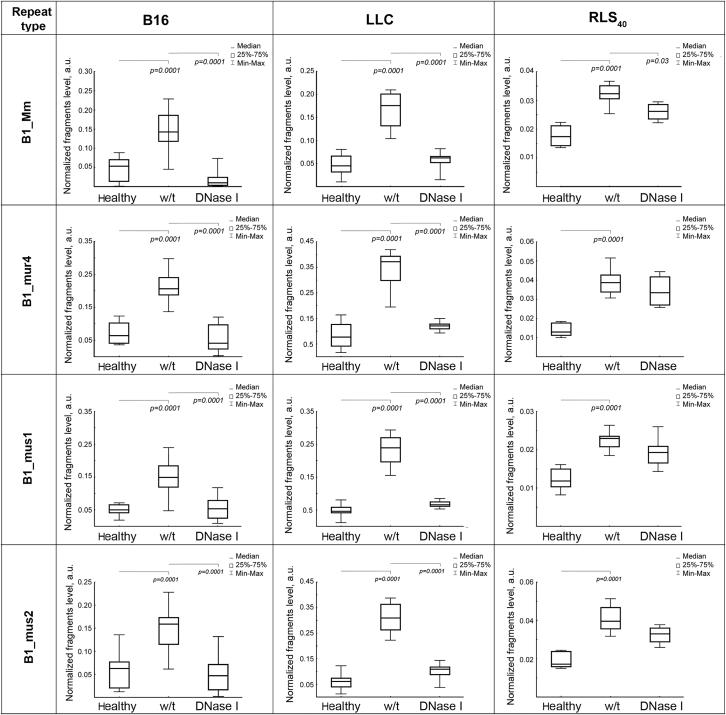
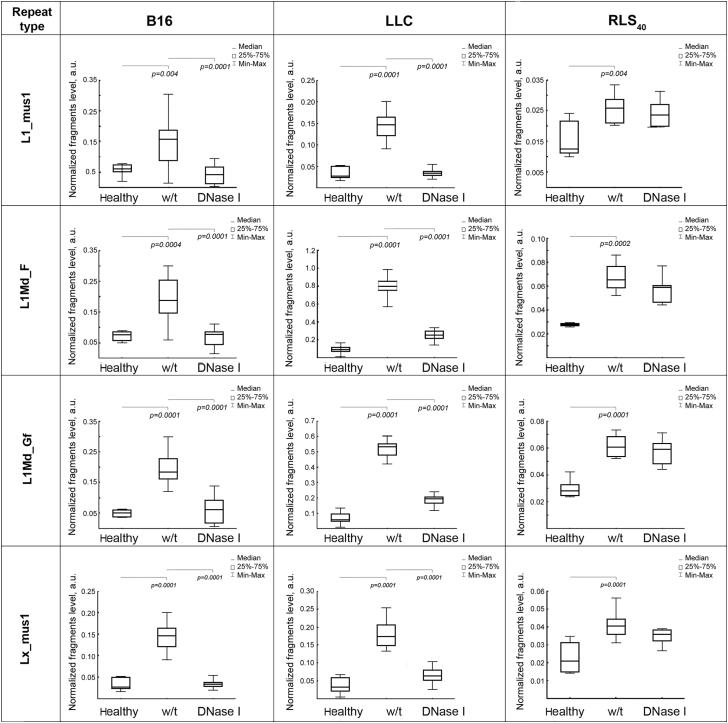
Tumor-associated cell-free DNAs (cfDNAs) are found to play some important roles at different stages of tumor progression; they are involved in the transformation of normal cells and contribute to tumor migration and invasion. DNase I is considered a promising cancer cure, due to its ability to degrade cfDNAs. Previous studies using murine tumor models have proved the high anti-metastatic potential of DNase I. Later circulating cfDNAs, especially tandem repeats associated with short-interspersed nuclear elements (SINEs) and long-interspersed nuclear elements (LINEs), have been found to be the enzyme's main molecular targets. Here, using Lewis lung carcinoma, melanoma B16, and lymphosarcoma RLS murine tumor models, we reveal that tumor progression is accompanied by an increase in the level of SINE and LINEs in the pool of circulating cfDNAs. Treatment with DNase I decreased in the number and area of metastases by factor 3-10, and the size of the primary tumor node by factor 1.5-2, which correlated with 5- to 10-fold decreasing SINEs and LINEs. We demonstrated that SINEs and LINEs from cfDNA of tumor-bearing mice are able to penetrate human cells. The results show that SINEs and LINEs could be important players in metastasis, and this allows them to be considered as attractive new targets for anticancer therapy.
肿瘤相关游离DNA(cfDNA)在肿瘤进展的不同阶段发挥着重要作用;它们参与正常细胞的转化,并促进肿瘤的迁移和侵袭。由于DNase I能够降解cfDNA,因此被认为是一种有前景的癌症治疗方法。先前使用小鼠肿瘤模型的研究已经证明了DNase I具有很高的抗转移潜力。后来发现,循环cfDNA,尤其是与短散在核元件(SINE)和长散在核元件(LINE)相关的串联重复序列,是该酶的主要分子靶点。在这里,我们使用Lewis肺癌、黑色素瘤B16和淋巴瘤RLS小鼠肿瘤模型,发现肿瘤进展伴随着循环cfDNA池中SINE和LINE水平的增加。用DNase I治疗可使转移灶的数量和面积减少3至10倍,原发肿瘤结节的大小减少1.5至2倍,这与SINE和LINE减少5至10倍相关。我们证明,荷瘤小鼠cfDNA中的SINE和LINE能够穿透人类细胞。结果表明,SINE和LINE可能是转移过程中的重要参与者,这使得它们被视为有吸引力的抗癌治疗新靶点。



 Zotero 插件