
系统生物学分析揭示了 8 个 SLC22 转运蛋白亚群,包括 OATs、OCTs 和 OCTNs。
Systems Biology Analysis Reveals Eight SLC22 Transporter Subgroups, Including OATs, OCTs, and OCTNs.
机构信息
Department of Biology, University of California San Diego, San Diego, CA 92093, USA.
Department of Bioengineering, University of California San Diego, San Diego, CA 92093, USA.
出版信息
Int J Mol Sci. 2020 Mar 5;21(5):1791. doi: 10.3390/ijms21051791.
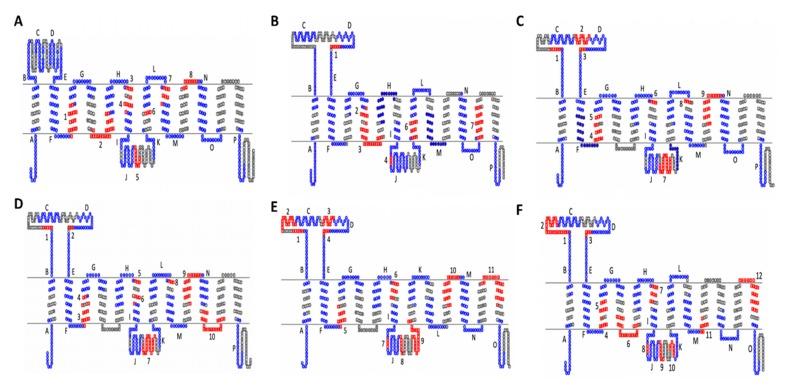
The SLC22 family of OATs, OCTs, and OCTNs is emerging as a central hub of endogenous physiology. Despite often being referred to as "drug" transporters, they facilitate the movement of metabolites and key signaling molecules. An in-depth reanalysis supports a reassignment of these proteins into eight functional subgroups, with four new subgroups arising from the previously defined OAT subclade: OATS1 (SLC22A6, SLC22A8, and SLC22A20), OATS2 (SLC22A7), OATS3 (SLC22A11, SLC22A12, and Slc22a22), and OATS4 (SLC22A9, SLC22A10, SLC22A24, and SLC22A25). We propose merging the OCTN (SLC22A4, SLC22A5, and Slc22a21) and OCT-related (SLC22A15 and SLC22A16) subclades into the OCTN/OCTN-related subgroup. Using data from GWAS, in vivo models, and in vitro assays, we developed an SLC22 transporter-metabolite network and similar subgroup networks, which suggest how multiple SLC22 transporters with mono-, oligo-, and multi-specific substrate specificity interact to regulate metabolites. Subgroup associations include: OATS1 with signaling molecules, uremic toxins, and odorants, OATS2 with cyclic nucleotides, OATS3 with uric acid, OATS4 with conjugated sex hormones, particularly etiocholanolone glucuronide, OCT with neurotransmitters, and OCTN/OCTN-related with ergothioneine and carnitine derivatives. Our data suggest that the SLC22 family can work among itself, as well as with other ADME genes, to optimize levels of numerous metabolites and signaling molecules, involved in organ crosstalk and inter-organismal communication, as proposed by the remote sensing and signaling theory.
SLC22 家族的 OATs、OCTs 和 OCTNs 正在成为内源性生理学的中心枢纽。尽管它们经常被称为“药物”转运体,但它们促进代谢物和关键信号分子的运动。深入的重新分析支持将这些蛋白质重新分配到八个功能亚群中,其中四个新的亚群是从之前定义的 OAT 亚群中产生的:OATS1(SLC22A6、SLC22A8 和 SLC22A20)、OATS2(SLC22A7)、OATS3(SLC22A11、SLC22A12 和 Slc22a22)和 OATS4(SLC22A9、SLC22A10、SLC22A24 和 SLC22A25)。我们建议将 OCTN(SLC22A4、SLC22A5 和 Slc22a21)和 OCT 相关(SLC22A15 和 SLC22A16)亚群合并到 OCTN/OCTN 相关亚群中。使用来自 GWAS、体内模型和体外测定的数据,我们开发了一个 SLC22 转运体-代谢物网络和类似的亚群网络,这表明具有单、寡和多特异性底物特异性的多种 SLC22 转运体如何相互作用以调节代谢物。亚群关联包括:OATS1 与信号分子、尿毒症毒素和气味物质有关,OATS2 与环核苷酸有关,OATS3 与尿酸有关,OATS4 与结合性激素有关,特别是 5α-雄烷二醇葡萄糖醛酸苷,OCT 与神经递质有关,而 OCTN/OCTN 相关与ergothioneine 和肉碱衍生物有关。我们的数据表明,SLC22 家族可以在自身之间以及与其他 ADME 基因一起工作,以优化许多代谢物和信号分子的水平,这些代谢物和信号分子参与器官串扰和种间通讯,正如远程感应和信号理论所提出的那样。


 Zotero 插件