
通向心血管死亡率之路的高危多重共病模式。
High-risk multimorbidity patterns on the road to cardiovascular mortality.
机构信息
Section for Science of Complex Systems, CeMSIIS, Medical University of Vienna, Spitalgasse 23, Vienna, A-1090, Austria.
Complexity Science Hub Vienna, Josefstädter Straße 39, Vienna, A-1080, Austria.
出版信息
BMC Med. 2020 Mar 10;18(1):44. doi: 10.1186/s12916-020-1508-1.
BACKGROUND
Multimorbidity, the co-occurrence of two or more diseases in one patient, is a frequent phenomenon. Understanding how different diseases condition each other over the lifetime of a patient could significantly contribute to personalised prevention efforts. However, most of our current knowledge on the long-term development of the health of patients (their disease trajectories) is either confined to narrow time spans or specific (sets of) diseases. Here, we aim to identify decisive events that potentially determine the future disease progression of patients.
METHODS
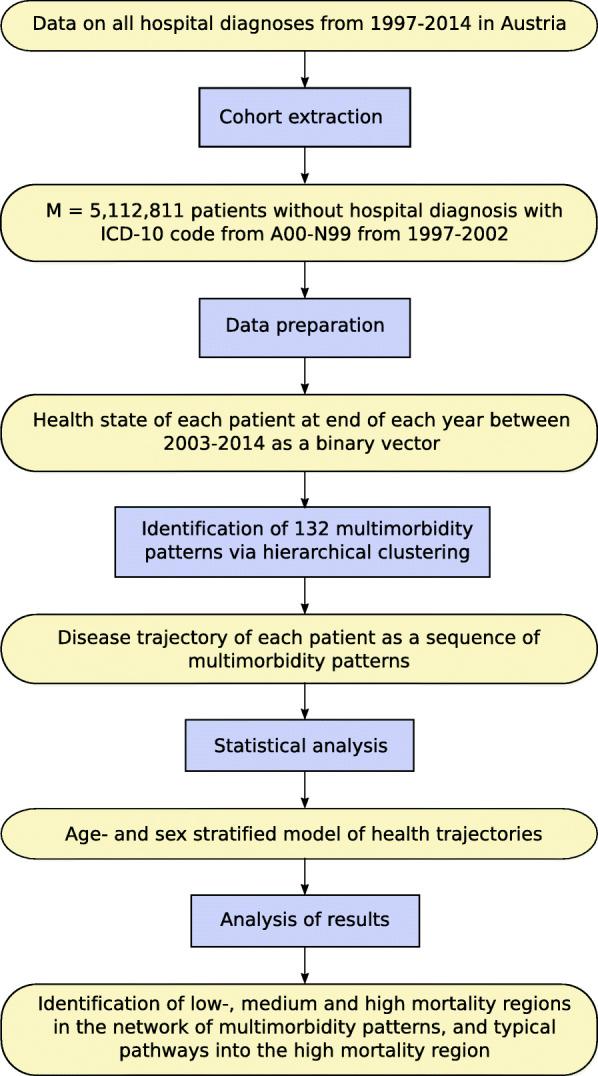
Health states of patients are described by algorithmically identified multimorbidity patterns (groups of included or excluded diseases) in a population-wide analysis of 9,000,000 patient histories of hospital diagnoses observed over 17 years. Over time, patients might acquire new diagnoses that change their health state; they describe a disease trajectory. We measure the age- and sex-specific risks for patients that they will acquire certain sets of diseases in the future depending on their current health state.
RESULTS
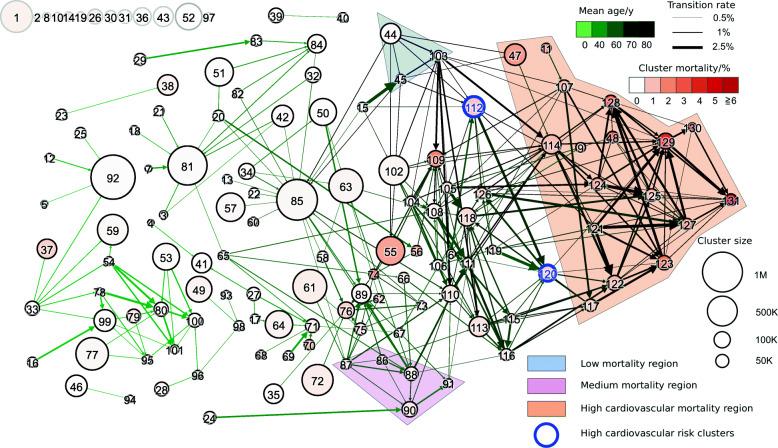
In the present analysis, the population is described by a set of 132 different multimorbidity patterns. For elderly patients, we find 3 groups of multimorbidity patterns associated with low (yearly in-hospital mortality of 0.2-0.3%), medium (0.3-1%) and high in-hospital mortality (2-11%). We identify combinations of diseases that significantly increase the risk to reach the high-mortality health states in later life. For instance, in men (women) aged 50-59 diagnosed with diabetes and hypertension, the risk for moving into the high-mortality region within 1 year is increased by the factor of 1.96 ± 0.11 (2.60 ± 0.18) compared with all patients of the same age and sex, respectively, and by the factor of 2.09 ± 0.12 (3.04 ± 0.18) if additionally diagnosed with metabolic disorders.
CONCLUSIONS
Our approach can be used both to forecast future disease burdens, as well as to identify the critical events in the careers of patients which strongly determine their disease progression, therefore constituting targets for efficient prevention measures. We show that the risk for cardiovascular diseases increases significantly more in females than in males when diagnosed with diabetes, hypertension and metabolic disorders.
背景
多种疾病同时存在于一位患者体内,即共病,是一种常见现象。了解不同疾病如何在患者的一生中相互影响,可能会极大地促进个性化预防工作。然而,我们目前对患者健康的长期发展(即他们的疾病轨迹)的了解,要么局限于狭窄的时间段,要么局限于特定的(一组)疾病。在这里,我们旨在确定可能决定患者未来疾病进展的决定性事件。
方法
在对 900 万例观察了 17 年的医院诊断患者病史进行的人群分析中,通过算法识别的共病模式(包含或排除疾病的组)来描述患者的健康状况。随着时间的推移,患者可能会获得新的诊断,从而改变他们的健康状况;他们描述了疾病轨迹。我们根据患者当前的健康状况,衡量他们未来获得某些疾病集的年龄和性别特异性风险。
结果
在本分析中,人群由一组 132 种不同的共病模式描述。对于老年患者,我们发现与低(每年院内死亡率为 0.2-0.3%)、中(0.3-1%)和高(2-11%)院内死亡率相关的 3 组共病模式。我们确定了显著增加以后进入高死亡率健康状态风险的疾病组合。例如,在 50-59 岁被诊断患有糖尿病和高血压的男性(女性)中,与同年龄和性别的所有患者相比,一年内进入高死亡率区域的风险增加了 1.96±0.11 倍(2.60±0.18 倍),如果还被诊断患有代谢紊乱,则增加了 2.09±0.12 倍(3.04±0.18 倍)。
结论
我们的方法可用于预测未来的疾病负担,也可用于识别患者生涯中的关键事件,这些事件强烈决定着他们的疾病进展,因此构成了有效预防措施的目标。我们表明,当被诊断患有糖尿病、高血压和代谢紊乱时,女性的心血管疾病风险增加得比男性更为显著。



 Zotero 插件