
认知重评成功和失败的神经特征:一项 ERP 研究。
Neural characteristics of cognitive reappraisal success and failure: An ERP study.
机构信息
Shanghai Institute for Advanced Communication and Data Science, School of Communication and Information Engineering, Qianweichang College, Shanghai University, Shanghai, China.
Laboratory of Cognitive Neuroscience, Boston VA Healthcare System, Brockton Division and Department of Psychiatry, Harvard Medical School, Boston, MA, USA.
出版信息
Brain Behav. 2020 Apr;10(4):e01584. doi: 10.1002/brb3.1584. Epub 2020 Mar 11.
INTRODUCTION
Cognitive reappraisal, an important strategy of emotion regulation, can change emotional experience and attention to emotional information. However, not all individuals can deploy reappraisal strategies successfully. In the current study, we investigated event-related potential (ERP) characteristics of reappraisal success and of reappraisal failure.
METHODS
Twenty-six participants were divided into the success group or the failure group based on self-report ratings of how successful they were in reducing their response to negative images using cognitive reappraisal strategy. All participants viewed 30 neutral images and 30 negative images which they were asked to just watch, and 30 negative stimuli that they were asked to reappraise, while electroencephalogram (EEG) was recorded.
RESULTS
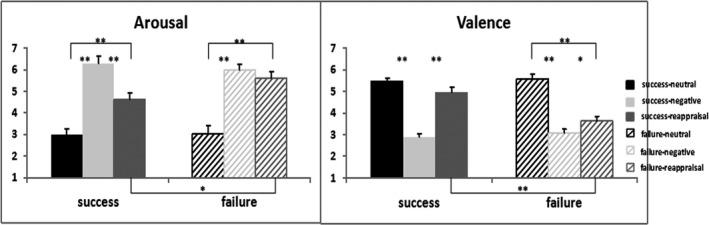
The success group reported a significant reduction in the unpleasantness of negative images than the failure group in the negative-reappraisal condition. The ERP data indicated that two time windows differentiated between the success and failure groups. In 200-300 ms, P200 was significantly more positive to the negative-watch condition relative to both negative-reappraisal and neutral conditions in the failure group, while no difference was observed in the success group. In 300-5,000 ms, cognitive reappraisal led to increased late positive potential (LPP) relative to negative-watch in the early and middle latency windows (300-3,100 ms) in both groups; in the late latency window (3,100-5,000 ms), the reappraisal success group showed the LPP amplitude to the negative-reappraisal stimuli to be more positive than to the negative-watch stimuli, while no difference was found in the reappraisal failure group.
CONCLUSION
Our study provided direct evidence that different neurophysiological features were associated with reappraisal success and failure while engaging in the reappraisal of negative stimuli. This result will contribute to better understanding of the neural mechanism of emotion regulation in emotional disorders (i.e., depression and anxiety).
简介
认知重评作为一种重要的情绪调节策略,可以改变情绪体验和对情绪信息的注意。然而,并非所有个体都能成功地运用这种策略。在本研究中,我们考察了认知重评成功和失败的事件相关电位(ERP)特征。
方法
根据 26 名参与者在使用认知重评策略减少对负性图片反应的自我报告评定,将其分为成功组或失败组。所有参与者观看 30 张中性图片和 30 张负性图片,要求他们观看,同时观看 30 张负性刺激图片并对其进行重评,同时记录脑电图(EEG)。
结果
成功组在负性重评条件下报告的负性图片的不愉快感明显低于失败组。ERP 数据表明,在两个时间窗口上,成功组和失败组存在差异。在 200-300ms 时,与负性观看和中性条件相比,失败组的 P200 在负性观看条件下更负;而在成功组中则没有观察到差异。在 300-5000ms 时,认知重评导致在早期和中期潜伏期窗口(300-3100ms)中与负性观看相比,晚正电位(LPP)增加;在晚期潜伏期窗口(3100-5000ms)中,重评成功组对负性重评刺激的 LPP 振幅比负性观看刺激更积极,而重评失败组则没有差异。
结论
本研究提供了直接证据,表明在对负性刺激进行重评时,不同的神经生理特征与重评的成功和失败有关。这一结果将有助于更好地理解情绪障碍(即抑郁和焦虑)中情绪调节的神经机制。


 Zotero 插件