
链球菌蛋白酶 SpeB 通过切割金黄色葡萄球菌 USA300 的 SdrC 蛋白拮抗该人类病原体的生物膜。
The Streptococcal Protease SpeB Antagonizes the Biofilms of the Human Pathogen Staphylococcus aureus USA300 through Cleavage of the Staphylococcal SdrC Protein.
机构信息
Department of Biological Sciences, University of Notre Dame, Notre Dame, Indiana, USA.
Eck Institute for Global Health, University of Notre Dame, Notre Dame, Indiana, USA.
出版信息
J Bacteriol. 2020 May 11;202(11). doi: 10.1128/JB.00008-20.
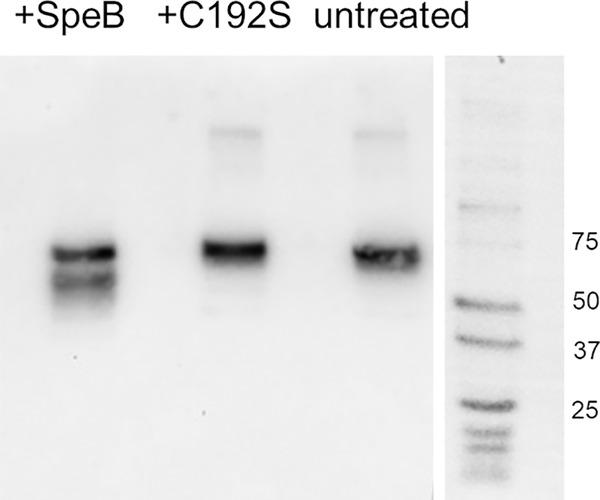
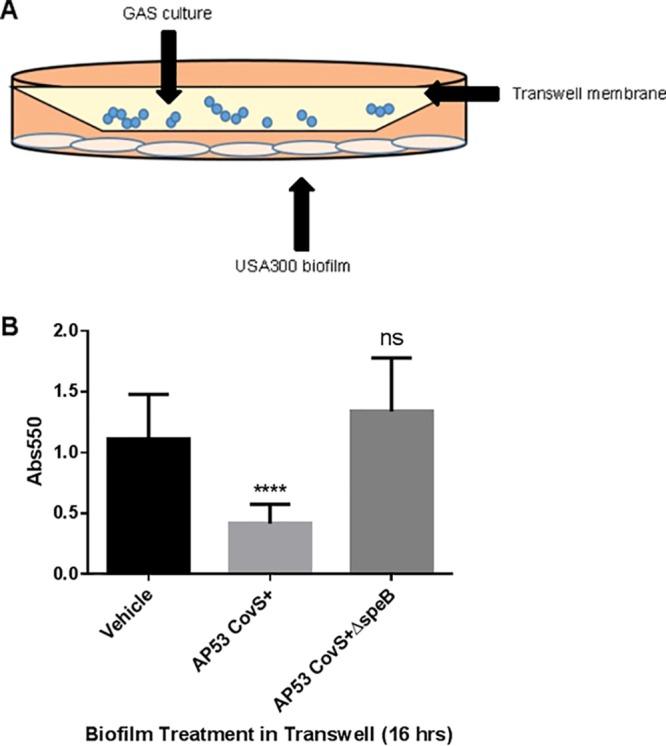
, or group A (GAS), is both a pathogen and an asymptomatic colonizer of human hosts and produces a large number of surface-expressed and secreted factors that contribute to a variety of infection outcomes. The GAS-secreted cysteine protease SpeB has been well studied for its effects on the human host; however, despite its broad proteolytic activity, studies on how this factor is utilized in polymicrobial environments are lacking. Here, we utilized various forms of SpeB protease to evaluate its antimicrobial and antibiofilm properties against the clinically important human colonizer , which occupies niches similar to those of GAS. For our investigation, we used a skin-tropic GAS strain, AP53CovS+, and its isogenic Δ mutant to compare the production and activity of native SpeB protease. We also generated active and inactive forms of recombinant purified SpeB for functional studies. We demonstrate that SpeB exhibits potent biofilm disruption activity at multiple stages of biofilm formation. We hypothesized that the surface-expressed adhesin SdrC in was cleaved by SpeB, which contributed to the observed biofilm disruption. Indeed, we found that SpeB cleaved recombinant SdrC and in the context of the full biofilm. Our results suggest an understudied role for the broadly proteolytic SpeB as an important factor for GAS colonization and competition with other microorganisms in its niche. (GAS) causes a range of diseases in humans, ranging from mild to severe, and produces many virulence factors in order to be a successful pathogen. One factor produced by many GAS strains is the protease SpeB, which has been studied for its ability to cleave and degrade human proteins, an important factor in GAS pathogenesis. An understudied aspect of SpeB is the manner in which its broad proteolytic activity affects other microorganisms that co-occupy niches similar to that of GAS. The significance of the research reported herein is the demonstration that SpeB can degrade the biofilms of the human pathogen , which has important implications for how SpeB may be utilized by GAS to successfully compete in a polymicrobial environment.
化脓性链球菌(GAS)既是人类宿主的病原体又是无症状定植者,可产生大量表面表达和分泌的因子,导致多种感染结果。GAS 分泌的半胱氨酸蛋白酶 SpeB 对其对人类宿主的影响已有深入研究;然而,尽管其具有广泛的蛋白水解活性,但关于该因子在多微生物环境中如何被利用的研究却很少。在这里,我们利用各种形式的 SpeB 蛋白酶来评估其针对临床重要定植者 的抗菌和抗生物膜特性, 定植者 占据与 GAS 相似的生态位。为了进行我们的研究,我们使用了一种具有皮肤趋向性的 GAS 菌株 AP53CovS+及其同工基因缺失突变株,以比较天然 SpeB 蛋白酶的产生和活性。我们还生成了具有活性和非活性形式的重组纯化 SpeB 用于功能研究。我们证明 SpeB 在 生物膜形成的多个阶段均表现出强大的破坏生物膜的活性。我们假设 表面表达的黏附素 SdrC 被 SpeB 切割,这导致了观察到的生物膜破坏。事实上,我们发现 SpeB 可切割重组 SdrC 和完整的 生物膜中的 SdrC。我们的结果表明,广泛蛋白水解的 SpeB 作为 GAS 定植和与生态位中其他微生物竞争的重要因素,其作用被低估了。(GAS)可引起人类从轻度到重度的一系列疾病,并产生许多毒力因子以成为成功的病原体。许多 GAS 菌株产生的一种因子是蛋白酶 SpeB,其已被研究用于其切割和降解人类蛋白的能力,这是 GAS 发病机制的一个重要因素。SpeB 的一个研究较少的方面是其广泛的蛋白水解活性影响与 GAS 相似的生态位中共同定植的其他微生物的方式。本文报道的研究的意义在于证明 SpeB 可降解人类病原体 的生物膜,这对于 SpeB 如何被 GAS 利用以在多微生物环境中成功竞争具有重要意义。




 Zotero 插件