
甲状腺功能和功能障碍与总体、乳腺癌和甲状腺癌的因果关系:一项两样本孟德尔随机化研究。
Causal associations of thyroid function and dysfunction with overall, breast and thyroid cancer: A two-sample Mendelian randomization study.
机构信息
Unit of Cardiovascular and Nutritional Epidemiology, Institute of Environmental Medicine, Karolinska Institutet, Stockholm, Sweden.
Department of Surgical Sciences, Uppsala University, Uppsala, Sweden.
出版信息
Int J Cancer. 2020 Oct 1;147(7):1895-1903. doi: 10.1002/ijc.32988. Epub 2020 Apr 3.
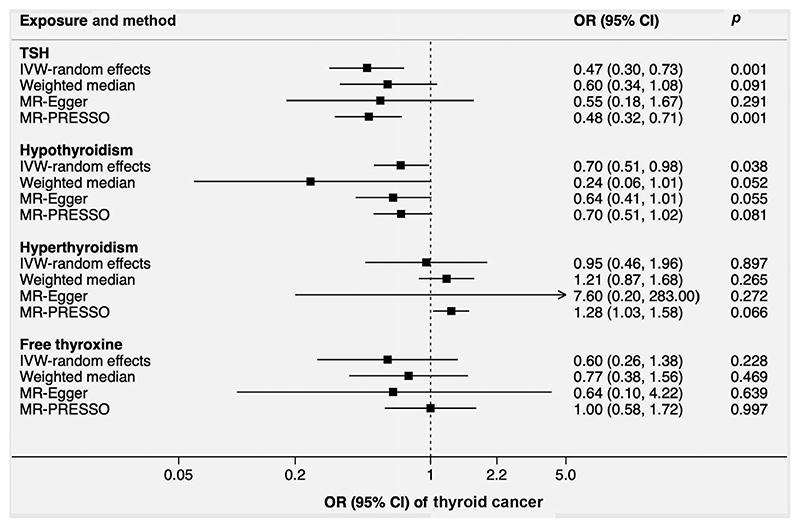
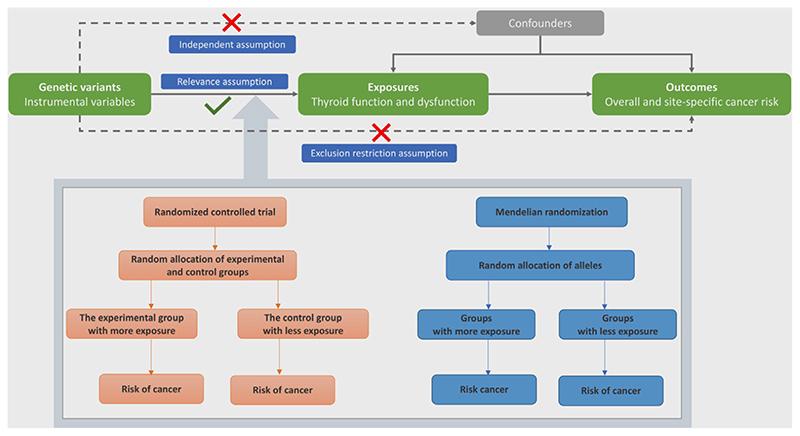
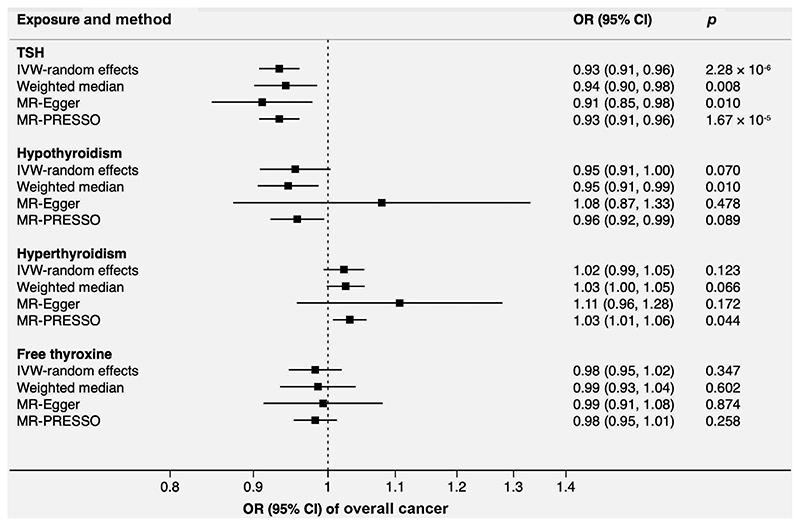
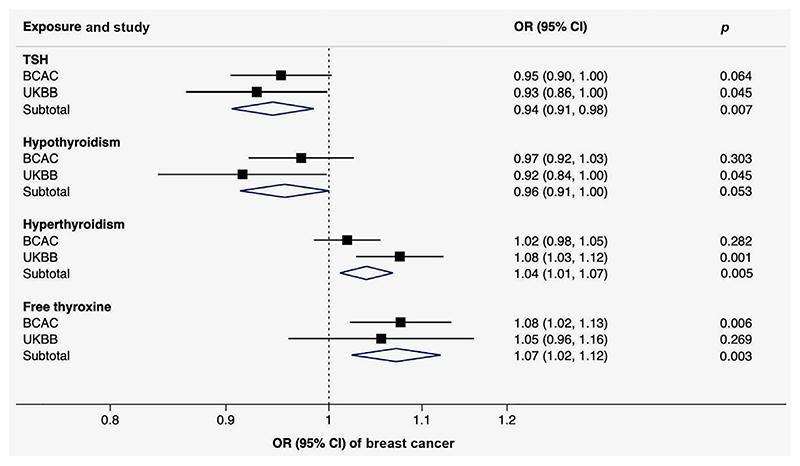
Whether thyroid dysfunction plays a causal role in the development of cancer remains inconclusive. We conducted a two-sample Mendelian randomization study to investigate the associations between genetic predisposition to thyroid dysfunction and 22 site-specific cancers. Single-nucleotide polymorphisms associated with four traits of thyroid function were selected from a genome-wide association meta-analysis with up to 72,167 European-descent individuals. Summary-level data for breast cancer and 21 other cancers were extracted from the Breast Cancer Association Consortium (122,977 breast cancer cases and 105,974 controls) and UK Biobank (367,643 individuals). For breast cancer, a meta-analysis was performed using data from both sources. Genetically predicted thyroid dysfunction was associated with breast cancer, with similar patterns of associations in the Breast Cancer Association Consortium and UK Biobank. The combined odds ratios of breast cancer were 0.94 (0.91-0.98; p = 0.007) per genetically predicted one standard deviation increase in TSH levels, 0.96 (0.91-1.00; p = 0.053) for genetic predisposition to hypothyroidism, 1.04 (1.01-1.07; p = 0.005) for genetic predisposition to hyperthyroidism and 1.07 (1.02-1.12; p = 0.003) per genetically predicted one standard deviation increase in free thyroxine levels. Genetically predicted TSH levels and hypothyroidism were inversely with thyroid cancer; the odds ratios were 0.47 (0.30-0.73; p = 0.001) and 0.70 (0.51-0.98; p = 0.038), respectively. Our study provides evidence of a causal association between thyroid dysfunction and breast cancer (mainly ER-positive tumors) risk. The role of TSH and hypothyroidism for thyroid cancer and the associations between thyroid dysfunction and other cancers need further exploration.
甲状腺功能障碍是否在癌症的发生中起因果作用仍不确定。我们进行了一项两样本孟德尔随机化研究,以调查甲状腺功能障碍遗传易感性与 22 个特定部位癌症之间的关联。从一项全基因组关联荟萃分析中选择了与甲状腺功能的四个特征相关的单核苷酸多态性,该分析纳入了多达 72167 名欧洲血统个体。乳腺癌和 21 种其他癌症的汇总水平数据从乳腺癌协会联盟(122977 例乳腺癌病例和 105974 例对照)和英国生物银行(367643 人)中提取。对于乳腺癌,使用来自两个来源的数据进行了荟萃分析。遗传预测的甲状腺功能障碍与乳腺癌相关,在乳腺癌协会联盟和英国生物银行中观察到相似的关联模式。乳腺癌的合并比值比为 0.94(0.91-0.98;p=0.007),每增加一个遗传预测的 TSH 水平标准差;0.96(0.91-1.00;p=0.053)与甲状腺功能减退的遗传易感性相关;1.04(1.01-1.07;p=0.005)与甲状腺功能亢进的遗传易感性相关;1.07(1.02-1.12;p=0.003)与每增加一个遗传预测的游离甲状腺素水平标准差相关。遗传预测的 TSH 水平和甲状腺功能减退与甲状腺癌呈负相关;比值比分别为 0.47(0.30-0.73;p=0.001)和 0.70(0.51-0.98;p=0.038)。我们的研究提供了甲状腺功能障碍与乳腺癌(主要是 ER 阳性肿瘤)风险之间存在因果关联的证据。TSH 和甲状腺功能减退对甲状腺癌的作用以及甲状腺功能障碍与其他癌症之间的关联需要进一步探索。
 Zotero 插件