
医用口罩与 N95 呼吸器预防医护人员感染 COVID-19:随机试验的系统评价和荟萃分析。
Medical masks vs N95 respirators for preventing COVID-19 in healthcare workers: A systematic review and meta-analysis of randomized trials.
机构信息
Department of Health Research Methods, Evidence and Impact, McMaster University, Hamilton, ON, Canada.
Department of Medicine, Division of Respirology, McMaster University, Hamilton, ON, Canada.
出版信息
Influenza Other Respir Viruses. 2020 Jul;14(4):365-373. doi: 10.1111/irv.12745. Epub 2020 Apr 21.
BACKGROUND
Respiratory protective devices are critical in protecting against infection in healthcare workers at high risk of novel 2019 coronavirus disease (COVID-19); however, recommendations are conflicting and epidemiological data on their relative effectiveness against COVID-19 are limited.
PURPOSE
To compare medical masks to N95 respirators in preventing laboratory-confirmed viral infection and respiratory illness including coronavirus specifically in healthcare workers.
DATA SOURCES
MEDLINE, Embase, and CENTRAL from January 1, 2014, to March 9, 2020. Update of published search conducted from January 1, 1990, to December 9, 2014.
STUDY SELECTION
Randomized controlled trials (RCTs) comparing the protective effect of medical masks to N95 respirators in healthcare workers.
DATA EXTRACTION
Reviewer pair independently screened, extracted data, and assessed risk of bias and the certainty of the evidence.
DATA SYNTHESIS
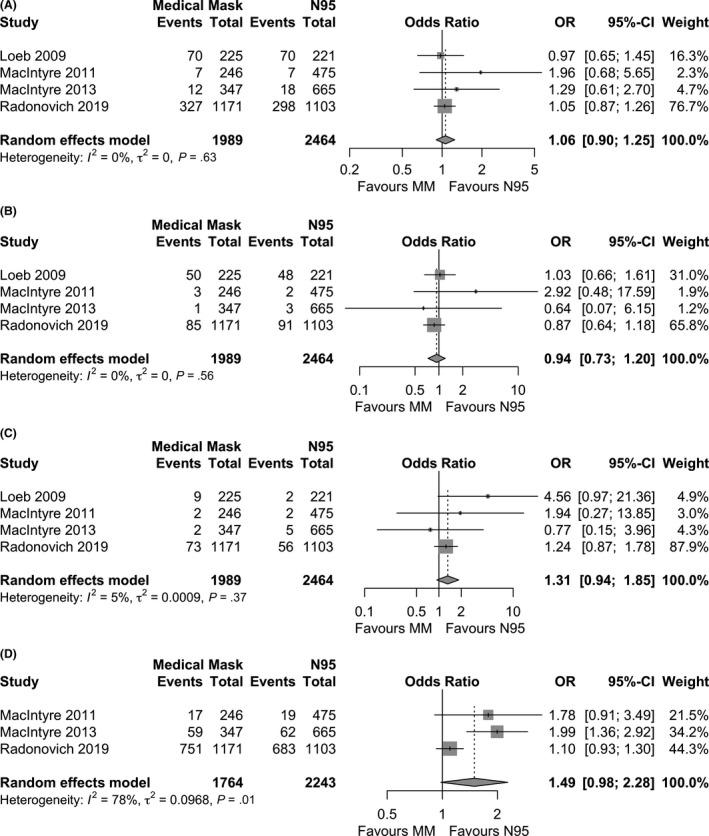
Four RCTs were meta-analyzed adjusting for clustering. Compared with N95 respirators; the use of medical masks did not increase laboratory-confirmed viral (including coronaviruses) respiratory infection (OR 1.06; 95% CI 0.90-1.25; I = 0%; low certainty in the evidence) or clinical respiratory illness (OR 1.49; 95% CI: 0.98-2.28; I = 78%; very low certainty in the evidence). Only one trial evaluated coronaviruses separately and found no difference between the two groups (P = .49).
LIMITATIONS
Indirectness and imprecision of available evidence.
CONCLUSIONS
Low certainty evidence suggests that medical masks and N95 respirators offer similar protection against viral respiratory infection including coronavirus in healthcare workers during non-aerosol-generating care. Preservation of N95 respirators for high-risk, aerosol-generating procedures in this pandemic should be considered when in short supply.
背景
在新型 2019 冠状病毒病(COVID-19)高风险医护人员中,呼吸防护装置对于防止感染至关重要;然而,建议存在差异,且针对其预防 COVID-19 的相对有效性的流行病学数据有限。
目的
比较医用口罩与 N95 口罩在预防实验室确诊的病毒感染和呼吸道疾病(包括冠状病毒)方面的效果,具体针对医护人员。
数据来源
从 2014 年 1 月 1 日到 2020 年 3 月 9 日,MEDLINE、Embase 和 CENTRAL。从 1990 年 1 月 1 日到 2014 年 12 月 9 日对已发布的搜索进行更新。
研究选择
比较医用口罩与 N95 口罩在医护人员中的防护效果的随机对照试验(RCT)。
数据提取
审查员对数据进行独立筛选、提取,并评估偏倚风险和证据的确定性。
数据综合
对调整了聚类的四项 RCT 进行了荟萃分析。与 N95 口罩相比,使用医用口罩并未增加实验室确诊的病毒性(包括冠状病毒)呼吸道感染(OR 1.06;95%CI 0.90-1.25;I = 0%;证据的确定性为低)或临床呼吸道疾病(OR 1.49;95%CI:0.98-2.28;I = 78%;证据的确定性为极低)。仅有一项试验单独评估了冠状病毒,发现两组之间无差异(P =.49)。
局限性
现有证据的间接性和不准确性。
结论
低确定性证据表明,在非气溶胶生成护理期间,医用口罩和 N95 口罩对医护人员的病毒性呼吸道感染(包括冠状病毒)提供相似的保护。在这种大流行期间,应考虑将 N95 口罩保存用于高风险的、产生气溶胶的程序,以应对短缺情况。

 Zotero 插件