
γ射线辐照大麦植株的代谢谱分析确定了氮代谢的重新分配和代谢应激反应。
Metabolic Profiling of γ-Irradiated Barley Plants Identifies Reallocation of Nitrogen Metabolism and Metabolic Stress Response.
作者信息
Volkova Polina Yu, Clement G, Makarenko E S, Kazakova E A, Bitarishvili S V, Lychenkova M A
机构信息
Russian Institute of Radiology and Agroecology, Obninsk, Russian Federation.
Institut Jean-Pierre Bourgin, INRA, Versailles, France.
出版信息
Dose Response. 2020 Mar 24;18(1):1559325820914186. doi: 10.1177/1559325820914186. eCollection 2020 Jan-Mar.
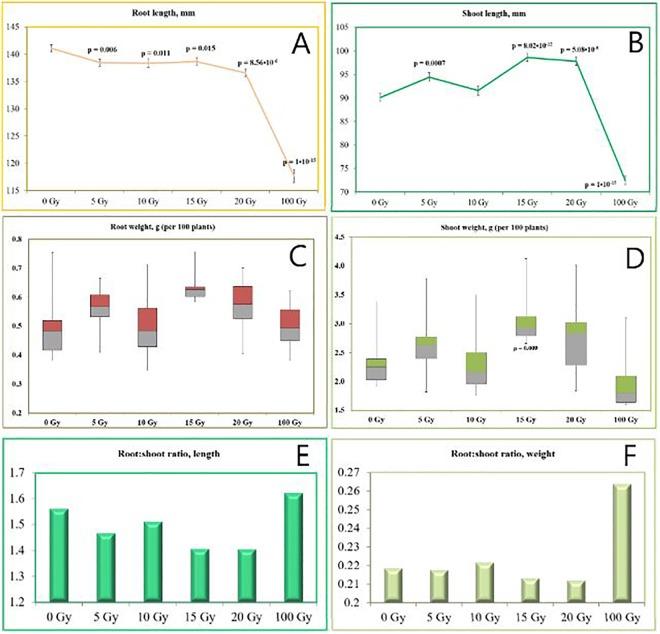
The favorable responses of crop species to low-dose γ irradiation can help to develop cultivars with increased productivity and improved stress tolerance. In the present study, we tried to reveal the candidate metabolites involved in growth stimulation of barley seedlings after applying low-dose γ-radiation (Co) to seeds. Stimulating doses (5-20 Gy) provided a significant increase in shoot length and biomass, while relatively high dose of 100 Gy led to significant inhibition of growth. Gas chromatography-mass spectrometry metabolomic analysis uncovered several compounds that may take part in radiation hormesis establishment in irradiated plants. This includes molecules involved in nitrogen redistribution (arginine, glutamine, asparagine, and γ-aminobutyric acid) and stress-responsive metabolites, such as ascorbate, -inositol and its derivates, and free amino acids (l-serine, β-alanine, pipecolate, and GABA). These results contribute to the understanding of the molecular mechanisms of hormesis phenomenon.
作物品种对低剂量γ辐射的良好反应有助于培育出产量更高、抗逆性更强的品种。在本研究中,我们试图揭示在对种子施加低剂量γ辐射(钴)后,参与刺激大麦幼苗生长的候选代谢物。刺激剂量(5-20 Gy)使茎长和生物量显著增加,而相对较高剂量的100 Gy则导致生长显著受到抑制。气相色谱-质谱代谢组学分析发现了几种可能参与辐照植物辐射兴奋效应建立的化合物。这包括参与氮重新分配的分子(精氨酸、谷氨酰胺、天冬酰胺和γ-氨基丁酸)以及应激反应代谢物,如抗坏血酸、肌醇及其衍生物和游离氨基酸(L-丝氨酸、β-丙氨酸、哌啶酸和γ-氨基丁酸)。这些结果有助于理解兴奋效应现象的分子机制。

 Zotero 插件