
特应性皮炎患者的系统性免疫调节治疗:系统评价和网络荟萃分析。
Systemic Immunomodulatory Treatments for Patients With Atopic Dermatitis: A Systematic Review and Network Meta-analysis.
机构信息
Division of Dermatology, Department of Medicine, University of Toronto, Toronto, Ontario, Canada.
Women's College Research Institute, Department of Medicine, Women's College Hospital, Toronto, Ontario, Canada.
出版信息
JAMA Dermatol. 2020 Jun 1;156(6):659-667. doi: 10.1001/jamadermatol.2020.0796.
IMPORTANCE
Most clinical trials assessing systemic immunomodulatory treatments for patients with atopic dermatitis are placebo-controlled.
OBJECTIVE
To compare the effectiveness and safety of systemic immunomodulatory treatments for patients with atopic dermatitis in a systematic review and network meta-analysis.
DATA SOURCES
The Cochrane Central Register of Controlled Trials, MEDLINE, Embase, Latin American and Caribbean Health Science Information database, Global Resource of Eczema Trials database, and clinical trial registries were searched from inception to October 28, 2019.
STUDY SELECTION
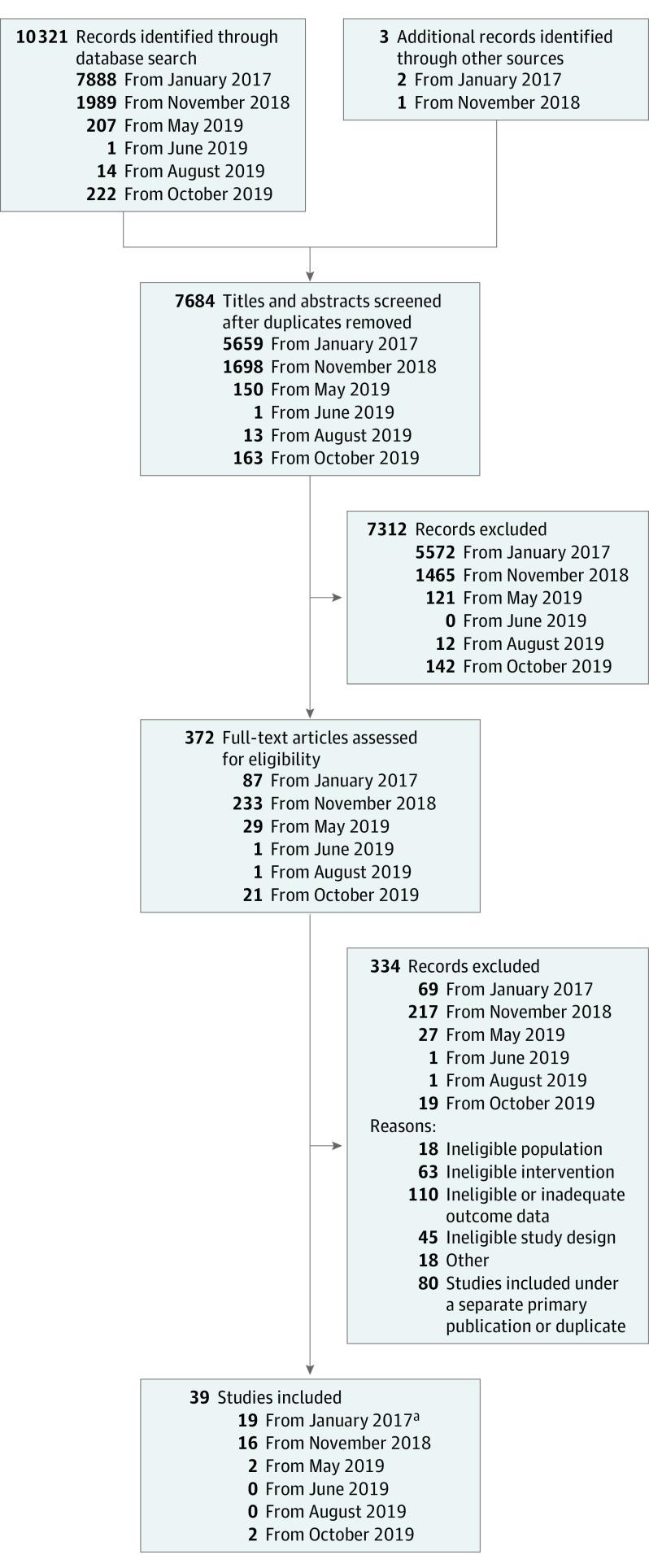
English-language randomized clinical trials of 8 weeks or more of treatment with systemic immunomodulatory medications for moderate to severe atopic dermatitis were included. Titles, abstracts, and articles were screened in duplicate. Of 10 324 citations, 39 trials were included.
DATA EXTRACTION AND SYNTHESIS
Data were extracted in duplicate, and the review adhered to Preferred Reporting Items for Systematic Reviews and Meta-analyses for Network Meta-Analyses guidelines. Random-effects bayesian network meta-analyses were performed and certainty of evidence was assessed using Grading of Recommendations Assessment, Development and Evaluation criteria.
MAIN OUTCOMES AND MEASURES
Prespecified outcomes were change in signs of disease, symptoms, quality of life, itch, withdrawals, and serious adverse events.
RESULTS
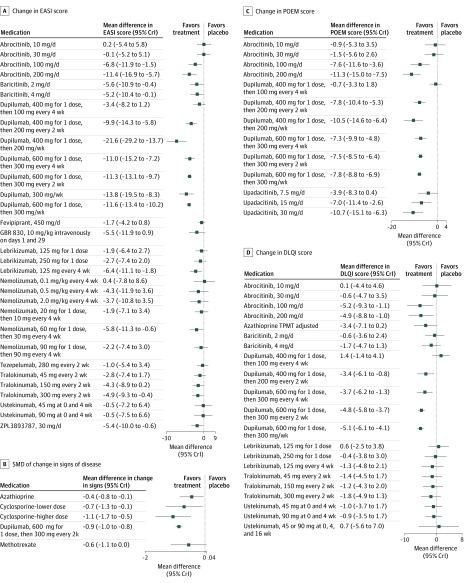
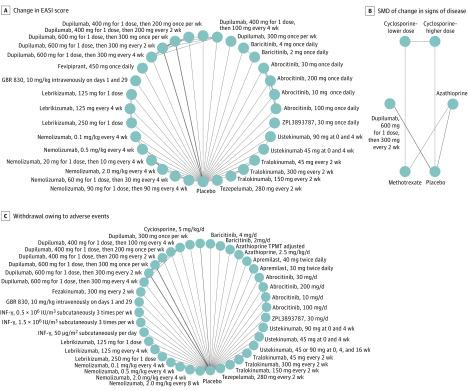
A total of 39 trials with 6360 patients examining 20 medications and placebo were included. Most trials were conducted for adults receiving up to 16 weeks of therapy. Dupilumab, 300 mg every 2 weeks, was associated with improvement in the Eczema Area and Severity Index score vs placebo (mean difference, 11.3-point reduction; 95% credible interval [CrI], 9.7-13.1 [high certainty]). Cyclosporine (standardized mean difference, -1.1; 95% CrI, -1.7 to -0.5 [low certainty]) and dupilumab (standardized mean difference, -0.9; 95% CrI, -1.0 to -0.8 [high certainty]) were similarly effective vs placebo in clearing clinical signs of atopic dermatitis and may be superior to methotrexate (standardized mean difference, -0.6; 95% CrI, -1.1 to 0.0 [low certainty]) and azathioprine (standardized mean difference, -0.4; 95% CrI, -0.8 to -0.1 [low certainty]). Several investigational medications for atopic dermatitis are promising, but data to date are limited to small early-phase trials. Safety analyses were limited by low event rates.
CONCLUSIONS AND RELEVANCE
Dupilumab and cyclosporine may be more effective for up to 16 weeks of treatment than methotrexate and azathioprine for treating adult patients with atopic dermatitis. More studies directly comparing established and novel treatments beyond 16 weeks are needed and will be incorporated into future updates of this review.
重要性
大多数评估特应性皮炎患者全身免疫调节治疗的临床试验均为安慰剂对照。
目的
通过系统评价和网络荟萃分析比较特应性皮炎患者全身免疫调节治疗的有效性和安全性。
数据来源
从创建到 2019 年 10 月 28 日,检索了 Cochrane 对照试验中心注册库、MEDLINE、Embase、拉丁美洲和加勒比健康科学信息数据库、全球湿疹试验数据库和临床试验注册处。
研究选择
纳入了治疗中重度特应性皮炎的全身免疫调节剂治疗 8 周或以上的英文随机临床试验。通过重复筛选标题、摘要和文章,共筛选出 10324 条引文,其中 39 项试验符合纳入标准。
数据提取和综合
数据由两人重复提取,本综述遵循网络荟萃分析中系统评价和荟萃分析的首选报告项目的报告规范。进行了随机效应贝叶斯网络荟萃分析,并使用推荐评估、制定与评估分级标准评估证据的确定性。
主要结局和测量指标
预先规定的结局是疾病体征、症状、生活质量、瘙痒、停药和严重不良事件的变化。
结果
共纳入 39 项试验,涉及 6360 例患者,共评估了 20 种药物和安慰剂。大多数试验均在接受长达 16 周治疗的成年患者中进行。与安慰剂相比,度普利尤单抗(300mg,每 2 周 1 次)可改善特应性皮炎严重指数评分(平均差异为 11.3 分,95%可信区间为 9.7-13.1[高确定性])。环孢素(标准化均数差,-1.1;95%可信区间,-1.7 至-0.5[低确定性])和度普利尤单抗(标准化均数差,-0.9;95%可信区间,-1.0 至-0.8[高确定性])与安慰剂相比同样有效清除特应性皮炎的临床体征,且可能优于甲氨蝶呤(标准化均数差,-0.6;95%可信区间,-1.1 至 0.0[低确定性])和硫唑嘌呤(标准化均数差,-0.4;95%可信区间,-0.8 至-0.1[低确定性])。几种治疗特应性皮炎的研究性药物很有前途,但迄今为止的数据仅限于小型早期试验。安全性分析受到低事件发生率的限制。
结论和相关性
度普利尤单抗和环孢素治疗特应性皮炎患者,在长达 16 周的治疗期间,可能比甲氨蝶呤和硫唑嘌呤更有效。需要进行更多的直接比较现有和新型治疗方法超过 16 周的研究,并且将纳入本综述的未来更新。
 Zotero 插件